
UNISON Migrant Care Worker Protest – Key Issues, Worker Demands, & Government Response
 • April 24, 2026
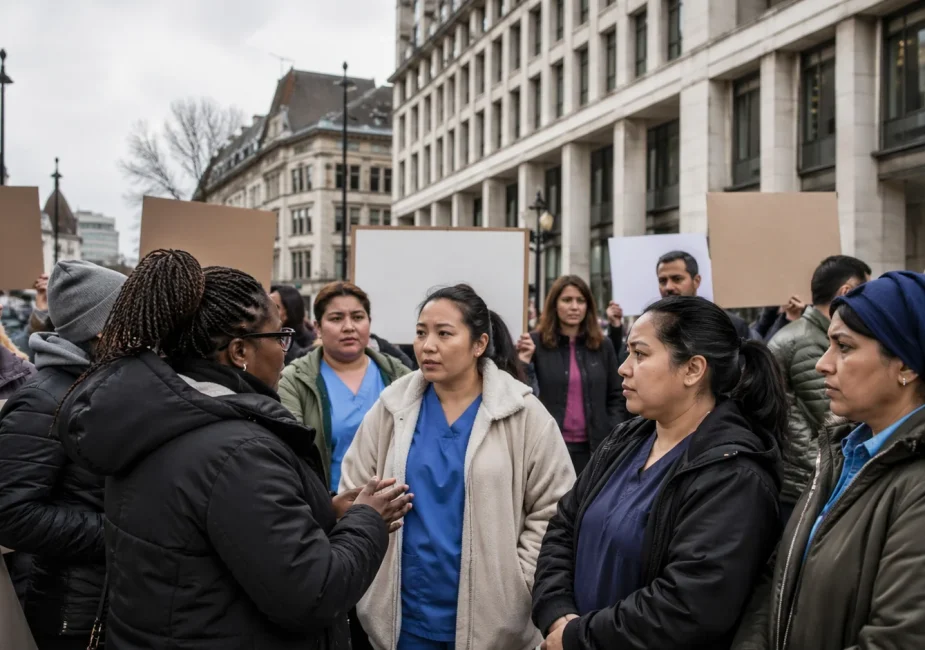
The UNISON migrant care worker protest highlights a growing dispute over UK immigration reforms that could significantly delay settlement rights for thousands of essential workers.
The main issue centres on proposed changes to the “earned settlement” system, which may extend the pathway to indefinite leave to remain from five years to as long as 15 years for care workers.
This has sparked widespread concern across the sector, particularly among migrant staff who form a vital part of the workforce.
Key points to understand include:
- Proposed settlement period increasing from 5 to 10 or 15 years
- Rising concerns over worker exploitation and visa dependency
- Increased pressure on an already-strained social care system
- UNISON’s campaign demanding fairer immigration and employment policies
These developments are shaping an urgent national conversation about fairness, workforce stability, and the future of care in the UK.
What Is the UNISON Migrant Care Worker Protest About?

The UNISON migrant care worker protest is a coordinated campaign led by the UK’s largest trade union, UNISON, alongside hundreds of migrant care workers.
The movement has gained national attention through organised demonstrations, parliamentary lobbying, and large-scale public awareness campaigns.
A major part of the protest includes leafleting campaigns in key constituencies such as Birmingham Ladywood, where thousands of residents are being informed about the proposed immigration changes.
This marks a rare instance of a Labour-affiliated union publicly opposing a central government policy.
The protest is part of UNISON’s broader “Fair Visas Now” campaign, which seeks to address systemic issues affecting migrant workers in essential roles. With migrant staff making up nearly one-third of the care workforce, the stakes are particularly high.
Why Are Migrant Care Workers Protesting Against UK Settlement Rule Changes?
Migrant care workers are protesting because the proposed immigration reforms fundamentally alter the expectations they had when entering the UK workforce.
Many workers accepted roles under the assumption that they could apply for settlement after five years.
Key Reasons Behind the Protest:
- The extension of settlement timelines creates long-term uncertainty
- Workers feel the government is “moving the goalposts” after commitments were made
- Families face prolonged instability and limited access to rights
- Increased financial burden due to visa renewals and associated costs
The emotional impact is equally significant. Workers describe feelings of betrayal and anxiety, particularly those who relocated with families and built their lives around existing policies.
What Immigration Changes Has the Government Proposed?

The UK government has introduced proposals to reform the “earned settlement” system, significantly altering how and when migrant workers can obtain indefinite leave to remain (ILR).
These changes are part of a broader strategy to control migration while redefining eligibility for permanent residency.
How Could the Settlement Period Change from Five Years to 10 or 15 Years?
Under the new proposals:
Current Rule Proposed Change Impact on Care Workers
5 years to settlement 10 years for most migrants Doubled waiting time and delayed stability
5 years baseline Up to 15 years for care workers Extended uncertainty for “low-skilled” roles
Fixed pathway Conditional extensions More complex and less predictable process
In some cases, the qualifying period could extend even further depending on individual circumstances, such as prior immigration status, gaps in employment, or benefit claims. This adds another layer of uncertainty to an already complex system.
A Home Office spokesperson stated:
“The privilege of living here forever should be earned, not automatic.”
This reflects the government’s broader aim to reduce long-term migration levels while maintaining stricter control over settlement pathways and eligibility criteria.
Why Does UNISON Say the Policy Is Unfair to Migrant Care Workers?
UNISON has strongly criticised the proposals, arguing that they disproportionately affect essential workers who already contribute significantly to society.
According to UNISON General Secretary Andrea Egan :
“Extending the qualifying period risks driving experienced, committed staff out of the sector altogether.”
The union believes the policy is unfair for several reasons:
- It retroactively changes conditions for workers already in the UK
- It increases vulnerability to exploitation due to visa dependency
- It undermines trust in the UK immigration system
From a policy perspective, critics argue that the reforms fail to recognise the essential role migrant workers play in sustaining health and social care services.
How Could the New Visa Rules Affect the UK Social Care Sector?

The UK social care sector is already under significant pressure, with more than 100,000 vacancies reported nationwide.
Migrant workers have played a crucial role in filling these gaps, particularly as domestic recruitment has struggled to keep pace with demand.
Impact on Workforce and Recruitment
Factor Current Situation Projected Impact
Workforce composition ~30% migrant workers Potential decline
Recruitment rates Already falling Further reduction
Vacancy levels Over 100,000 Likely increase
Staff retention Challenging Worsening conditions
The proposed rules could discourage new applicants while prompting existing workers to leave, intensifying the staffing crisis.
A senior policy analyst noted:
“Policies that increase insecurity for migrant workers risk destabilising essential public services, particularly in social care.”
This highlights the broader economic and social implications of the reforms.
What Are Migrant Care Workers Saying About Exploitation and Job Insecurity?
Many migrant workers have shared firsthand experiences of exploitation linked to the current visa system, where employment is tied to a single sponsor.
In one real-life account, a care worker described their situation:
“I came to the UK to build a better future and support vulnerable people. But everything changed when I realised how dependent I was on my employer. I joined the protest because I felt I had no voice. As one worker told me during the protest, ‘We are not asking for sympathy – we are asking for justice.’”
These experiences reveal systemic issues, including:
- Workers being unable to leave abusive employers
- Threats of deportation linked to job loss
- Financial strain from repeated visa applications
UNISON argues that this structure creates conditions where exploitation can occur “by design,” particularly when workers fear speaking out.
What Are UNISON’s Main Demands from the Government?

UNISON has set out a clear list of demands focused on improving conditions for migrant care workers while safeguarding the long-term stability of the UK’s social care sector.
The union argues that without immediate policy adjustments, both workers and vulnerable service users could face serious consequences.
Core Demands
- Scrap the proposed 15-year settlement rule, which significantly delays access to permanent residency
- Introduce a sector-wide visa to allow greater job mobility and reduce dependency on single employers
- Accelerate the Fair Pay Agreement to improve wages, standards, and overall working conditions
- Protect the rights and immigration status of existing migrant workers already contributing to the sector
These demands reflect a broader call for fairness and consistency in immigration policy, particularly for workers who have already committed to supporting essential public services.
Why Is UNISON Calling for a Sector-Wide Care Worker Visa?
A sector-wide visa is one of UNISON’s key proposals, aimed at fixing structural issues in the current sponsorship system.
At present, many migrant care workers are tied to a single employer, limiting their ability to leave unsafe or exploitative environments.
With a sector-wide visa, workers could move more freely between registered care providers without risking their immigration status. This would reduce exploitation and create a more flexible labour market in the care sector.
Andrea Egan highlighted the urgency of this reform, stating:
“If they speak out, they risk everything. That is not justice. It’s exploitation by design.”
Such changes could help establish a more balanced system, one that protects workers’ rights while ensuring employers maintain fair and ethical practices.
How Has the Government Responded to the Protest?
The government has defended its position, emphasising the need to manage migration levels and ensure that settlement is based on long-term contribution.
Officials have pointed to historically high migration figures and argue that reforms are necessary to maintain public confidence in the immigration system.
At the same time, the government has acknowledged the importance of migrant workers, stating that those who contribute positively will continue to be welcomed.
However, critics argue that the current proposals send mixed signals, particularly to workers in essential sectors like healthcare and social care.
Why Does This Protest Matter for London and the Wider UK?

The UNISON migrant care worker protest carries significant implications for London and the wider UK, particularly in regions heavily reliant on migrant labour.
In London, demand for social care services is especially high due to population density and demographic trends.
Any disruption to workforce supply could lead to immediate challenges, including longer waiting times for care, increased workloads for existing staff, and reduced service quality.
More broadly, the protest raises critical questions about how the UK balances immigration control with economic and social needs.
It also highlights the importance of creating policies that support both workforce sustainability and fair treatment of workers.
What Could Happen Next in the UNISON Migrant Care Worker Campaign?
The campaign is expected to continue gaining momentum, with further demonstrations, political lobbying, and public engagement planned.
Possible next steps include:
- Increased parliamentary debates and policy reviews
- Expansion of public awareness campaigns
- Potential revisions to the proposed immigration rules
The eventual outcome will depend on a combination of political pressure, stakeholder engagement, and public response. As the debate continues, the issue remains central to the future of the UK’s social care system and immigration policy.
Conclusion
The UNISON migrant care worker protest underscores deep structural challenges within the UK’s social care system. It highlights the sector’s reliance on migrant labour, while also exposing vulnerabilities in immigration policies.
At its core, the issue is about balancing migration control with fairness and workforce sustainability. Without careful policy adjustments, the UK risks exacerbating an already fragile care system.
The protest serves as a critical reminder that behind policy debates are real workers, families, and communities whose lives are directly affected.
Frequently Asked Questions
What is the UNISON migrant care worker protest?
The protest is a campaign led by UNISON and migrant care workers opposing proposed UK immigration changes that extend settlement timelines and impact worker rights.
Why are migrant care workers concerned about settlement changes?
They fear increased uncertainty, financial strain, and delayed access to permanent residency, which affects their long-term stability.
How long do migrant care workers currently wait for settlement?
Currently, most migrant care workers can apply for settlement after five years of continuous residence in the UK.
What changes are being proposed to settlement rules?
The government proposes extending the settlement period to 10 years for most migrants and up to 15 years for care workers.
Why does UNISON oppose the new immigration rules?
UNISON argues the rules are unfair, increase exploitation risks, and could worsen the social care staffing crisis.
What is a sector-wide visa for care workers?
It is a proposed visa system allowing workers to change employers without losing their immigration status, reducing dependency and exploitation.
How could the protest affect the UK care sector?
If concerns are not addressed, the sector may face increased staff shortages, reduced recruitment, and declining service quality.