
Government Grants For Small Business UK 2026: Top 15 Funding Options
 • October 25, 2025

Government grants for small business owners in the UK can support startup costs, innovation, research and development, new technology, equipment, low-carbon improvements and business expansion.
Funding ranges from smaller grants worth a few hundred or a few thousand pounds to specialist innovation programmes providing substantial six-figure support.
There is no single grant available to every small business. Eligibility usually depends on the company’s location, size, sector, trading position and the type of project being funded.
- Funding Range: From small startup awards to six-figure innovation funding
- Eligibility: Usually based on location, business size, sector and project
- Match Funding: Required under some programmes
- Availability: Some schemes remain open while others use fixed application rounds
- Applications: Larger grants normally require budgets, forecasts and measurable project outcomes
- Repayment: Genuine grants generally do not require normal loan repayments when funding conditions are met
Businesses should check the latest eligibility rules before committing expenditure because funding programmes, grant values and deadlines can change.
Last Updated: 15.09.2026
What Are Government Grants For Small Businesses?
Government grants provide financial support towards approved business activities without operating like conventional commercial loans.
They are normally designed to encourage projects that support innovation, productivity, sustainability, employment, research or regional economic development.
Unlike a normal business loan, a genuine grant does not usually require scheduled capital and interest repayments.
However, this does not mean the money can be used freely. Funding providers normally define eligible expenditure and may require invoices, progress reports or evidence showing that agreed outcomes have been delivered.
Grant funding may contribute towards equipment, specialist machinery, product development, software, consultancy, research, low-carbon technology or project-related employment.
Some programmes cover only part of the total cost, meaning the business must provide the remaining investment itself.
Businesses should therefore view a grant as funding for a defined project rather than unrestricted working capital.
Who Can Apply For Small Business Grants?
Sole traders, partnerships, limited companies, social enterprises and other organisations can qualify for certain grants, although eligibility differs between programmes.
Location is often one of the first requirements.
A business may need to operate within a particular council area, UK nation or economic region. Other schemes focus on specific industries such as agriculture, manufacturing, biotechnology, digital technology or low-carbon development.
Business size also matters. Some programmes are restricted to micro businesses and SMEs, while larger research competitions may allow companies of different sizes to participate.
Applicants can also face requirements relating to employee numbers, turnover, trading history or financial viability.
Businesses should expect to explain what the project will achieve, why public funding is required and how any match funding will be provided.
Meeting the minimum criteria allows a company to submit an application, but competitive programmes can still reject eligible businesses when stronger projects receive higher assessment scores.
Top 15 Government Grants For Small Business In The UK For 2026
1. The King’s Trust Enterprise Programme
The King’s Trust Enterprise Programme helps eligible young people aged 18 to 30 develop and launch businesses across the UK. It combines startup funding with mentoring and practical business support.
The programme is particularly useful for first-time entrepreneurs who may have a workable idea but limited experience creating business plans, cash-flow forecasts or securing startup finance.
 Key Funding Details:
- Test My Business Grant: Up to £500
- Startup Grant: Up to £5,000
- Loan Funding: Between £500 and £25,000 may also be available
- Who Can Apply: Eligible people aged 18 to 30
- Business Stage: Preparing to start within 12 months or actively trading for less than one year
- Ownership Requirement: Applicant must own or plan to own at least 50% of the business
- Region: UK
- Additional Support: Mentoring, business planning and up to three years of post-launch support
The government’s Enterprise programme listing confirms that funding is subject to eligibility, business viability and affordability, so applicants should not assume that completing the programme guarantees financial support.
Best For: Young entrepreneurs aged 18 to 30 who need financial assistance and structured support to launch their first business.
2. Knowledge Transfer Partnerships
Knowledge Transfer Partnerships help businesses work with universities, research organisations, colleges or Catapult centres to solve strategic business and innovation challenges.
A KTP normally places a specialist associate within the company while academic or technical experts support the project. This allows SMEs to introduce expertise that may not already exist within the organisation.

Key Funding Details:
- Funding Contribution: SMEs can receive up to 67% of eligible costs for qualifying full economic cost projects
- Business Contribution: The company must fund the remaining eligible costs and other excluded expenditure
- Who Can Participate: UK businesses working with an eligible knowledge-base organisation
- Minimum Business Size: Current rounds generally require the business partner to have at least two full-time employees
- Project Focus: Strategic innovation and knowledge transfer
- Typical Duration: Projects can run for up to several years, although shorter projects are encouraged
- Current Funding: Round 3 has a total fund of up to £12.5 million
- Current Deadline: 14 October 2026
KTP funding is most valuable where a business has identified a genuine strategic challenge and needs specialist expertise rather than simply additional capital.
Best For: SMEs that want to use academic or technical expertise to develop new products, processes or internal capabilities.
3. Innovate UK Funding Competitions
Innovate UK runs competitive funding opportunities throughout the year for companies developing innovative products, processes and technologies.
Businesses should no longer treat Smart Grants as the default route for innovation funding because the programme has been paused since 2025.
Instead, companies can target individual funding competitions aligned with specific sectors, technologies and government priorities.

Key Funding Details:
- Funding Available: Varies by individual competition
- Who Can Apply: Usually UK-registered businesses subject to programme rules
- Business Size: Many opportunities are available to SMEs
- What It Supports: Research, prototypes, product development, trials and commercialisation
- Focus Areas: Can include manufacturing, technology, life sciences, agriculture and clean energy
- Match Funding: Frequently required
- Application Type: Competitive
- Availability: New competitions are introduced throughout the year
A business should choose a competition that closely matches an existing project rather than reshaping a weak idea purely to qualify for grant funding.
Best For: Innovative SMEs with clear research and development projects and realistic routes to commercialisation.
4. Workplace Charging Scheme
The Workplace Charging Scheme helps eligible businesses reduce the upfront cost of purchasing and installing electric vehicle chargepoints.
The scheme was extended for a final year from April 2026, while the maximum contribution increased from £350 to £500 per socket.
Key Funding Details:
- Funding Available: Up to £500 per socket
- Funding Rate: Up to 75% of eligible purchase and installation costs
- Maximum Sockets: 40 across all sites per applicant
- Who Can Apply: Eligible businesses, charities and public sector organisations
- Parking Requirement: Dedicated off-road parking associated with the premises
- Region: England, Scotland, Wales and Northern Ireland
- Current Status: Open
- Scheduled Closing Date: 31 March 2027
Businesses considering workplace EV infrastructure can check the government’s Workplace Charging Scheme guidance before installation, as the site, applicant and installation must satisfy the programme’s conditions.
Best For: Businesses that want to reduce the cost of installing EV charging facilities at eligible workplaces.
5. Boiler Upgrade Scheme
The Boiler Upgrade Scheme provides support towards eligible low-carbon heating installations in England and Wales, including qualifying non-domestic properties.
The scheme can help businesses that own suitable premises move away from traditional fossil-fuel heating, although eligibility depends on the building and proposed heating system.
Key Funding Details:
- Air-To-Water Heat Pump: £7,500
- Ground Source Heat Pump: £7,500
- Air-To-Air Heat Pump: £2,500
- Biomass Boiler: £5,000 where eligible
- Eligible Off-Gas-Grid Heat Pumps: Up to £9,000 in qualifying circumstances
- Region: England and Wales
- Application Process: Installer-led
- Current Status: Available
The temporary £9,000 rate applies to certain off-gas-grid properties replacing oil or LPG heating and is available until 31 March 2027.
Best For: Businesses that own qualifying premises and want to reduce the cost of moving to low-carbon heating.
6. Scottish Enterprise Small Capital Grant
The Small Capital Grant helps eligible Scottish businesses invest in equipment, machinery, technology and other capital improvements.
It is not available automatically to every business in Scotland. Applicants must already be working with Scottish Enterprise account management or relevant specialist support services.
Key Funding Details:
- Funding Available: £15,000 to £250,000
- Funding Rate: Up to 50% of eligible expenditure
- Who Can Apply: Eligible companies working with Scottish Enterprise support
- What It Covers: Machinery, equipment, property improvements, software and digital technology
- Business Contribution: Remaining costs must come from other sources
- Payment Structure: Businesses generally pay first and claim eligible costs afterwards
- Region: Eligible Scottish Enterprise areas
- Availability: Current financial year
Because the scheme is reimbursement-based, applicants need sufficient cash flow to pay eligible project costs before claiming the grant.
Best For: Scottish SMEs planning significant capital investment to improve productivity, capacity or efficiency.
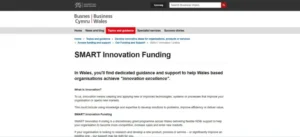
7. SMART Innovation Funding Wales
SMART Innovation Funding provides research, development and innovation support to businesses and other organisations operating in Wales.
The programme is designed to help organisations create new products, processes or services, or make significant technical improvements to existing ones.
Key Funding Details:
- Funding Available: Determined according to the individual project
- Who Can Apply: Micro businesses, SMEs, larger companies and eligible organisations
- Business Location: Applicant must have an active operational base in Wales
- What It Supports: Research, development and innovation
- Key Requirement: Project must deliver meaningful technical advancement
- Economic Requirement: Activity should provide measurable benefits in Wales
- Project Timing: Work already started is generally not supported
- Current Status: Available subject to assessment
The official SMART Innovation Funding guidance from Business Wales also highlights priority areas including digital transformation, net zero, agri-tech, life sciences and manufacturing.
Best For: Welsh businesses developing genuinely innovative products, technologies, services or operational processes.
8. Ambition To Grow
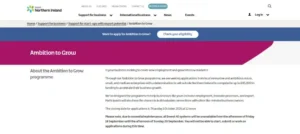
Ambition to Grow is an Invest Northern Ireland programme for ambitious businesses that want to create employment and increase sales outside Northern Ireland.
The 2026 programme combines grant funding with structured business-growth activity, making it particularly relevant to trading companies that have already demonstrated commercial potential.
Key Funding Details:
- Maximum Funding: Up to £45,000
- Employment Support: Up to £30,000
- Business Development Support: Up to £10,000
- Additional Support: £5,000 linked to specified growth activities
- Who Can Apply: Eligible Northern Ireland micro businesses and SMEs
- Turnover Requirement: Annual turnover below £2 million or external sales below £250,000
- Growth Requirement: Ability to create new employment and increase external sales
- Application Deadline: 1 October 2026 at 12 noon
The programme is not designed for businesses still at the idea stage. Applicants need to be generating sales and demonstrate how support would contribute to employment and market growth.
Best For: Established Northern Ireland SMEs preparing to recruit staff and grow sales outside the region.
9. Local Authority Business Grants
Local councils can provide some of the most accessible grant opportunities for small businesses because funding is usually restricted to companies operating within a particular area.
Programmes vary throughout the year and may be introduced using local economic development budgets or wider government funding.

Key Funding Details:
- Funding Available: Varies by council
- Who Can Apply: Usually businesses operating within the relevant council area
- Common Uses: Equipment, digital technology, premises, sustainability and growth
- Business Size: SMEs are frequently prioritised
- Match Funding: May be required
- Application Window: Often time-limited
- Competition: Usually restricted geographically
- Current Status: Depends on local availability
Local schemes can sometimes be more practical for smaller companies than large national competitions because project values and application requirements may be better suited to SME investment.
Best For: Small businesses seeking locally targeted support for equipment, expansion, premises or productivity improvements.
10. London Borough Business Grants
London businesses may find grant opportunities through individual boroughs, local partnerships and temporary economic development programmes.
There is no single borough grant available to every London company. Funding depends heavily on the business location and current priorities within each borough.

Key Funding Details:
- Funding Available: Varies by borough and programme
- Who Can Apply: Usually businesses operating within a participating London borough
- Common Uses: Growth, digital adoption, sustainability, premises and workforce development
- Business Size: SMEs commonly targeted
- Match Funding: Depends on programme rules
- Region: London
- Application Window: Often limited
- Current Status: Changes throughout the year
Businesses should check both borough-level funding and London-wide business support because a company that does not qualify for one programme may still meet the conditions of another.
Best For: London SMEs looking for location-specific grants and business support.
11. Farming Innovation Programme: Small R&D Partnership Projects
The Farming Innovation Programme supports collaborative research and development designed to solve major challenges within farming and agricultural production.
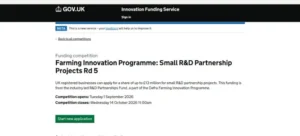
Round 5 of the Small R&D Partnership Projects competition opened on 1 September 2026 and is funded by Defra in partnership with Innovate UK.
Key Funding Details:
- Total Funding Pool: Up to £13 million
- Project Costs: Between £1 million and £3 million
- Project Length: Up to 30 months
- Project Type: Collaborative research and development
- Project Location: Work must be carried out in the UK
- Expected Benefit: Results must benefit farmers, growers or foresters in England
- Closing Date: 14 October 2026
- Project Start: By 1 April 2027
The competition focuses on meaningful industry challenges rather than routine farm expenditure, making it more relevant to innovative businesses, researchers and agricultural partners developing new solutions.
Best For: Agri-tech businesses and collaborative teams developing innovative farming technologies, products or systems.
12. Investor Partnerships – ACT And Semiconductors
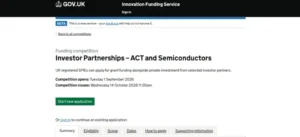
Investor Partnerships combines public grant funding with private investment for high-growth SMEs working in advanced connectivity technologies and semiconductors.
The structure differs from a standard grant because applicants need to secure investment from an approved investor partner alongside public funding.
Key Funding Details:
- Grant Funding: £150,000 to £900,000
- Total Grant Scheme: £15 million
- Who Can Apply: Eligible UK-registered SMEs
- Focus Areas: Advanced connectivity technologies, semiconductors and related innovation
- Investment Requirement: Private investment from a selected investor partner
- Opening Date: 1 September 2026
- Closing Date: 14 October 2026
- Application Type: Competitive
This option is more appropriate for businesses with significant growth potential and a credible investment proposition than very early-stage companies seeking basic startup finance.
Best For: Technology SMEs that need both innovation grant funding and private investment to scale.
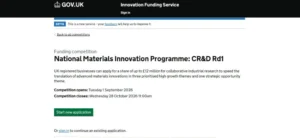
13. National Materials Innovation Programme
The National Materials Innovation Programme supports collaborative industrial research designed to accelerate commercial applications for advanced materials.
Its first collaborative R&D round in 2026 targets high-growth areas where new materials could generate significant technological and economic value.
Key Funding Details:
- Funding Available: £500,000 to £1 million
- Total Competition Funding: Up to £12 million
- Who Can Apply: Eligible UK-registered businesses
- Project Type: Collaborative industrial research
- Focus: Advanced materials innovation
- Opening Date: 1 September 2026
- Closing Date: 28 October 2026
- Current Status: Open
The relatively high project values mean this programme is aimed at substantial R&D activity rather than routine equipment purchases or general business expansion.
Best For: Manufacturing, engineering and technology businesses developing advanced material applications.
14. Engineering Biology Access To Infrastructure Pilot
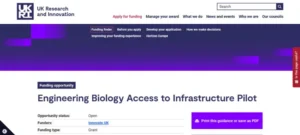
The Engineering Biology Access to Infrastructure Pilot supports businesses that need specialist facilities to move laboratory-proven engineering biology innovations towards pilot or demonstration scale.
The programme aims to reduce one of the major barriers faced by smaller biotechnology businesses, which is gaining affordable access to specialist scale-up infrastructure.
Key Funding Details:
- Total Funding Pool: Up to £5 million
- Eligible Project Costs: £200,000 to £750,000
- Who Can Apply: Eligible UK-registered businesses
- Project Length: Up to 24 months
- Infrastructure Requirement: Must involve suitable UK scale-up or validation capabilities
- Opening Date: 7 September 2026
- Closing Date: 21 October 2026
- Project Start: By 1 February 2027
Projects must focus on engineering biology and demonstrate how specialist infrastructure will help validate the technical and economic viability of scaling the innovation.
Best For: Biotechnology and engineering biology SMEs progressing from laboratory development towards commercial-scale production.
15. UK-Singapore Collaborative R&D 2026
UK-Singapore Collaborative R&D supports UK companies working with Singapore businesses on innovative commercial research and development projects.
The competition is designed to encourage international collaboration in areas where businesses in both countries can contribute technology, expertise and market access.

Key Funding Details:
- UK Grant Funding: £100,000 to £900,000
- Total UK Funding Pool: Up to £3 million
- Who Can Apply: Eligible UK-registered businesses
- Partnership Requirement: At least one eligible Singapore business partner
- Focus Areas: Advanced manufacturing, clean energy, life sciences and frontier technologies
- Opening Date: 24 August 2026
- Closing Date: 16 December 2026
- Application Type: Collaborative and competitive
The programme is particularly relevant to innovative businesses with international ambitions because applicants need a genuine Singapore partner rather than simply demonstrating plans to export there.
Best For: Innovative UK SMEs that want to develop technology collaboratively and build commercial opportunities in Singapore.
Top 15 Government Grants For Small Business – Comparison Table
Grant Or Funding Option Funding Available Best For Region 2026 Position
The King’s Trust Enterprise Programme Up To £5,000 Grant Young Entrepreneurs UK Available
Knowledge Transfer Partnerships Up To 67% Of Eligible SME Costs Business And Academic Collaboration UK Open Round
Innovate UK Competitions Varies Innovation And R&D UK Multiple Competitions
Workplace Charging Scheme Up To £500 Per Socket EV Charging UK Available
Boiler Upgrade Scheme Up To £9,000 Low-Carbon Heating England And Wales Available
Scottish Enterprise Small Capital Grant £15,000–£250,000 Capital Investment Scotland Available
SMART Innovation Funding Project Dependent Innovation And R&D Wales Available
Ambition To Grow Up To £45,000 Jobs And Market Growth Northern Ireland Open
Local Authority Business Grants Varies Local SMEs Local Varies
London Borough Business Grants Varies London SMEs London Varies
Farming Innovation Programme Share Of £13 Million Agri-Tech And Farming R&D UK With England Benefit Open
Investor Partnerships £150,000–£900,000 Technology Scaleups UK Open
National Materials Innovation Programme £500,000–£1 Million Advanced Materials UK Open
Engineering Biology Pilot Projects £200,000–£750,000 Biotechnology UK Open
UK-Singapore Collaborative R&D £100,000–£900,000 International R&D UK Open
Funding status is based on information available on 15 September 2026. Competitive schemes may close, reopen or be replaced by new funding rounds.
Which Business Grants Have Closed Or Changed In 2026?
Older grant articles can create confusion because schemes remain visible online after funding has ended. Several programmes previously promoted to SMEs have either closed, been paused or changed significantly.
Scheme 2026 Position What Businesses Should Know
Innovate UK Smart Grants Paused Smart Grants have been paused since 2025, so businesses should check current Innovate UK competitions instead
UK Tradeshow Programme Withdrawn The government page is marked withdrawn and should not be presented as an active 2026 grant
EV Infrastructure Grant For Staff And Fleets Closed Customer applications closed on 31 March 2026
Commercial Landlord Chargepoint Grant Closed Customer applications closed on 31 March 2026
Workplace Charging Scheme Available The scheme remains open until 31 March 2027 with a maximum of £500 per socket
The closure of one scheme does not necessarily mean support for that activity has disappeared.
Governments frequently replace older programmes with new competitions or revised grant structures, which is why businesses should check current availability rather than relying on historical funding lists.
Where Can Small Businesses Find Grants Across The UK?
The most useful starting point for many companies is the government’s Find a Grant service, which allows businesses to search live and upcoming government funding opportunities by applicant type, location and other criteria.
However, businesses should not limit their search to national schemes.
Companies in England can also check local authorities and regional business-support organisations, particularly when seeking funding for equipment, town-centre investment, sustainability or smaller growth projects.
Scottish companies can explore support through Scottish Enterprise and the Find Business Support service.
Welsh businesses can use Business Wales alongside national schemes, while Northern Ireland companies should check Invest Northern Ireland and local council programmes.
London businesses should also look at individual borough funding and London-wide business support.
Local schemes can be particularly valuable because the applicant pool may be geographically restricted rather than open to companies across the whole UK.
How To Apply For A Government Grant For A Small Business?
Applying for a business grant becomes much easier when you follow the process in the right order.
Start by finding a scheme that matches your business and project, then prepare the required information carefully before submitting the application.
Step 1: Find A Suitable Grant
- Choose a grant that matches your business location, sector and planned project.
Step 2: Check The Eligibility
- Confirm the business size, trading status, location and project requirements before applying.
Step 3: Check What Costs Are Covered
- Make sure the grant can be used for the equipment, technology, staff or other costs you want to fund.
Step 4: Confirm Match Funding
- Check whether your business needs to contribute part of the total project cost.
Step 5: Prepare Your Documents
- Gather your business plan, project budget, financial forecasts, supplier quotes and any other required evidence.
Step 6: Explain The Project Clearly
- Show what the funding will achieve, such as creating jobs, increasing productivity, developing a new product or reducing costs.
Step 7: Submit Before The Deadline
- Complete every required section and provide all supporting documents before the application closes.
Step 8: Wait Before Starting The Project
- Do not make purchases or begin work until you have checked whether spending before approval is allowed.
What Should Businesses Know Before Applying?
Match funding is one of the most important issues to understand.
If a programme covers 50% of a £40,000 project, the business will normally need to finance the remaining £20,000 itself. A large headline grant can therefore still require substantial private investment.
Cash flow is also important. Some programmes reimburse businesses after eligible expenditure has been paid.
The Scottish Enterprise Small Capital Grant, for example, requires eligible applicants to fund project expenditure first and subsequently submit a claim.
Businesses should also check when a project is allowed to start. Some schemes can refuse expenditure incurred before formal approval.
The Engineering Biology Access to Infrastructure Pilot specifically states that projects must not begin until the Grant Offer Letter has been approved.
Eligible costs should be checked carefully. Grant funding intended for machinery, R&D or digital technology cannot automatically be redirected towards debt repayment, owner drawings or routine overheads.
Conclusion
Government grants for small business owners can make startup, innovation, sustainability and expansion projects more affordable without creating the same repayment obligations as conventional debt.
However, there is no universal grant available to every business. The strongest applications usually come from companies that identify a funding programme closely aligned with a project they already intend to deliver.
Businesses should check current status, eligibility, match-funding requirements, deadlines and eligible expenditure before applying.
This is particularly important in 2026 because several schemes promoted in older grant lists have closed or changed, while new innovation competitions continue to open throughout the year.
FAQs
What Government Grants Are Available For Small Businesses?
UK businesses can find grants covering innovation, equipment, low-carbon technology, research, agriculture and regional growth. Availability depends on the company’s location and proposed project.
Can I Get A Government Grant To Start A Business?
Yes, although startup grants are often targeted by age, location or business type. Not every new company automatically qualifies for government funding.
How Much Can A Small Business Get From A Government Grant?
Funding can range from a few hundred pounds to substantial six-figure awards. Larger innovation collaborations can involve projects worth considerably more.
Can Sole Traders Apply For Business Grants?
Yes, some programmes accept sole traders. Others require an incorporated company, partnership or collaboration with another organisation.
Do Small Businesses Need Match Funding?
Some grants require applicants to contribute part of the project cost. The required percentage varies according to the programme and business size.
Can A Business Apply For More Than One Grant?
Yes, where the individual funding rules allow it. Businesses should not normally use multiple public grants to claim the same project expenditure twice.
Do Government Business Grants Have To Be Repaid?
Genuine grants usually do not require conventional repayment when all conditions are met. Funding may be recovered if the business breaches the agreement or uses the money incorrectly.