

eTarget Limited Parcel: What It Means and How UK Shoppers Can Check a Delivery Safely?
 • August 17, 2026
•
1 Comment
• August 17, 2026
•
1 Comment
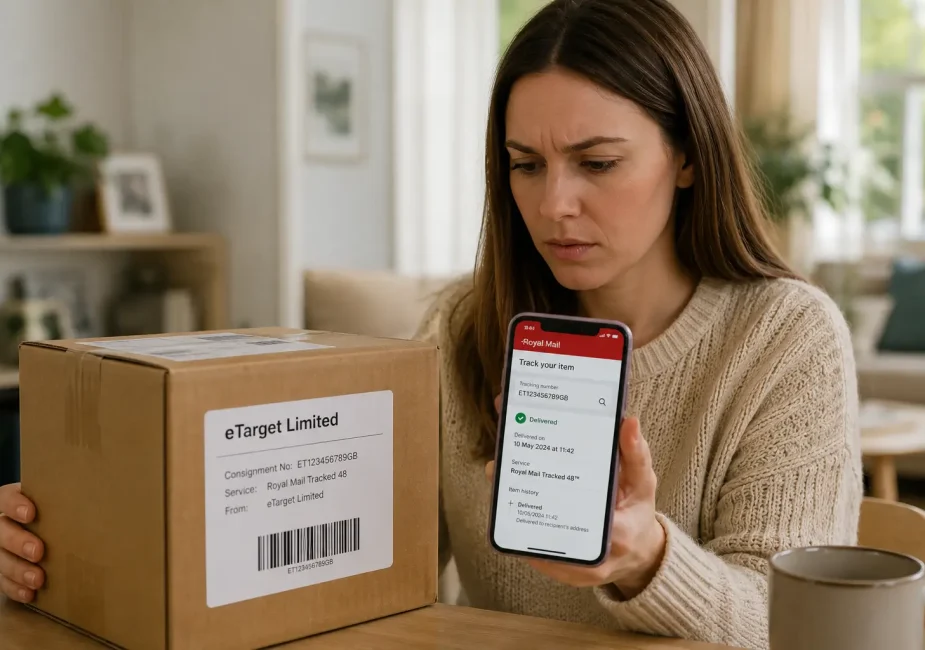
An eTarget Limited parcel is a package or delivery notification that displays the name “eTarget Limited” as a sender or associated business.
UK recipients may notice the name when checking a Royal Mail delivery even though they do not remember buying anything directly from a company called eTarget Limited.
An unfamiliar sender name does not automatically mean that a parcel is fraudulent. Online orders can involve retailers, marketplace sellers, warehouses, exporters and delivery companies, meaning the name visible during shipping may differ from the shop or marketplace recognised by the customer.
However, there is an important distinction. Public records confirm that businesses using the eTarget Limited name exist, but the available evidence does not establish that every eTarget Limited parcel delivered in the UK comes from one particular company.
Recipients should therefore identify the individual order and verify the tracking information rather than relying solely on the sender name.
Why Does the Name eTarget Limited Appear on a Parcel?
The precise reason can depend on the order and shipping arrangement.
An eTarget Limited parcel UK recipients encounter may have passed through several businesses before reaching its destination. This is particularly possible with international e-commerce, where the company selling a product to the customer may not be the same business named in shipping or customs information.
That does not prove that eTarget Limited is acting as the fulfilment provider in every case. It simply explains why a shopper may encounter an unfamiliar business name on an otherwise expected delivery.
Public records also reveal an important identity issue that should be considered before linking a particular parcel to a company.
What Do UK Companies House Records Show?
The UK Companies House record for E-TARGET LIMITED identifies company number 07242152 as an active private limited company. It was incorporated on 4 May 2010 and has a registered office in White Colne, Essex.
Most importantly, its registered nature of business is SIC code 70229, which is “management consultancy activities other than financial management”. Companies House does not classify this particular company as a parcel delivery, logistics or fulfilment business.
This matters because simply finding a UK company with a matching name does not prove that it is responsible for a particular eTarget Limited Royal Mail parcel.
A company-name match and a confirmed sender identity are two different things.
What International Trade Records Show?
There is separate evidence of international shipping activity under the name Etarget Limited.
ImportGenius records for Etarget Limited describe a supplier based in China and show a contact address at Lockhart Center in Wan Chai. Its database recorded 1,615 US customs shipments covering the period from November 2006 to 14 August 2026.
Recent entries include products such as storage organisers, guard rails and wire mesh decks, demonstrating that the Etarget Limited name appears in commercial international shipping records.
These records are useful evidence of trade activity, but they concern customs movements into the United States. They do not establish that the business listed by ImportGenius dispatched any specific UK consumer parcel.
There is therefore not enough verified evidence to assume that the UK Companies House entity, the business appearing in international trade data and every sender appearing as “eTarget Limited” on UK parcels are necessarily the same organisation.
Why Might eTarget Limited Appear on a Royal Mail Delivery?
Modern online shopping can involve more businesses than the buyer sees at checkout.
A typical transaction could involve:
- Retailer Selling The Product To The Customer
- Marketplace Seller Processing The Individual Order
- Warehouse Preparing The Goods For Dispatch
- Exporter Moving The Product From Its Country Of Origin
- Logistics Provider Handling Part Of The Journey
- Royal Mail Completing Delivery Within The UK
The visible sender or tracking information can therefore be different from the retailer name appearing on a bank statement or order confirmation.
This is especially relevant when products are bought through marketplaces containing independent sellers.
For example, the distinction between a platform and the individual merchant is also important when assessing whether OnBuy is legitimate for UK shoppers or determining whether an OnBuy product is second hand. A marketplace, seller and dispatching business can all play different roles in the same transaction.
Why the Sender Name May Differ From the Shop Name?
Several ordinary circumstances can create this difference.
A seller may use a warehouse operated by another business. An international merchant may pass a parcel to an exporter before it enters Britain. A marketplace order can also be fulfilled by the seller rather than the marketplace itself.
As a result, searching for the sender name alone may not immediately reveal the product that is arriving.
For someone expecting an eTarget Limited delivery, the most useful information is usually the tracking number, purchase date, retailer order history and expected delivery date.
eTarget Limited Parcel: What Is Confirmed and What Is Not?
The available evidence makes it possible to separate established facts from assumptions.
Question What Can Be Established
Does E-TARGET LIMITED Exist As A UK Company? Yes. Companies House records an active company numbered 07242152.
Is The Registered UK Company's SIC Activity Parcel Logistics? No. Its listed activity is management consultancy.
Does The Etarget Limited Name Appear In International Trade Records? Yes. ImportGenius records substantial US customs activity under the name.
Does This Prove The UK And Overseas Records Refer To The Same Operation? No. The available records do not establish that connection.
Does The Sender Name Prove A Royal Mail Message Is Genuine? No. The tracking information and message should be checked independently.
Does An Unfamiliar Sender Automatically Mean Fraud? No. An unknown sender name alone is not enough to establish that a parcel is fraudulent.
This distinction is particularly important because search results can make an uncertain relationship appear more definite than the underlying evidence supports.
What Actually Identifies the Sender?
Select the evidence around the parcel. Some details provide useful context, but shipment-specific information is more useful when connecting the name to an individual delivery.
sent it?
A Sender Name Is a Clue, Not an Identity Check
Seeing “eTarget Limited” on a parcel tells you the name associated with that delivery information. It does not by itself prove which legal business dispatched the parcel.
The shipment is displaying or associating the eTarget Limited name with the delivery.
It does not confirm that every UK parcel showing this name comes from one particular company.
Inspect the request, not just the branding.
Do not rely solely on a link inside an unexpected delivery message. If Royal Mail tracking is involved, the reference can be checked independently through Royal Mail’s official tracking service.
A matching company name is not the same as a confirmed sender. Order history, tracking references, dispatch dates, seller information and delivery details provide more useful evidence for identifying the individual parcel.
Is an eTarget Limited Parcel a Scam?
An eTarget Limited parcel is not proven to be a scam simply because the recipient does not recognise the sender name.
At the same time, seeing a real company name in a text message or email does not prove that the communication is genuine. Fraudsters can impersonate legitimate companies, delivery services and retailers.
Royal Mail specifically warns that fraudulent messages can use its branding and even forged sender details.
Its online security and scam guidance advises people who are uncertain about a message to check the barcode or tracking number independently through Royal Mail’s tracking service.
This makes independent verification especially important when a person receives an unexpected eTarget Limited Royal Mail notification.
Signs a Royal Mail Delivery Message Deserves Extra Caution
A delivery message deserves further checking when it contains unusual requests or does not correspond with an expected purchase.
Warning signs can include:
- Unexpected Links That Ask The Recipient To Enter Personal Or Financial Details
- Unrecognised Tracking Numbers That Cannot Be Matched To An Order
- Requests For Sensitive Information Through Email Or Text
- Unusual Payment Instructions That Do Not Match Normal Courier Procedures
- Poorly Presented Messages Containing Suspicious Spelling, Formatting Or Sender Details
- Pressure To Act Immediately Without Giving The Recipient Time To Verify The Delivery
Royal Mail says customers should never send sensitive personal information, security details or card numbers by email or text. It also advises against clicking a link when the recipient is unsure about it.
There is one important qualification. A request involving money is not automatically fraudulent because Royal Mail can legitimately contact customers when an item has a customs fee applied. Royal Mail says these cases can also involve a grey “Fee to Pay” card.
The correct response is therefore verification rather than assuming every payment message is either genuine or fraudulent.
How to Check an eTarget Limited Parcel Safely?

A recipient trying to identify an eTarget Limited parcel can usually narrow down its origin by comparing several pieces of information.
Check Recent Online Orders
The first step is to review purchases made during the previous few weeks.
International products can spend longer in transit than domestic orders, so the parcel may relate to something purchased earlier than expected.
Checks should include:
- Marketplace Accounts Such As Amazon, eBay Or Other Shopping Platforms
- Retailer Order Histories For Recently Purchased Products
- Confirmation Emails Containing Dispatch Dates
- Pre-Orders That May Have Shipped Later Than Originally Expected
- Orders Made By Other Household Members Using The Same Address
When buying through third-party marketplaces, the seller responsible for fulfilment may differ from the platform used to place the order.
Verify the Tracking Number Through Royal Mail
If a notification contains a Royal Mail tracking reference, the recipient should avoid relying solely on a link contained in an unexpected message.
The tracking reference can instead be entered independently into Royal Mail’s official system. Royal Mail itself recommends this approach when a customer is concerned that an email or text may be fraudulent.
Tracking can also remain important outside the standard Monday-to-Friday pattern.
Royal Mail continues to handle parcels at weekends, and the practical differences between services are covered in the current information on Royal Mail Saturday deliveries.
Compare the Delivery With Marketplace Order History
The next step is to compare:
- Tracking Reference
- Dispatch Date
- Expected Delivery Window
- Product Origin
- Seller Name
- Order Number
- Delivery Address
A close match across several of these details provides much more useful evidence than the sender name alone.
This can be particularly helpful with marketplace purchases because a consumer may remember the platform but not the individual seller handling the product.
Contact the Retailer or Seller Directly
If the parcel still cannot be identified, the retailer or marketplace seller can be contacted through the account used to place the order.
The recipient can provide the order number and ask whether a third party was used for dispatch.
Contact details should preferably come from the retailer’s official website or the customer’s existing shopping account rather than from an unexpected delivery message.
What If an eTarget Limited Parcel Arrives but Nothing Was Ordered?
Receiving an unexpected parcel from eTarget Limited can understandably cause confusion, but several explanations are possible.
A Forgotten or Delayed Online Purchase
An older order may have taken longer than expected to travel internationally.
The buyer may also have forgotten about a low-value purchase, pre-order, replacement product or item with an extended delivery window.
Delivery timing can vary further during busy periods. For example, the postal network operates differently around seasonal peaks, including Royal Mail deliveries on Christmas Eve.
A Purchase Made by Someone Else at the Address
The parcel may belong to:
- A Partner Who Used The Same Home Address
- A Family Member Waiting For An Online Purchase
- A Housemate Who Did Not Mention The Delivery
- A Previous Resident Whose Stored Address Was Not Updated
- Someone Sending A Gift Directly To The Recipient
Checking the full name and delivery address can help narrow down these possibilities.
An Address or Delivery Error
A parcel can also reach the wrong address because of incorrect information entered during checkout or an error somewhere in the delivery process.
The recipient should check the name, house number and postcode before assuming that the item was intended for them.
Different courier networks can also have different delivery and weekend arrangements. This is visible when comparing Evri weekend deliveries with DHL Saturday delivery arrangements.
An Unsolicited or Suspicious Parcel
If there is no identifiable order and nobody at the address recognises the delivery, caution is appropriate.
Recipients should avoid scanning unfamiliar QR codes, following unexplained links or entering payment details simply because instructions are included with a package.
An unexpected parcel does not automatically establish fraud, but it is sensible to verify its origin before responding to requests for information or money.
Does eTarget Limited Sell Products Directly?
The available evidence does not establish a definitive consumer product catalogue belonging to the exact business responsible for UK parcels carrying the eTarget Limited name.
This makes the question “What does eTarget Limited sell?” more difficult than it first appears.
ImportGenius records show a variety of goods shipped internationally under the Etarget Limited supplier name. Recent records include guard rails, storage organisers and wire mesh decks.
However, these records document US customs movements rather than a UK consumer storefront. They should not be treated as proof that those products represent everything sold by eTarget Limited or that a UK recipient’s parcel contains one of those goods.
The UK Companies House record is also insufficient to answer the question because the registered E-TARGET LIMITED is classified under management consultancy rather than retail or logistics.
Therefore, someone trying to identify what is inside an eTarget Limited package will usually get a more reliable answer from their own order history than from the company name alone.
Why Online Information About eTarget Limited Can Be Confusing?
The biggest difficulty is that several different pieces of information can appear to fit together without actually proving a direct relationship.
One website may identify a UK company with the same name. Another may describe international shipments. A parcel recipient may report seeing eTarget Limited in delivery information.
Those facts can all exist without proving that they refer to exactly the same legal entity or commercial operation.
This creates a risk of turning an assumption into a factual statement.
The Difference Between a Company Name Match and a Confirmed Sender Identity
Three separate questions should be considered:
- Does A Company With This Name Exist? Yes, a UK company named E-TARGET LIMITED is recorded at Companies House.
- Does The Name Appear In Shipping Data? Yes, Etarget Limited also appears in international customs data.
- Does Either Record Prove Who Sent A Particular UK Parcel? No, not without additional evidence connecting that parcel to the specific business.
This distinction is essential when researching an eTarget Limited sender.
A similar company name, matching spelling or general involvement in international trade should not be treated as automatic proof of identity.
What Should UK Recipients Do With an Unrecognised eTarget Limited Parcel?
The safest approach is to investigate the specific delivery rather than trying to decide whether the sender name itself is “good” or “bad”.
A recipient can follow this sequence:
- Review Recent Purchases: Check retailer accounts, marketplace histories and confirmation emails.
- Check Other Household Members: Confirm whether somebody else used the same delivery address.
- Verify The Tracking Reference: Enter the reference independently through the courier’s official website.
- Compare Dates And Order Details: Check whether dispatch dates and estimated delivery dates correspond.
- Contact The Seller Independently: Use the retailer or marketplace account rather than an unknown link.
- Avoid Providing Sensitive Information: Do not enter banking or personal details simply because a message claims to relate to a parcel.
These checks can usually provide more certainty than searching the sender name in isolation.
Conclusion: How to Deal With an eTarget Limited Parcel Safely
An eTarget Limited parcel can be confusing because the sender name may not correspond with a retailer the recipient immediately recognises.
The evidence currently available confirms that a UK E-TARGET LIMITED exists and that the Etarget Limited name also appears in international trade records. However, those records do not establish that the same organisation is responsible for every parcel displaying the name.
For UK recipients, the most reliable approach is therefore to verify the individual shipment.
Checking order history, tracking information, delivery dates and seller details can establish whether the parcel corresponds with a genuine purchase.
If a Royal Mail message appears suspicious, the tracking reference should be checked independently rather than trusting an unexpected link.
An unfamiliar eTarget Limited delivery should prompt verification, not an automatic conclusion that the parcel is either legitimate or fraudulent.
Frequently Asked Questions
What Is an eTarget Limited Parcel?
An eTarget Limited parcel is a package or delivery notification showing eTarget Limited as a sender or associated name. The name may not necessarily match the retailer from which the customer remembers ordering.
Why Am I Receiving a Parcel From eTarget Limited?
It may relate to an online purchase where another company handled part of the dispatch or shipping process. The exact origin should be confirmed by comparing the tracking reference, order history and delivery date.
Is eTarget Limited Connected to Royal Mail?
The available evidence does not establish a general corporate relationship between eTarget Limited and Royal Mail. Royal Mail may simply be the delivery carrier for an individual parcel. Seeing both names on the same delivery does not by itself prove a wider business connection.
Is an eTarget Limited Parcel a Scam?
There is no basis for saying that every eTarget Limited parcel is a scam. An unfamiliar sender name alone does not prove fraud. However, unexpected texts, emails, payment requests and tracking links should be checked independently before personal information is supplied.
How Can Someone Track an eTarget Limited Parcel?
If the parcel is being handled by Royal Mail, the recipient can use the tracking number shown in their legitimate order or delivery information and enter it directly into Royal Mail’s official tracking system. The order history should also be checked for a matching reference.
What Does eTarget Limited Sell?
There is no verified evidence establishing a single UK consumer catalogue for the exact sender behind every eTarget Limited parcel. International customs data records various goods under the Etarget Limited name, but those records should not be treated as a complete UK product list.
What Should Someone Do If They Did Not Order an eTarget Limited Parcel?
The recipient should first check whether another household member placed an order, review older marketplace purchases, confirm the name and address on the parcel and verify any tracking information independently. If nothing matches, the recipient should avoid following unfamiliar links or providing personal and financial information until the parcel’s origin has been established.



[…] eCommerce UK is commonly used for domestic parcel deliveries and ecommerce shipments. Saturday delivery can be added as an upgrade when the parcel meets the […]