
How Much Is Unemployment Benefit in the UK? Universal Credit and JSA Rates Explained
 • November 13, 2026

For anyone asking how much the unemployment benefit in the UK, there is no single fixed unemployment benefit payment.
The main forms of financial support for someone who is out of work are New Style Jobseeker’s Allowance (JSA) and Universal Credit.
For the 2026/27 benefit year, New Style JSA pays up to £75.65 a week for someone under 25 and £95.55 a week for someone aged 25 or over.
Universal Credit is calculated monthly, with a standard allowance of £338.58 for a single person under 25 and £424.90 for a single person aged 25 or over.
Couples can receive a standard household allowance of £528.34 or £666.97 a month, depending on their ages.
The actual unemployment benefit UK amount can be higher or lower depending on age, household circumstances, earnings, savings, housing costs, children, health conditions and caring responsibilities.
What Unemployment Benefits Can Someone Claim In The UK?
The term “unemployment benefit” is still widely used, but it is not the formal name of one current UK benefit.
For most working-age people who lose their job, the two main benefits to consider are New Style Jobseeker’s Allowance and Universal Credit.
New Style Jobseeker’s Allowance
New Style JSA is a contribution-based benefit. It is mainly designed for people who have recently worked as employees and have paid or been credited with enough Class 1 National Insurance contributions.
It can normally be claimed when someone is unemployed or working fewer than 16 hours a week on average.
Savings and a partner’s income or savings do not normally affect entitlement, although earnings and some pension income can reduce the payment.
New Style JSA is generally paid every two weeks and can be received for up to 182 days, which is approximately six months.
Universal Credit
Universal Credit is a means-tested benefit designed to help with living costs. It can be available to people who are unemployed as well as those who are working but have a low income.
The monthly payment begins with a standard allowance and may include additional amounts for rent, children, disability or health conditions and caring responsibilities.
Current Universal Credit benefit rates for 2026/27 therefore extend beyond the basic monthly figures shown for a single unemployed claimant.
A person can sometimes receive New Style JSA and Universal Credit at the same time.
However, New Style JSA is taken into account as income when Universal Credit is calculated, so receiving both does not normally mean receiving the full value of both payments on top of each other.
How Much Is Jobseeker’s Allowance In The UK?
The maximum JSA rates in the UK for 2026/27 depend on the claimant’s age.
| Age | Maximum New Style JSA |
|---|---|
| Under 25 | £75.65 Per Week |
| 25 Or Over | £95.55 Per Week |
These are maximum weekly amounts. A claimant may receive less depending on circumstances such as part-time earnings or pension income.
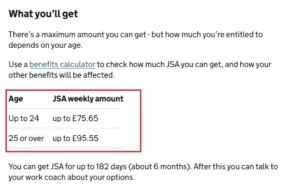
GOV.UK confirms the 2026/27 maximum New Style JSA rates of £75.65 a week for under-25s and £95.55 for people aged 25 or over.
JSA Rates For People Under 25
A claimant under 25 can receive up to £75.65 per week in New Style Jobseeker’s Allowance.
Because JSA is normally paid every two weeks, the full weekly rate would usually correspond to about £151.30 for a normal two-week payment period, although the first payment can differ.
JSA Rates For People Aged 25 And Over
A claimant aged 25 or over can receive up to £95.55 per week.
At the maximum rate, that would normally equal about £191.10 over two weeks.
The Department for Work and Pensions published proposed 2027/28 rates on 11 November 2026.
Those proposals would raise New Style JSA to £78.30 for under-25s and £98.90 for people aged 25 or over. Those are future proposed rates, not the amounts currently payable in November 2026.
How Long Can New Style JSA Be Claimed?
New Style JSA can normally be paid for up to 182 days.
Eligibility is based heavily on the claimant’s National Insurance record. For a claim made on or before 2 January 2027, GOV.UK states that the relevant contribution years will normally be 6 April 2023 to 5 April 2024 and 6 April 2024 to 5 April 2025.
That makes New Style JSA different from Universal Credit, which is assessed primarily according to household income, capital and other circumstances.
How Much Universal Credit Does An Unemployed Person Get?
The amount of Universal Credit an unemployed person can get starts with a standard monthly allowance.
For 2026/27, the standard allowances are:
| Household Circumstances | Monthly Standard Allowance |
|---|---|
| Single And Under 25 | £338.58 |
| Single And 25 Or Over | £424.90 |
| Couple, Both Under 25 | £528.34 |
| Couple, One Or Both Aged 25 Or Over | £666.97 |
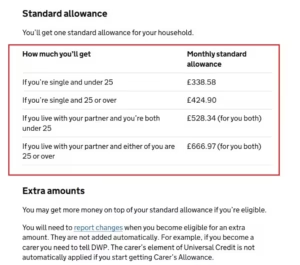
GOV.UK shows the current 2026/27 Universal Credit standard allowances for single claimants and couples.
These figures are household standard allowances, not guaranteed final payments. Universal Credit can include extra elements or be reduced because of earnings, savings, other income, deductions or sanctions.
The government has also published proposed rates for 2027/28. These would increase the monthly standard allowance to £353.87 for a single claimant under 25 and £443.21 for a single claimant aged 25 or over.
The current 2026/27 figures remain applicable until the next uprating takes effect.
Universal Credit Standard Allowance
The standard allowance is the basic component of Universal Credit.
A single unemployed person aged 25 or over with no earnings, no relevant deductions and no additional elements may therefore start with a maximum standard allowance of £424.90 per monthly assessment period.
This does not mean every unemployed person aged 25 or over automatically receives £424.90. Household income, savings, other benefits and individual circumstances all affect the final award.
Extra Universal Credit Payments For Housing, Children, Health Conditions And Caring Responsibilities
Universal Credit can include additional amounts when a claimant meets the relevant conditions.
For 2026/27, an eligible household may receive £303.94 a month for each child, with a higher £351.88 amount applying to a qualifying first child born before 6 April 2017.
The two-child limit on Universal Credit child elements ended on 6 April 2026, although the overall benefit cap can still restrict the total amount received by some households.
That makes the continuing impact of the DWP benefit cap relevant to families whose combined benefits reach the applicable household limit.
An eligible carer can receive a Universal Credit carer element of £209.34 a month if the qualifying conditions are met.
A person providing care may also need to consider how Carer’s Allowance is treated for tax and Universal Credit purposes because the two payments follow different rules.
Health-related additions also vary according to the claimant’s circumstances and when entitlement arose.
Housing support is not a single national fixed amount because rent, household circumstances and local housing rules can affect the housing element.
JSA Vs Universal Credit: How Much Could Someone Receive?
New Style JSA and Universal Credit serve different purposes, so their headline amounts should not be compared as though they are interchangeable.
| Feature | New Style JSA | Universal Credit |
|---|---|---|
| Payment Basis | National Insurance Record | Household Means Test |
| Under-25 Basic Amount | Up To £75.65 Weekly | £338.58 Monthly For A Single Claimant |
| Age 25+ Basic Amount | Up To £95.55 Weekly | £424.90 Monthly For A Single Claimant |
| Savings Affect Claim | Generally No | Yes |
| Partner’s Income Affects Claim | Generally No | Yes |
| Maximum Claim Period | Usually 182 Days | No Equivalent Fixed Six-Month Limit |
| Extra Housing Or Child Amounts | No | Potentially Yes |
| Can Be Claimed Together | Yes, In Some Cases | JSA Is Counted As Income |
Someone qualifying for both should not simply add £95.55 a week to £424.90 a month and assume that is the total unemployment benefit payment. New Style JSA is taken into account when Universal Credit is calculated.
Who Is Eligible For Unemployment Benefit In The UK?
Eligibility differs depending on which benefit is being claimed.
New Style JSA Eligibility
A claimant will normally need to have worked as an employee and paid enough Class 1 National Insurance contributions or received qualifying credits.
Other key conditions generally include:
- Working Hours: The claimant must normally be unemployed or working fewer than 16 hours per week
- Age: The claimant must generally be 18 or over and below State Pension age
- Availability For Work: The claimant must be capable of working and actively looking for employment
- National Insurance Record: Sufficient Class 1 contributions or credits are normally required
- Claimant Commitment: Agreed work-search requirements usually need to be followed
Northern Ireland administers New Style JSA separately through the Department for Communities, but the current maximum weekly rates are also £75.65 for under-25s and £95.55 for those aged 25 or over.
Universal Credit Eligibility
Universal Credit may be available to someone who is out of work or on a low income.
A claimant will generally need to:
- Live In The UK: Residency and immigration conditions apply
- Meet the Age Rules: Most claimants must be at least 18 and under State Pension age
- Stay Within the Capital Limit: Money, savings and investments must normally be £16,000 or less
- Meet Household Conditions: A partner’s income and capital are normally considered as part of a joint household assessment
Does Savings Or Part-Time Work Affect Unemployment Benefits?
Savings and work affect Universal Credit and New Style JSA in very different ways.
How Savings Affect Universal Credit?
Savings below £6,000 normally do not reduce Universal Credit.
When capital is between £6,000 and £16,000, Universal Credit is reduced. The current calculation assumes £4.35 of monthly income for every £250, or part of £250, held above £6,000.
A claimant with more than £16,000 in capital will normally not qualify for Universal Credit. A partner’s capital is also considered for a joint claim.
New Style JSA is different. A claimant’s savings and a partner’s savings or income generally do not prevent a New Style JSA claim, although the claimant’s own earnings and some pension payments can affect the amount.
How Earnings Affect Universal Credit And JSA?
There is no fixed limit on the number of hours someone can work while receiving Universal Credit.
For each £1 of earnings counted in the Universal Credit calculation, the payment normally falls by 55p.
Certain households with children or qualifying health conditions receive a work allowance before the 55% taper begins.
For 2026/27, the work allowance is £427 a month where Universal Credit includes help with housing costs and £710 a month where it does not.
New Style JSA normally requires someone to work fewer than 16 hours a week on average, and earnings can reduce the amount paid.
People moving from unemployment into work should also remember that the National Minimum Wage and National Living Wage can affect both earnings and means-tested benefit calculations.
The current UK minimum wage rates for 2026 provide useful context when estimating income from a new part-time or full-time role.
How To Apply For Unemployment Benefit In The UK?
Universal Credit and New Style JSA have separate application processes.
How To Apply For Universal Credit?
Universal Credit is normally claimed online.
The claimant will usually need information about income, savings, housing costs, household circumstances and bank details. Once a claim has been submitted, an assessment period begins.
In England and Wales, Universal Credit is normally paid monthly and the first payment usually arrives around five weeks after the claim.
Payment arrangements differ in Northern Ireland, where Universal Credit is normally paid twice monthly.
A repayable advance may be available where someone cannot manage financially while waiting for the first Universal Credit payment.
Someone receiving Universal Credit while trying to return to employment may also be able to receive help with certain job-related costs through the Flexible Support Fund, depending on their circumstances and the decision of their work coach.
How To Apply For New Style Jobseeker’s Allowance?
New Style JSA can also normally be claimed online.
Applicants should have information such as their National Insurance number, bank details and recent employment history available.
In Great Britain, there may be a waiting period of up to seven days before JSA entitlement starts, followed by up to two weeks before the first payment. Later payments are normally made every two weeks.
Northern Ireland uses its own New Style JSA application process through nidirect and the Department for Communities.
Conclusion: How Much Is Unemployment Benefit In The UK?
The answer to how much is unemployment benefit in the UK depends on which benefit a claimant qualifies for.
For 2026/27, New Style Jobseeker’s Allowance pays up to £75.65 per week for someone under 25 or £95.55 per week for someone aged 25 or over.
Universal Credit is calculated monthly. A single claimant receives a standard allowance of £338.58 if under 25 or £424.90 if aged 25 or over, before any additional elements, earnings reductions, capital adjustments or other deductions.
The most important distinction is that JSA is mainly based on a claimant’s recent National Insurance contribution record, while Universal Credit is based on household financial circumstances.
Someone may qualify for either benefit or both, but New Style JSA is taken into account when Universal Credit is calculated.
Benefit rules and rates can change, so an individual claimant should check current government guidance or an authorised benefits calculator before relying on an estimated payment.
Frequently Asked Questions
How Much Is Unemployment Benefit A Week In The UK?
New Style JSA pays up to £75.65 a week for under-25s and £95.55 a week for people aged 25 or over in 2026/27.
How Much Universal Credit Does An Unemployed Person Get Per Month?
A single claimant can receive a standard allowance of £338.58 a month if under 25 or £424.90 if aged 25 or over, before adjustments and additional elements.
How Much Is Jobseeker’s Allowance For Someone Aged 25 Or Over?
The maximum New Style Jobseeker’s Allowance rate for someone aged 25 or over is £95.55 per week for 2026/27.
Can Someone Claim JSA And Universal Credit At The Same Time?
Yes, some claimants can receive both. However, New Style JSA is treated as income when Universal Credit is calculated, so the payments are not simply added together.
Does Savings Affect Unemployment Benefit In The UK?
Savings can affect Universal Credit once capital exceeds £6,000, with normal eligibility ending above £16,000. Savings generally do not affect New Style JSA.
Can Someone Work Part-Time And Still Claim Unemployment Benefits?
Yes. Universal Credit can continue while someone works, although earnings can reduce the payment. New Style JSA normally requires work to remain below 16 hours per week on average.
How Long Can Someone Claim New Style JSA?
New Style JSA can normally be paid for up to 182 days, which is approximately six months, provided the claimant continues to meet the eligibility conditions.