
What London Apartments Can Teach Us About Small-Space Living?
 • August 18, 2026
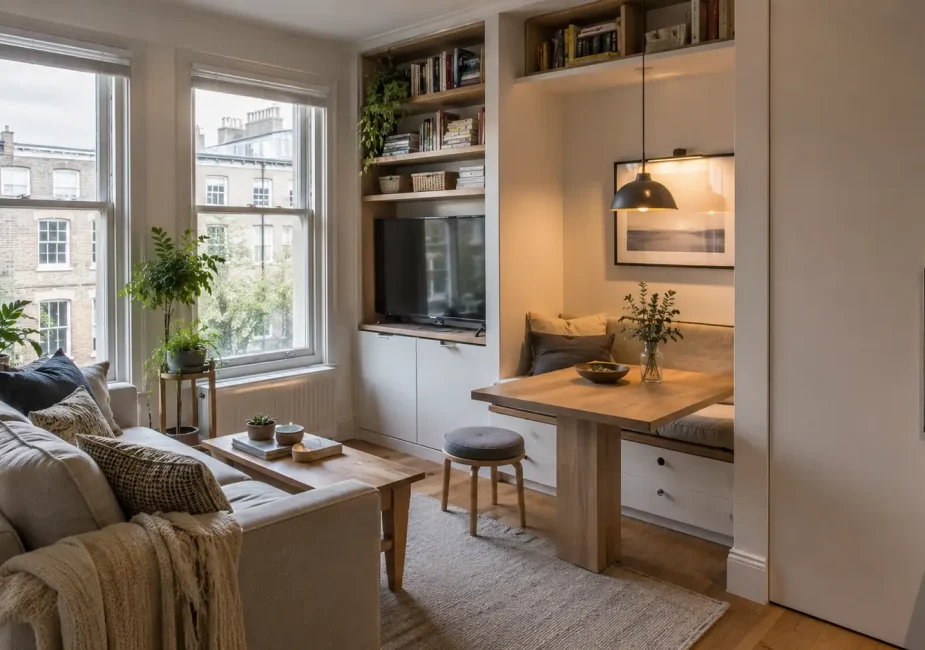
If you’ve ever stepped inside a London flat, you’ll know that space is a luxury most residents simply don’t have. The average one-bedroom apartment in the city hovers around 46 square metres, and in older conversions, it can be even less.
But what’s interesting is how little that seems to bother people who’ve lived there long enough.
Londoners have developed a whole toolkit of habits and design tricks that make compact living feel completely normal. Most of these translate perfectly to tight apartments in any major city.
We’ve pulled together the main ones, from vertical storage and flexible furniture through to a trick with off-site units that frees up more room than you’d expect.
Walls Do More Than Hold Up the Ceiling
In most London flats, you’ll spot shelving, hooks, pegboards, or wall-mounted storage within seconds of walking through the door. Floor space is too scarce to waste on anything that could hang instead.
Kitchens are a good example. Magnetic knife strips, hanging pot racks, and narrow floating shelves above the worktop are standard. They free up drawer and cupboard space for everything else.
The same logic applies to bedrooms. Wall-mounted bedside shelves replace bulky nightstands, and over-door hooks handle bags, coats, and dressing gowns without needing a wardrobe twice the size.
Even bathrooms get the treatment, with suction-mounted caddies and ladder shelves tucked into corners.
The key is thinking of your walls as usable surface area. If something can go up, it probably should.
Why Londoners Prefer Freestanding Furniture?
Built-in wardrobes and custom cabinetry sound appealing, but most London renters avoid them for a simple reason: they can’t take them with them. With the average tenancy lasting around two to three years, investing in permanent fixtures doesn’t make much sense.
Freestanding furniture is portable, resaleable, and often more flexible.
A narrow bookcase can serve as a room divider in one flat and fit into an alcove in the next. A rolling kitchen trolley works as extra worktop space today and a drinks cart when friends come over.
Londoners tend to pick furniture that earns its keep in more than one way, and that mindset will help in any small apartment.
Mirrors, Paint, and the Illusion of Depth
One trick you’ll see in almost every well-styled London flat is the use of mirrors to stretch a room. A large mirror placed opposite a window effectively doubles the natural light and makes the room feel significantly bigger.
It’s one of the cheapest design moves available, and it works every time.
Paint colour matters too. Lighter tones on walls and ceilings reflect more light, which opens up a space visually. Many London flats stick to off-whites, soft greys, and pale blues for this reason.
Darker accent walls can work, but they’re usually reserved for a single feature wall to add depth without closing the room in.
Even furniture colour plays a role. Lighter, slimmer pieces tend to make a room feel more open than heavy dark-wood units. It’s a small detail, but in a compact flat, small details add up fast.
External Storage as an Extension of the Home
Here’s something that surprises people who haven’t lived in London: a lot of residents treat off-site storage as a genuine part of their living setup. Seasonal clothes, sports equipment, suitcases, and sentimental items that don’t need daily access get moved out of the flat entirely.
It’s a practical decision that instantly frees up wardrobe and cupboard space.
South London has become a popular area for this, partly because transport links make it easy to get to a unit without half a day’s effort.
Residents near Clapham Junction, for example, can reach storage in Wandsworth within minutes, which means swapping winter coats for summer gear or pulling out holiday decorations doesn’t turn into a chore.
The broader lesson is that your home doesn’t need to hold everything you own. If you’re in a city with decent storage options nearby, using external space for things you only need a few times a year will make your day-to-day living area feel much more manageable.
A Smaller Space Doesn’t Have to Feel Like One
London’s housing market has forced millions of people to get resourceful with limited square footage, and the results are genuinely impressive.
The tricks aren’t complicated: go vertical, keep furniture flexible, use light and mirrors to your advantage, and don’t try to cram everything into your flat when off-site storage exists for a reason.
These aren’t London-specific ideas. They’ll work in a studio in New York, a one-bed in Sydney, or a compact apartment in any city where space comes at a premium. The real change is in how you think about a room, not how many square metres it gives you.