
Why Is OnBuy So Cheap in the UK? | 2026 Guide
 • November 19, 2025

OnBuy has become a noticeable alternative to larger online marketplaces in the UK, particularly for shoppers comparing prices on electronics, home products, toys, beauty products and everyday goods.
That has also created an obvious question: why is OnBuy so cheap compared with some other retailers and marketplaces?
There is not one single reason. OnBuy operates differently from a traditional retailer.
Independent sellers set their own prices and compete for customers, while the marketplace provides the technology connecting those retailers with shoppers.
Sellers can also use promotional tools, clear excess inventory and offer refurbished or older-generation products.
OnBuy has changed significantly since launching in 2016. It has introduced cashback, expanded internationally and developed seller tools designed to increase competition and customer retention.
Understanding this structure explains why prices can sometimes appear unusually low without automatically meaning there is something wrong with the product.
Why Is OnBuy So Cheap in the UK in 2026?
OnBuy’s prices are largely determined by the retailers selling through the marketplace rather than by one central retailer deciding what every product should cost.
This creates competition. If several sellers offer the same television, smartphone, toy or household appliance, each seller has an incentive to make its offer attractive. Price is one of the easiest ways to achieve that.
Several factors can therefore contribute to lower prices:
- Independent Seller Competition: Multiple retailers can compete for the same customers by adjusting their prices.
- Seller-Controlled Pricing: Individual retailers decide what they charge based on their own margins, stock levels and commercial strategy.
- Marketplace Structure: OnBuy operates as a platform connecting shoppers with retailers rather than relying on the traditional model of purchasing and holding all products itself.
- Clearance Stock: Sellers may reduce prices to move excess, discontinued or seasonal inventory.
- Older Product Generations: Previous models can become significantly cheaper after newer versions are released.
- Refurbished And Used Products: Some listings may cost less because the product is not factory-new.
- International Competition: Retailers operating in different countries can have different supply costs and pricing strategies.
- Cashback: Customers may receive value after purchasing, reducing the effective cost of shopping through the marketplace.
A cheap price therefore does not necessarily come from OnBuy directly discounting an item. In many cases, it is the result of individual sellers competing within the marketplace.
How Does OnBuy’s Business Model, Seller Fees and Features Keep Prices Competitive?
One of OnBuy’s important structural differences is its positioning as a marketplace that works with third-party retailers rather than competing against them through a large catalogue of its own retail inventory.
That distinction matters because sellers are not simultaneously competing against the marketplace operator for the same customer.
OnBuy’s seller structure also affects how retailers calculate prices.
According to its current seller pricing and marketplace information OnBuy seller pricing and marketplace information, the standard selling fee is 15% for most products, while certain categories use lower rates.
Consumer electronic devices and large appliances are currently listed at 7%. A minimum fee of £0.25 per product applies in the UK. The fee information was last modified in January 2026.
This does not mean OnBuy will always be cheaper for every retailer or category. Seller costs vary considerably depending on the product, marketing choices, delivery expenses and subscription package.
OnBuy also offers several features that influence competition.
OnBuy Boost
Boost allows sellers to increase the visibility of selected products. Sellers can choose a Boost level between 5% and 30% in addition to standard selling fees.
Unlike traditional pay-per-click advertising, sellers using Boost are charged when a promoted product sells rather than every time somebody clicks an advertisement.
OnBuy says Boost can provide enhanced placements, improved product rankings and offsite advertising.
That creates another route for sellers to compete. A retailer may accept a smaller margin on a highly competitive product if stronger visibility generates additional sales.
Sale Prices And Promotions
Sellers can also use promotions to make individual products more competitive. Retailers clearing inventory, responding to competitors or trying to increase sales volume may temporarily lower their prices.
That means prices can change between sellers and over time rather than remaining fixed across the marketplace.
Cashback
Cashback has become an important part of OnBuy’s proposition.
Instead of relying entirely on reducing the upfront product price, cashback gives customers value that can be used after making purchases.
This can make the overall shopping proposition more attractive even when the headline price is similar to another retailer.
The combination of seller competition, promotional tools and cashback means OnBuy does not depend on only one mechanism for creating value.
Why Can Some OnBuy Products Be Much Cheaper Than Other Retailers?
A particularly cheap product deserves a closer comparison because two listings that initially appear identical may not actually represent the same offer.
Clearance stock is one reason. Retailers do not want old inventory occupying warehouse space indefinitely. Reducing the price can free storage capacity and release money tied up in stock.
Seasonal products are particularly likely to be discounted when demand falls.
Technology provides another common example. When a new generation of smartphone, laptop, television or wearable launches, sellers holding previous-generation stock may cut prices quickly.
The older product can still be new and unused. It is simply no longer the newest model.
Refurbished products can also explain large price differences. A refurbished device has previously been returned, used or repaired before being prepared for resale. Its condition and warranty should therefore be checked carefully.
Individual sellers may also operate with different margins. One seller may have purchased stock at a lower wholesale price, while another may be willing to accept less profit to increase sales volume.
International sourcing creates additional variation. Different supplier relationships, currencies, distribution arrangements and regional pricing can all affect what a seller is able to charge.
The key point is that cheap does not automatically mean poor quality, but it also does not guarantee that two listings are completely identical.
How Has OnBuy Changed From Its 2016 Launch to 2026?

OnBuy was founded by Cas Paton in the UK in 2016 with a marketplace model designed around third-party retailers.
Its development since then shows how the business has moved beyond simply being another UK shopping website.
2016: OnBuy Launches
The company started as a British online marketplace connecting retailers with consumers.
Rather than building its strategy around becoming a major retailer itself, its model centred on providing the marketplace infrastructure sellers needed to reach shoppers.
2021: Expansion Funding
OnBuy raised £35 million in a Series A+ funding round in 2021 as it prepared for further growth.
The funding period helped strengthen its technology and longer-term international expansion ambitions.
2023: Cashback Becomes A Major Part Of The Model
One of OnBuy’s most significant strategic changes arrived in 2023 when it introduced cashback across purchases.
The company initially announced £10 million for customer rewards and positioned cashback as a way of rewarding returning shoppers rather than concentrating promotions solely on attracting new customers.
The change was important because OnBuy was no longer competing purely through marketplace prices. It was adding a loyalty mechanism intended to encourage customers to purchase again.
2023: First Profitable Month
Later in 2023, OnBuy announced that it had recorded its first profitable month. The company linked the milestone with wider platform improvements and plans for international expansion.
2025: International Expansion Accelerates
The company moved its headquarters from Bournemouth to London as part of a broader growth strategy and also established a presence in New York.
Its international ambitions subsequently became much more visible.
2026: OnBuy Reaches 21 European Markets
A major milestone arrived in March 2026 when the company announced launches in Sweden, Norway, Denmark, Poland, Hungary, Romania, the Czech Republic and Switzerland.
The expansion brought OnBuy’s European presence to 21 countries.
According to the company’s March 2026 European expansion announcement March 2026 European expansion announcement, its first 12 European markets recorded 152% quarterly sales growth, while average monthly visits increased by 300% during the second half of the measured period.
These are company-reported figures rather than independently audited market-share statistics.
Expansion matters for pricing because a larger marketplace can connect more retailers and customers across different countries.
Greater seller participation can increase product choice and price competition, although it does not guarantee that every product will become cheaper.
What Was OnBuy’s Biggest Business Model Change?
The introduction of cashback is arguably the clearest change to OnBuy’s original marketplace proposition.
When cashback launched in 2023, the company moved from mainly competing through marketplace choice, seller economics and prices towards a model combining price competition with customer rewards.
Cashback serves several commercial purposes.
First, it gives shoppers another reason to compare OnBuy with competing marketplaces.
Second, customers who accumulate cashback have an incentive to return and make another purchase.
Third, repeat customers can become more valuable to sellers because retailers may gain access to buyers who are already motivated to continue shopping within the marketplace.
OnBuy’s 2026 expansion statements continue to describe the company as a cashback marketplace, showing that the programme has become part of its wider company structure rather than remaining a temporary promotion.
For shoppers, however, it is important to separate the listed price from the effective value after cashback.
A retailer elsewhere may sometimes have the lowest immediate checkout price even when an OnBuy purchase generates cashback.
Is A Cheap OnBuy Listing Always A Like-For-Like Deal?
Not necessarily. Suppose one seller lists a smartphone for £420 while another retailer sells what appears to be the same phone for £500. The £80 difference may be genuine, but buyers should establish why it exists.
Check the full specification rather than relying only on the product name.
Storage capacity, colour, model generation and included accessories can change the price substantially.
Condition matters too. A new item, refurbished product and used product should not be compared as though they are identical.
Buyers should also examine warranty arrangements. An imported electronic product may come with different warranty support from a product intended specifically for the UK market.
Delivery charges can alter the calculation further. A £190 item plus £20 delivery is not necessarily a better deal than the same product offered for £205 with free shipping.
For a meaningful comparison, look at the total like-for-like cost, not simply the largest discount displayed next to a listing.
Is OnBuy Legit And Safe To Use In 2026?
OnBuy is an established UK-founded marketplace, but buyers should remember that individual retailers are responsible for fulfilling marketplace orders.
That means the experience can differ between sellers.
A retailer with a strong history of positive feedback, detailed product information and reliable fulfilment may provide a different experience from a newly established seller with limited feedback.
Before ordering, buyers should look at the seller rating and recent reviews rather than considering only OnBuy’s overall reputation.
There is also a distinction between the marketplace itself being legitimate and every product listing representing equal value. Large marketplaces can host many different retailers, so due diligence at seller and product level remains useful.
OnBuy provides a purchase-protection process for eligible orders. Its current OnBuy Protection policy says eligible items are automatically covered for up to 180 days after purchase, regardless of the payment method used.
Protection can apply when an order does not arrive, is not as described, arrives damaged or faulty, or when there is a problem receiving a refund. Buyers are normally expected to contact the seller first.
OnBuy can then become involved if the issue is not resolved.
That protection is useful, but it should complement rather than replace checking the seller and product before buying.
How Does OnBuy Compare With Amazon And eBay In 2026?
OnBuy, Amazon and eBay all connect third-party sellers with online shoppers, but their business structures are not identical.
| Feature | OnBuy | Amazon | eBay |
|---|---|---|---|
| Third-Party Sellers | Yes | Yes | Yes |
| Marketplace-Owned Retail Inventory | Not Central To Model | Yes | Generally No |
| Seller-Controlled Prices | Yes | Yes | Yes |
| New Products | Yes | Yes | Yes |
| Refurbished And Used Products | Available | Available | Available |
| Seller Ratings | Yes | Yes | Yes |
| Buyer Protection | Yes | Yes | Yes |
| Cashback-Led Marketplace Model | Yes | No | No |
OnBuy’s main structural distinction is that its marketplace proposition is built around partnering with retailers rather than competing heavily against those retailers through platform-owned inventory.
Amazon combines its marketplace with its own retail operations, while eBay has traditionally focused heavily on third-party sellers.
This does not make one marketplace universally cheaper. Prices should still be compared product by product because individual sellers, promotions, shipping costs and product conditions change constantly.
What Should You Check Before Buying A Very Cheap OnBuy Product?
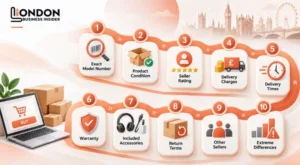
A substantial discount can be genuine, but the following checks can help establish whether the offer represents good value:
- Check The Exact Model Number: Small differences in generation or specification can create large price differences.
- Confirm the Product Condition: Establish whether the item is new, refurbished or used.
- Review the Seller Rating: Look beyond the overall score and read recent feedback.
- Check Delivery Charges: Include shipping when calculating the final price.
- Review Delivery Times: Particularly low prices may sometimes involve longer international shipping.
- Check the Warranty: Confirm who provides the warranty and how long it lasts.
- Check Included Accessories: Make sure chargers, cables or other expected components are included.
- Read the Return Terms: Understand the process before placing the order.
- Compare Other Sellers: Search for the same model across several reputable retailers.
- Question Extreme Differences: If one listing is dramatically cheaper than every comparable option, check the details carefully before buying.
An OnBuy product can therefore represent genuine value, but the strongest comparison is always based on specification, condition, delivery, warranty and seller reputation together.
Conclusion
So, why is OnBuy so cheap? The answer comes largely from how its marketplace operates rather than one universal discount policy.
Independent retailers control their own stock and prices, while competition encourages sellers to make their offers attractive.
Clearance stock, older product generations, refurbished items, international sourcing and promotional pricing can create further savings.
OnBuy has also changed substantially since its 2016 launch. Cashback has become a central part of its proposition, while its European expansion has increased the size of the marketplace and the potential number of competing sellers.
Cheap prices should still be assessed individually. Buyers should compare the exact model, condition, seller, warranty, shipping costs and returns terms before assuming two offers are identical.
When those factors match, a lower OnBuy price may simply reflect marketplace competition rather than a compromise in the product itself.
Frequently Asked Questions
Why Are OnBuy Prices So Low?
OnBuy is a marketplace where independent sellers control their own prices. Competition between retailers, clearance stock, seller promotions, refurbished products and different sourcing arrangements can all contribute to lower prices.
Does OnBuy Set Product Prices?
Prices are generally set by the independent retailers selling products through the marketplace. Different sellers can therefore offer the same or similar product at different prices.
Does OnBuy Hold Its Own Stock?
OnBuy’s marketplace model is built around connecting shoppers with third-party retailers rather than operating primarily as a traditional retailer buying and reselling its own inventory.
What Is OnBuy Cashback?
OnBuy Cashback rewards customers after qualifying purchases. Cashback can increase the effective value of a purchase and is also designed to encourage customers to return to the marketplace.
Is OnBuy Safe To Buy From In 2026?
OnBuy provides seller ratings, order-resolution processes and purchase protection for eligible products. Buyers should still check individual seller reviews, product descriptions, warranty details and return conditions before ordering.
Are OnBuy Products Shipped From The UK?
Not necessarily. OnBuy has both domestic and international marketplace activity. Buyers should check the individual listing for delivery estimates, seller information and any details affecting warranty or product compatibility.