DWP Pension Banking Rules 2026: What Bank Account Checks Mean for Pensioners?
 • November 17, 2025

The DWP pension banking rules discussed in 2026 mainly relate to new legal powers designed to help the Department for Work and Pensions identify potentially incorrect benefit payments using limited information held by banks and other financial institutions.
The rules come from the Public Authorities (Fraud, Error and Recovery) Act 2025, which received Royal Assent on 2 December 2025.
The legislation created the legal framework for Eligibility Verification Notices, commonly shortened to EVNs. The full legal framework can be found in the Public Authorities (Fraud, Error and Recovery) Act 2025.
An EVN can require a financial institution to check relevant accounts against eligibility indicators specified by DWP and provide permitted information when those conditions are met.
However, this does not give DWP unrestricted access to a pensioner’s online banking, nor does it create a live feed showing every purchase or transaction.
The distinction is particularly important because the phrase “DWP pension banking rules” can make it sound as though all people receiving a State Pension are affected. That is not the case.
Last Updated: 19.08.2026
Did New DWP Bank Account Rules Really Start In September 2025?
No universal set of DWP bank account checks for pensioners began in September 2025.
Claims linking the changes to a September 2025 start date appeared before the legislation establishing the Eligibility Verification Measure had even received Royal Assent.
The Public Authorities (Fraud, Error and Recovery) Act became law on 2 December 2025, while the DWP’s final Code of Practice for Eligibility Verification Notices was published on 14 May 2026.
The latest explicit government implementation update identified during this review, published on 24 June 2026, described the Eligibility Verification Measure as a power that would be operational in future. The Code itself provides for an initial Test and Learn phase involving a small number of financial institutions before any broader rollout.
People concerned about wider DWP bank account checks in 2026 should therefore distinguish between powers that exist in law and the operational rollout of those powers.
Does DWP Monitor State Pension Bank Accounts?
Receiving the State Pension does not by itself mean that a person’s savings are being means-tested under the new Eligibility Verification Measure.
The State Pension and Pension Credit are different benefits.
The State Pension is primarily based on a person’s National Insurance record. Pension Credit is an income-related benefit intended to provide additional support to eligible people who have reached State Pension age.
This means a pensioner could receive the State Pension without receiving Pension Credit.
The difference has become even more important following the 2026 State Pension increase, as changes to State Pension rates should not be confused with the separate financial eligibility rules applying to Pension Credit.
State Pension Vs Pension Credit
Feature State Pension Pension Credit
Based Mainly On National Insurance record Income and financial circumstances
Means-Tested No Yes
Savings Can Affect Amount No Yes
Included In Current EVM Benefit List No Yes, as State Pension Credit
The current Eligibility Verification Code identifies State Pension Credit, rather than the State Pension generally, as one of the relevant benefits.
Which Benefits Are Covered By The Eligibility Verification Measure?
The current Code of Practice specifies three relevant benefits for the Eligibility Verification Measure:
- Universal Credit
- State Pension Credit
- Employment And Support Allowance
No other benefits are currently listed within the measure in the Code.
That distinction matters because discussions of DWP bank checks sometimes suggest that every benefit administered by DWP is included automatically.
It is also important not to confuse these bank-checking powers with wider changes to the welfare system. For example, the movement of some legacy claimants onto Universal Credit is a separate process covered by the site’s information on DWP benefit closures and Universal Credit migration.
How Do DWP Eligibility Verification Notices Work?
An Eligibility Verification Notice is a statutory notice that DWP can issue to a qualifying financial institution.
Rather than DWP logging into an individual’s bank account, the financial institution checks information already held within its own systems against eligibility indicators specified in the notice.
A simplified process looks like this:
- DWP Issues an EVN: A qualifying financial institution receives an Eligibility Verification Notice containing specified requirements.
- The Financial Institution Applies the Indicators: Relevant account data is checked against the eligibility criteria contained in the notice.
- Permitted Information Is Returned: Where an account meets the specified indicator, limited information can be supplied to DWP.
- DWP Reviews The Result: The information does not itself determine that fraud or an incorrect payment has occurred.
- Further Checks May Follow: DWP may investigate the circumstances before making a decision affecting entitlement.
The official Eligibility Verification Notices Code of Practice explains the requirements surrounding necessity, proportionality, safeguards and the use of information obtained through the measure.
What Role Do Banks And Building Societies Have?
Banks and other qualifying financial institutions do not simply hand DWP unrestricted access to customer accounts.
Their role under an EVN is to apply the specified eligibility indicators to relevant information and return only data that can lawfully be supplied.
This is different from DWP independently browsing a claimant’s bank account.
What Information Can Banks Share With DWP?
An EVN can require permitted information connected with an account, an account holder and the way an account meets an eligibility indicator.
Examples can include relevant identifying and account information required under the notice. The legislation also places restrictions on what DWP can demand and what financial institutions can provide.
Type Of Information Position Under An EVN
Relevant Account Details May Be Provided
Account Holder Information May Be Provided Where Permitted
Information Showing An Eligibility Indicator Is Met May Be Provided
Individual Transaction Details Cannot Be Required Through An EVN
Full Spending History Cannot Be Required Through An EVN
Online Banking Login Not Provided
This is why questions about whether the DWP can check a bank account without permission need a qualified answer. DWP can obtain certain financial information where Parliament has provided lawful authority, but that is very different from unrestricted bank account access.
Can DWP See Bank Transactions Or Spending?
An Eligibility Verification Notice cannot be used to obtain transaction information showing what somebody purchased, the amount of an individual transaction or the person or organisation they paid.
The Code specifically restricts the provision of transaction information through this process.
However, an EVN should not be confused with every other type of DWP check.
For example, during certain benefit reviews a claimant may be asked directly to provide bank statements. Separate information-gathering powers may also apply during a targeted fraud investigation.
The important question is therefore which DWP process is being used.
An EVN, a claimant-supplied bank statement and a targeted fraud investigation do not provide DWP with identical information.
How Much Savings Can A Pension Credit Claimant Have?
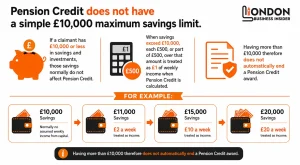
Pension Credit does not have a simple £10,000 maximum savings limit.
If a claimant has £10,000 or less in savings and investments, those savings normally do not affect Pension Credit.
When savings exceed £10,000, each £500, or part of £500, over that amount is treated as £1 of weekly income when Pension Credit is calculated.
For example:
- £10,000 Savings – Normally no assumed weekly income from capital
- £11,000 Savings – £2 a week treated as income
- £15,000 Savings – £10 a week treated as income
- £20,000 Savings – £20 a week treated as income
Having more than £10,000 therefore does not automatically end a Pension Credit award.
Is There A £16,000 Savings Limit For Pension Credit?
There is no general £16,000 capital cut-off for Pension Credit.
The £16,000 figure is commonly associated with Universal Credit capital rules, which is one reason inaccurate information about Pension Credit can spread online.
Pension Credit Vs Universal Credit Savings Rules
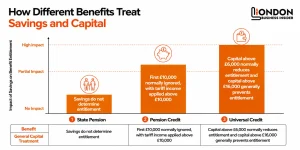
Benefit General Capital Treatment
Pension Credit First £10,000 normally ignored, with tariff income applied above £10,000
Universal Credit Capital above £6,000 normally reduces entitlement and capital above £16,000 generally prevents entitlement
State Pension Savings do not determine entitlement
Individual circumstances and disregarded forms of capital can affect the calculation, so claimants should check the rules applying to their own benefit before making financial decisions.
What Happens If A Bank Account Is Flagged By DWP?
Meeting an eligibility indicator is not proof of benefit fraud.
The Eligibility Verification Measure is intended to identify cases that may require further checking. It does not make the final decision about whether the person still satisfies the conditions of their benefit.
Human involvement remains necessary before an entitlement decision is made. DWP’s published position also states that automated analysis does not replace human judgement in decisions about benefit entitlement or payment.
Further action could include contacting the claimant, checking records or requesting supporting evidence where there is a lawful basis to do so.
Does A Bank Flag Automatically Stop Benefits?
No. A matching indicator by itself should not be treated as an automatic finding that a claimant has done something wrong.
Further checks are required before DWP determines whether the information affects entitlement.
If the information is explained by the claimant’s circumstances or by capital that should be disregarded under the benefit rules, entitlement may remain unchanged.
Who Is Most Likely To Be Affected By The New Bank Account Checks?
The Eligibility Verification Measure is most relevant to people receiving benefits where financial circumstances can affect entitlement.
For pensioners, Pension Credit is therefore much more relevant to these rules than the State Pension itself.
The system may potentially identify situations where financial information appears inconsistent with an eligibility condition. However, an indicator is designed to prompt verification rather than establish wrongdoing automatically.
Pensioners who receive only the State Pension should not assume that the new measure introduces a general savings test for their pension.
What Privacy And Data Protection Safeguards Apply?
The banking powers have attracted scrutiny because they involve government use of financial information.
Under the statutory framework, an Eligibility Verification Notice must be considered necessary and proportionate before it is issued. Restrictions also apply to the information that can be requested and supplied.
Human Review And Decision-Making
Information returned under an EVN is intended to identify potentially incorrect payments. It is not supposed to replace consideration of an individual’s circumstances before a benefit decision is made.
Limits On The Information Banks Can Provide
Transaction-level spending information cannot be supplied through the EVN process.
The measure is therefore not equivalent to DWP receiving a continuous view of everything somebody does with their bank account.
Concerns About Privacy And Proportionality
The new powers have nevertheless faced parliamentary scrutiny.
The House of Commons Public Accounts Committee warned in February 2026 that the new bank-checking powers must be used effectively and proportionately, highlighting the importance of maintaining public confidence.
Further detail is available through the Public Accounts Committee’s examination of DWP’s bank account checking powers.
This makes it important to distinguish between the Government’s objective of identifying incorrect benefit payments and the legitimate questions raised about privacy, safeguards and proportionality.
What Should Pension Credit Claimants Do If Their Savings Change?
Pension Credit recipients should keep information about their circumstances accurate and report relevant changes when required.
Changes that may matter include:
- Savings Or Investments Increasing
- Receiving An Inheritance Or Large Sum
- Changes To Pension Income
- Changes To Household Circumstances
- Moving Into Or Out Of Certain Types Of Accommodation
- Changes Affecting Other Income
There should not be an assumption that every increase above £10,000 ends Pension Credit. Instead, the amount above £10,000 can create tariff income that forms part of the entitlement calculation.
Anyone unsure which DWP service to contact can check the site’s updated DWP contact numbers and opening times before providing personal information or discussing a claim.
What Should Pensioners Do If DWP Contacts Them?
Receiving correspondence from DWP does not necessarily mean somebody is accused of benefit fraud.
The first step should be to establish whether the communication is genuine and what information is actually being requested.
Checking Whether The Contact Is Genuine
A pensioner should avoid responding through an unfamiliar link contained in an unexpected message. Contact details should be checked independently through an official channel if there is any doubt.
Providing Requested Evidence
Where DWP lawfully requests evidence, the claimant should:
- Read The Request Carefully
- Check Which Documents Are Required
- Check The Deadline Given By DWP
- Provide Accurate Information
- Keep Copies Of Documents Sent
- Keep Relevant Letters And References
Challenging A DWP Decision
An eligibility indicator does not remove a claimant’s normal rights to challenge a benefit decision.
For Pension Credit, a person who believes a decision is wrong can generally ask DWP to reconsider it through the mandatory reconsideration process before proceeding to an appeal where appropriate.
Independent welfare rights advice may also be useful where substantial payments, overpayments or disputed savings are involved.
What Has Changed Most Recently In 2026?
The main developments are legal and procedural rather than a sudden introduction of universal pensioner bank surveillance.
Public Authorities (Fraud, Error And Recovery) Act 2025
The Act received Royal Assent on 2 December 2025, providing the statutory framework for Eligibility Verification Notices.
2026 Eligibility Verification Code Of Practice
DWP published the final EVN Code of Practice on 14 May 2026.
It provides guidance on areas including:
- How EVNs Operate
- Roles Of Financial Institutions
- Necessity And Proportionality
- Information Restrictions
- Safeguarding
- Human Oversight
- Test And Learn Implementation
Test And Learn Rollout
The Code provides for DWP to begin using the system with a small number of financial institutions during a Test and Learn phase before broader implementation.
However, a subsequent GOV.UK announcement published on 24 June 2026 described the Eligibility Verification Measure as one of the PAFER Act powers that would become operational in future.
Therefore, the safest position as of August 2026 is not to claim that every bank or every relevant claimant is already subject to continuous automated monitoring.
What Should Pensioners Do Now?
Most pensioners do not need to change how they manage an ordinary bank account simply because of headlines about DWP banking rules.
Practical steps include:
- Keep Personal Details Accurate – Make sure DWP has current information where a change is relevant to a benefit claim
- Report Relevant Changes – Pension Credit recipients should report changes that could affect entitlement
- Keep Financial Records – Retain evidence relating to significant savings, investments, inheritances and pension income
- Check DWP Correspondence – Read requests carefully and verify unexpected communications
- Understand The Benefit Involved – State Pension and Pension Credit have different eligibility rules
- Do Not Assume A Flag Means Fraud – An eligibility indicator may lead to further checks rather than an automatic penalty
- Seek Advice When Necessary – Independent benefits advice can help where entitlement or an overpayment is disputed
Conclusion
The DWP pension banking rules in 2026 are more limited and structured than some headlines suggest.
The Public Authorities (Fraud, Error and Recovery) Act 2025 created a legal framework allowing DWP to use Eligibility Verification Notices to obtain limited information from financial institutions for specified benefits.
The current relevant-benefit list includes Universal Credit, State Pension Credit and Employment and Support Allowance.
This does not mean that every State Pension recipient has become subject to a savings test or that DWP has unrestricted access to pensioners’ bank accounts.
Transaction information cannot be obtained through an EVN, and information returned under the system does not automatically establish fraud.
Pension Credit recipients should pay particular attention to their financial circumstances. Savings above £10,000 can affect the calculation, but there is no general £16,000 Pension Credit savings cut-off.
As the system develops, pensioners should rely on current official information and distinguish confirmed legislation from claims about universal or continuous bank monitoring.
Frequently Asked Questions
Can DWP Check A Pensioner’s Bank Account In 2026?
DWP has legal powers that can allow limited financial information to be obtained in specified circumstances. However, this does not provide unrestricted access to a pensioner’s online banking or transaction history.
Does DWP Check Everyone Receiving State Pension?
No. Receiving the State Pension alone is not the same as receiving a means-tested benefit. The current Eligibility Verification Measure lists State Pension Credit rather than the State Pension generally.
Is Pension Credit Affected By The New Bank Account Rules?
Yes. State Pension Credit is one of the benefits currently specified for the Eligibility Verification Measure.
Can DWP See What A Pensioner Spends Money On?
Not through an Eligibility Verification Notice. Transaction information revealing individual purchases, transaction amounts or payment recipients cannot be required through the EVN process.
How Much Can A Pension Credit Claimant Have In Savings?
Savings of £10,000 or less normally do not affect Pension Credit. Above £10,000, every £500 or part of £500 is normally treated as £1 of weekly income. There is no general £16,000 Pension Credit savings cut-off.
Will Benefits Stop Automatically If A Bank Account Is Flagged?
No. Meeting an eligibility indicator does not automatically prove that a benefit payment is incorrect or fraudulent. Further consideration is required before an entitlement decision is made.
Can A Pensioner Challenge A DWP Decision?
Yes. Where DWP makes a benefit decision that the claimant believes is incorrect, established challenge rights remain available. For Pension Credit, this can include asking for a mandatory reconsideration before progressing to an appeal where applicable.