
HMRC Name and Shame Full Disclosure: Rules, Penalties and 2026 Changes
 • August 10, 2026

HMRC name and shame full disclosure can reduce the risk of publication where the taxpayer receives the maximum reduction for quality of disclosure.
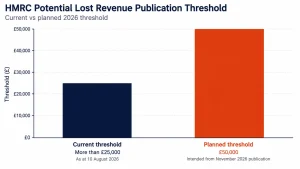
HMRC still has to apply the wider PDDD rules before publishing any details. As at 10 August 2026, the current qualifying Potential Lost Revenue threshold remains more than £25,000.
Full Disclosure Matters:
HMRC looks at how fully the taxpayer tells, helps and gives access to relevant records. A complete disclosure can affect whether a penalty qualifies for publication.
The Rules Apply to Deliberate Defaults:
The HMRC name and shame regime is aimed at qualifying deliberate tax defaults, not every tax mistake or underpayment.
The Current Threshold Is £25,000:
Qualifying Potential Lost Revenue must currently exceed £25,000. The government intends to raise this to £50,000 from the November 2026 publication, subject to implementation.
Publication Is Not Automatic:
Even where deliberate behaviour is involved, HMRC must still satisfy the relevant PDDD conditions before publishing a taxpayer’s details.
What Is the HMRC Name and Shame Scheme?

“HMRC name and shame” is the commonly used description for Publishing Details of Deliberate Defaulters (PDDD).
Section 94 of the Finance Act 2009 allows HMRC to publish identifying information about people or businesses that have incurred qualifying penalties for deliberate tax defaults.
HMRC’s current guidance covers deliberate inaccuracies in tax returns, deliberate failures to comply with certain tax obligations, and specified VAT or excise wrongdoings.
What is PDDD?
PDDD is a civil tax compliance publication regime. It is not simply a list of everyone who owes HMRC money or has made a tax mistake.
The current HMRC deliberate defaulters list concerns taxpayers who have incurred penalties arising from deliberate conduct and meet the publication criteria.
HMRC states specifically that this list relates to civil proceedings and does not contain criminal convictions recorded following prosecution in open court.
Who Do the Rules Apply to?
The regime can apply to individuals and businesses. A relevant penalty may arise from a deliberate or deliberate-and-concealed inaccuracy, certain deliberate failures to meet tax obligations, or qualifying VAT and excise wrongdoings.
The crucial distinction is behaviour. A careless error is not automatically the same as a deliberate default for PDDD purposes.
Who Can Be Included on the HMRC Deliberate Defaulters List?
HMRC does not publish somebody merely because additional tax becomes payable. The publication regime applies only when a series of specific conditions is met.
Deliberate Tax Defaults
HMRC’s PDDD guidance describes a deliberate default as an inaccuracy, failure, omission or wrongdoing giving rise to a relevant penalty.
A deliberate inaccuracy includes an inaccuracy in a tax return or other document caused by deliberate or deliberate-and-concealed behaviour.
Deliberate and Concealed Behaviour
HMRC penalty rules distinguish between careless, deliberate and deliberate-and-concealed inaccuracies. These classifications can lead to different maximum and minimum penalty ranges and therefore should not be treated as interchangeable.
Careless Mistakes Versus Deliberate Behaviour
A careless tax error does not automatically make a taxpayer a deliberate defaulter. HMRC must consider the behaviour underlying the relevant inaccuracy or failure.
Making a disclosure also does not, by itself, prove that the original behaviour was careless or deliberate. HMRC guidance requires the underlying facts and circumstances to be considered.
What is a Qualifying Relevant Penalty?
For HMRC name and shame purposes, HMRC defines a qualifying relevant penalty as a relevant penalty for which the taxpayer did not receive the maximum reduction for quality of disclosure.
That makes the quality and timing of disclosure particularly important where deliberate behaviour has been established.
HMRC Name and Shame Full Disclosure: How Disclosure Affects Publication?
HMRC assesses disclosure through the taxpayer’s actions, rather than simply whether they use the words “full disclosure”.
| Disclosure factor | What HMRC considers | Why it matters |
|---|---|---|
| Telling | Whether the taxpayer tells HMRC about the issue and explains it sufficiently | Forms part of the quality-of-disclosure assessment |
| Helping | Reasonable assistance in establishing and quantifying the tax position | Better cooperation can increase the disclosure reduction |
| Giving access | Access to relevant business records and other documents | Allows HMRC to verify and correct the position |
| Timing | When the disclosure is made and whether it is prompted or unprompted | Can affect the applicable penalty range |
| Completeness | The extent to which relevant information is disclosed | Incomplete disclosure may prevent the maximum reduction |
HMRC broadly weights telling at up to 30%, helping at up to 40% and giving access at up to 30% when assessing the quality of disclosure for inaccuracies. Special rules can also apply to offshore matters.
Maximum Reduction for Quality of Disclosure
This is the central point behind HMRC name and shame full disclosure.
HMRC’s Publishing Details of Deliberate Defaulters guidance says a taxpayer’s information will not be published where the person earns the maximum penalty reduction by fully disclosing the defaults.
Its internal manual frames the same issue through the qualifying-relevant-penalty test.
When Incomplete Disclosure May Increase Publication Risk?

If HMRC decides that the taxpayer has not told it enough, provided reasonable help or supplied appropriate access to records, the maximum quality-of-disclosure reduction may not be available.
That does not automatically mean publication will follow. HMRC must still satisfy all the remaining PDDD conditions.
Prompted vs Unprompted Disclosure
Whether a disclosure is prompted or unprompted can affect the penalty range.
An unprompted disclosure is generally made before the taxpayer has reason to believe HMRC has discovered, or is about to discover, the issue.
A disclosure made after an HMRC compliance check has started will not necessarily qualify as unprompted simply because it is made early in that check. HMRC can instead take early and complete cooperation into account when considering the quality of disclosure.
For ordinary onshore inaccuracies, different minimum penalty percentages can apply depending on whether a qualifying disclosure is prompted or unprompted.
Individual cases depend on the applicable legislation, behaviour and facts.
A voluntary disclosure therefore does not create an automatic guarantee that a person can never appear on the HMRC name and shame list. The precise PDDD and penalty conditions still have to be applied.
What Is the HMRC Name and Shame Threshold?
As at 10 August 2026, the current HMRC publication test remains based on qualifying Potential Lost Revenue exceeding £25,000.
The government has announced that this threshold is intended to rise to £50,000 from the November 2026 PDDD publication, but the operative date is subject to the secondary legislation required to make the change.
| Rule | Position at 10 August 2026 | What it means |
|---|---|---|
| Current PDDD threshold | Qualifying PLR must exceed £25,000 | This remains the test in current HMRC guidance |
| Announced new threshold | £50,000 | Government intends this to apply from the November 2026 PDDD publication |
| Implementation | Subject to secondary legislation | The £50,000 figure should not yet be described as the current threshold |
| Relevant calculation | Qualifying Potential Lost Revenue | It is calculated by reference to qualifying relevant penalties from the relevant investigation |
What is Potential Lost Revenue?
Potential Lost Revenue, commonly abbreviated to PLR, is an HMRC penalty concept representing tax put at risk by particular inaccuracies, failures or wrongdoings.
For PDDD, HMRC looks specifically at PLR relating to qualifying relevant penalties. Where more than one qualifying penalty arises from the same investigation, qualifying PLR can be considered for the publication threshold in accordance with HMRC’s rules.
Current £25,000 Threshold
Current HMRC guidance and section 94 of the Finance Act 2009 state that the qualifying PLR must exceed £25,000 before the relevant financial publication condition is satisfied.
Announced £50,000 Threshold Change in 2026
The government announced in July 2026 that the threshold will increase from £25,000 to £50,000 to focus publication on more serious deliberate non-compliance.
The policy states that the higher threshold is intended to apply from the November 2026 PDDD publication, with separate secondary legislation implementing the change.
HMRC Name and Shame Rules: Five Questions That Determine Publication
HMRC says all five publication questions must be answered yes before a person’s details can be considered for publication.
Is There a Relevant Penalty?
It must be a qualifying type of penalty involving deliberate or deliberate-and-concealed behaviour, including specified inaccuracies, failures or VAT and excise wrongdoings.
Does It Relate to the Required PDDD Period?

The relevant penalty must relate to the periods covered by the PDDD legislation. Current HMRC guidance generally refers to qualifying inaccuracies in periods beginning on or after 1 April 2010 or qualifying failures and wrongdoings occurring on or after that date.
Did It Arise From an HMRC Investigation?
The relevant penalty must have been found as a consequence of an investigation. For this purpose, HMRC says an investigation includes checks by an HMRC officer into a person’s tax affairs.
Is It a Qualifying Relevant Penalty?
The maximum reduction for quality of disclosure must not have been given.
Does Qualifying PLR Exceed the Threshold?
Under the rules currently reflected in HMRC guidance and legislation, qualifying PLR must exceed £25,000.
Even when all five tests are satisfied, HMRC’s specialist team makes the publication decision after the relevant penalties have become final. HMRC says a penalty becomes final after the appeal period ends without an appeal, once an appeal is finally determined, or when a contract settlement is made.
What Could Actually Appear on HMRC’s Name and Shame List?
Explore a fictional public entry, see which information HMRC may publish and compare today’s rules with the announced 2026 change.
Deliberate Defaulter Entry
Where publication conditions are met, HMRC can publish identifying information such as the taxpayer’s name, trading name and an appropriate address.
How Long Can the Entry Stay Public?
Move the slider through the possible publication period. HMRC states that details can remain published for a maximum of 12 months from first publication.
What Information Can HMRC Publish?
Personal, Business and Tax Details
Where the criteria are met, current law allows HMRC to publish information including a person’s name and trading name, address, nature of business, qualifying penalties, qualifying PLR and the periods in which the relevant default occurred.
HMRC says the information published should be limited to what is required to identify the taxpayer. Depending on the circumstances, an address can be a business address or a registered office in the case of a company.
What the Published Figures Actually Mean?
An important point is that the figures shown on the HMRC deliberate defaulters list do not necessarily represent the taxpayer’s complete default.
HMRC says published amounts relate to tax or duty on which qualifying penalties are based and to the penalties that meet the publication criteria. The list may therefore not represent the full default of the taxpayer.
How Long Does HMRC Keep Someone on the Name and Shame List?
A deliberate defaulter’s details can remain on GOV.UK for a maximum of 12 months from the date of first publication.
HMRC also says that, where publication is permitted, the relevant penalties must first become final before details can be published.
Being removed from the public list after the publication period does not itself mean that the underlying tax, penalty or compliance history has disappeared.
Does HMRC Warn You Before Publishing Your Details?
Yes. Where HMRC’s specialist team considers publication appropriate, HMRC says it will tell the person that it intends to publish their name and details and provide a reasonable opportunity to make representations.
HMRC’s internal guidance says it will normally allow 30 days for those representations, although the period can be extended where there is good reason.
Representations can explain why some or all of the information should not be published. HMRC can consider the circumstances raised before making the publication decision.
There is no separate appeal to the tax tribunal against HMRC’s publication decision.
However, taxpayers retain appeal rights over matters including the calculation of tax due or PLR, whether a penalty is due and the amount of the penalty. HMRC says the decision to publish can instead be challenged through judicial review.
HMRC Name and Shame Changes in 2026
HMRC’s name and shame rules are undergoing reform in 2026, but it is important not to describe every announced measure as already being in force.
Increase to the £50,000 Threshold
The government intends to increase the publication threshold from £25,000 to £50,000 qualifying Potential Lost Revenue from the November 2026 publication.
The policy document states that separate secondary legislation will implement the higher threshold.
Additional Information HMRC May Publish
Draft reforms published in July 2026 would allow HMRC to publish more information about the deliberate non-compliance that resulted in publication, including further details of the conduct involved.
The government says these expanded publication provisions form part of the Finance Bill 2026–27 reforms.
A UK Parliament statement on the draft Finance Bill also records the plan to publish more information about the deliberate non-compliance and increase the publication threshold to £50,000 PLR.
Company officers and Personal Liability Notices
The same reform package proposes allowing HMRC to publish details associated with Personal Liability Notices where the legislative conditions are satisfied.
Again, this forms part of the 2026 reform package rather than something that should be confused with the existing section 94 publication rules.
Common Misunderstandings About HMRC Name and Shame
“Every tax mistake leads to publication”
No. PDDD is focused on qualifying deliberate tax defaults. A careless error is not automatically a deliberate default.
“Any voluntary disclosure guarantees anonymity”
No. Timing matters, but so does the quality of disclosure and the specific penalty regime involved. HMRC must assess the relevant disclosure and the remaining PDDD conditions.
“The £50,000 threshold already applies”
Not as at 10 August 2026. Current legislation and HMRC guidance still specify a qualifying PLR threshold exceeding £25,000. The government intends £50,000 to apply from the November 2026 publication through separate secondary legislation.
“Published figures show everything the taxpayer owes”
Not necessarily. HMRC explicitly warns that published figures do not necessarily represent the taxpayer’s full default.
“Everyone on the list has been criminally convicted”
No. The PDDD regime concerns civil tax penalties and should not be treated as a list of criminal convictions.
What Should You Do If You Discover a Tax Irregularity?
The appropriate action depends on the type of tax, what happened, whether the behaviour may have been deliberate, the amounts and periods involved, and whether HMRC has already contacted you.
A taxpayer considering disclosure should establish the facts, preserve relevant accounting and tax records, determine which disclosure route may apply, and make sure any information supplied is accurate and complete.
Because HMRC takes account of disclosure quality when determining penalties, delaying or providing incomplete information can affect the penalty position.
Where significant tax, deliberate conduct, offshore issues or an existing HMRC investigation is involved, specialist tax advice may be appropriate before making representations or submitting a disclosure.
Conclusion: HMRC Name and Shame Full Disclosure Explained
HMRC name and shame full disclosure is best understood as part of the wider Publishing Details of Deliberate Defaulters regime rather than as a separate HMRC scheme.
Full disclosure matters because HMRC considers the quality of disclosure when reducing penalties.
For PDDD, a relevant penalty on which the maximum quality-of-disclosure reduction has not been obtained can become a qualifying relevant penalty. HMRC must then apply the remaining publication tests, including the qualifying PLR threshold.
For now, the current threshold remains more than £25,000 qualifying PLR. The government intends to increase it to £50,000 from the November 2026 publication, subject to implementation, alongside wider reforms to the information HMRC can publish.
Frequently Asked Questions
What does HMRC name and shame full disclosure mean?
It generally refers to the relationship between making a complete disclosure to HMRC and the Publishing Details of Deliberate Defaulters regime. HMRC says details are not published where the taxpayer receives the maximum reduction of the relevant penalties through full disclosure.
Can full disclosure stop HMRC publishing my name?
Potentially. Receiving the maximum reduction for quality of disclosure can prevent a relevant penalty from becoming a qualifying relevant penalty under the PDDD test. The exact outcome depends on the applicable penalty and facts.
What is the HMRC deliberate defaulters list?
It is HMRC’s public list of individuals and businesses whose cases meet the Publishing Details of Deliberate Defaulters criteria. It relates to civil tax penalties rather than being a general list of everyone with unpaid tax.
What counts as full disclosure to HMRC?
HMRC assesses disclosure through factors including telling HMRC about the issue, providing reasonable help and giving access to relevant records. The nature, extent and timing of the disclosure can affect the penalty reduction.
What is the HMRC name and shame threshold?
As at 10 August 2026, current legislation and HMRC guidance require qualifying PLR to exceed £25,000.
Is the HMRC threshold increasing to £50,000?
The government has announced that the PDDD threshold is intended to increase to £50,000 from the November 2026 publication, with separate secondary legislation implementing the change.
Does an unprompted disclosure prevent HMRC publication?
Not automatically. An unprompted disclosure can affect penalty treatment, while the quality of disclosure influences the available penalty reduction. PDDD publication still depends on the statutory publication conditions.
Can HMRC name you after a voluntary disclosure?
It depends on the facts and the resulting penalty position. Simply making a voluntary disclosure is not the same as automatically receiving the maximum reduction for quality of disclosure.