
Flexible Support Fund Universal Credit 2026: Who Can Get Help and What Has Changed
 • October 23, 2026

The Flexible Support Fund can provide financial help when an eligible Universal Credit claimant faces a practical cost that is preventing them from finding work, starting a job, increasing their earnings or moving closer to employment.
It is not an extra Universal Credit payment automatically added to a claimant’s monthly award.
Instead, the fund is administered through Jobcentre Plus, with work coaches able to consider support according to the claimant’s circumstances and the employment barrier they are facing.
In October 2026, the Department for Work and Pensions confirmed that the Flexible Support Fund can help with employment-related costs including travel, work clothing, tools and equipment. Support remains discretionary and is assessed individually.
That distinction is important because a claimant’s normal Universal Credit award follows separate rules. Changes to the Universal Credit benefit rates for 2026 to 2027 affect the underlying benefit calculation, while the Flexible Support Fund is designed to address particular barriers connected with employment.
How Does the Flexible Support Fund Work for Universal Credit Claimants?
The Flexible Support Fund is a locally managed Jobcentre Plus budget that gives work coaches some flexibility to deal with employment barriers that cannot easily be addressed through a standard benefit payment.
Current GOV.UK guidance says it can be considered where a claimant needs help to search for work, accept a firm job offer or move into self-employment.
It can also support training or education that helps move someone closer to employment.
This means the fund is based on need and purpose, rather than Universal Credit entitlement alone.
Someone may receive Universal Credit but have no current reason to access the fund. Another claimant may be offered work but face an immediate cost for transport, equipment or childcare that they cannot afford before their first wage arrives.
In that situation, the work coach can consider whether Flexible Support Fund assistance is appropriate.
The claimant does not automatically receive a set amount. The work coach considers whether the cost is necessary, whether it is reasonable and whether another organisation or funding scheme could meet it first.
DWP confirmed in March 2026 that work coaches are expected to check other possible sources of funding before making an award so that Flexible Support Fund spending does not duplicate support already available elsewhere.
This also separates the fund from broader changes affecting claimants moving onto Universal Credit.
The continuing closure of legacy DWP benefits and migration to Universal Credit concerns the benefit someone claims, while Flexible Support Fund assistance concerns particular employment-related costs after individual assessment.
What Can the Flexible Support Fund Pay For?
There is no single list guaranteeing that every cost will be approved. However, official DWP guidance identifies several expenses that can fall within the fund where they are necessary to remove a barrier to work.
- Travel Costs: Help may be considered for employment-related travel, including journeys associated with interviews, training or starting work.
- Work Clothing: Suitable clothing required for an interview or the beginning of employment may be funded where the claimant cannot reasonably meet the cost.
- Tools And Equipment: Essential tools or equipment required to start or undertake work may qualify.
- Training And Education: Relevant training may be considered where it helps a claimant move closer to employment and appropriate funding is not available elsewhere.
- Upfront Childcare Costs: Eligible parents may receive support with childcare costs that have to be paid before they can start work or increase their hours.
Official guidance also distinguishes ordinary work clothing from safety equipment that an employer is legally responsible for providing.
The fund is therefore not intended to function as general emergency income.
Someone struggling with food, energy or general household bills may need a different type of support. This is separate from the wider financial assistance discussed in relation to the DWP Cost of Living Payment and household support available in 2026.
The same distinction applies to reductions caused by the benefit cap. The impact of the DWP benefit cap on household income concerns the amount of benefit a household can receive, rather than whether a work coach can fund a particular employment barrier through the Flexible Support Fund.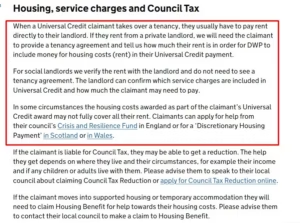
GOV.UK guidance confirms that Flexible Support Fund assistance can cover training, interview clothing, essential work equipment and travel costs.
How Can the Fund Help With Childcare?
Childcare has become one of the most important uses of the Flexible Support Fund for working parents on Universal Credit.
Universal Credit normally allows eligible working parents to reclaim up to 85% of qualifying registered childcare costs, subject to the applicable limits and rules.
However, that system can create a cash-flow problem because a provider may require payment before the parent receives wages or reimbursement.
The Flexible Support Fund can help bridge that gap.
In April 2026, DWP confirmed that its Upfront Childcare Costs provision can pay 100% of up to one month of upfront childcare costs where an eligible parent needs the support to move into work or increase their working hours.
The department also said it was streamlining the process and extending eligibility to parents returning from parental leave.
A later Parliamentary answer in September 2026 confirmed that eligible Universal Credit claimants can continue to reclaim up to 85% of eligible childcare costs each month, while the Flexible Support Fund may help those who need assistance with the initial upfront payment.
This creates two related but separate forms of support.
The Flexible Support Fund may address the immediate upfront barrier. Universal Credit childcare support can then contribute towards eligible ongoing childcare costs under the normal reimbursement rules.
Parents should therefore discuss the situation with their work coach before committing to costs on the assumption that Jobcentre Plus will reimburse them.
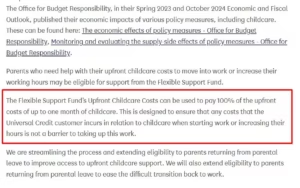
The April 2026 Parliamentary answer confirms that the Flexible Support Fund can pay 100% of up to one month of upfront childcare costs for eligible parents.
How Has the Flexible Support Fund Changed Over the Years?
The Flexible Support Fund is not a new Universal Credit scheme.
It was established in April 2011 as part of changes intended to give Jobcentre Plus greater freedom to provide employment support based on individual and local needs.
The fund brought together several previously targeted Jobcentre Plus budgets, including support that had existed through schemes such as the Adviser Discretion Fund and Travel to Interview Scheme.
The original idea was to move away from rigidly prescribing every type of support centrally. Jobcentre Plus districts and advisers were instead given greater scope to decide what assistance could remove barriers to employment.
Early DWP evaluations show that this greater discretion required advisers and managers to become familiar with a different way of working.
Guidance and application forms for the Flexible Support Fund were subsequently reviewed and revised in 2012.
The employment system around the fund has changed considerably since then.
Universal Credit gradually replaced several working-age means-tested benefits, placing Jobcentre Plus work coaches at the centre of employment support for many claimants.
The role of the Flexible Support Fund has consequently developed alongside Universal Credit.
It is now used not only for some people seeking an initial job but also in circumstances where eligible claimants need assistance to increase their earnings or progress in employment.
Research published by DWP in 2026 found that work coaches had used the fund to mitigate specific barriers faced by working Universal Credit claimants.
Childcare has also become more prominent. Support with upfront childcare costs now addresses a specific problem faced by some parents who are financially better off working but cannot initially afford the childcare needed to begin that work.
Administration has changed as well.
In March 2026, DWP said a new digital Flexible Support Fund application system was being rolled out nationally. The department said the system would improve data and allow more detailed scrutiny of awards.
That digital change should not be interpreted as meaning claimants can simply log into a public website and automatically apply for a grant.
The current public route still centres on discussion with the claimant’s work coach, who considers whether the expense qualifies and whether Flexible Support Fund assistance is appropriate.
How Has the Flexible Support Fund Affected People Looking for Work?
The practical importance of the fund comes from the gap between being offered an opportunity and being able to afford the immediate cost of taking it.
A claimant may be suitable for a job but unable to pay for several weeks of travel before receiving a first wage.
Someone entering a trade may need essential tools.
Another claimant may need suitable clothing for an interview.
A parent may have secured employment but need to pay a childcare provider before starting.
These are relatively specific expenses, but each can become a real barrier when someone has little disposable income.
That is why Flexible Support Fund assistance is targeted at the barrier rather than simply increasing the claimant’s monthly Universal Credit payment.
DWP research into in-work progression has found that work coaches use different forms of support to address transport, training and other barriers faced by working claimants, with the Flexible Support Fund forming part of that wider employment-support offer.
The impact is not identical for everyone.
Because awards are discretionary, two people facing apparently similar costs may receive different decisions after their individual circumstances are considered.
There are also safeguards around spending.
DWP confirmed in March 2026 that work coaches are expected to consider whether an item is necessary, whether the cost represents value for money and whether alternative funding is available.
The department also conducts post-award checks on funded items in some circumstances.
Where support is used as agreed, the Flexible Support Fund is different from a loan such as a Budgeting Advance. However, DWP has said an explanation or repayment can be considered where funded equipment or other support is not used for its agreed purpose.
The employment context is changing more widely too. In 2026, changes intended to reduce some claimants’ fear of trying employment were introduced alongside other work-support policies.
The separate DWP rules around trying work without automatically triggering certain benefit reassessments illustrate how employment support increasingly extends beyond simply directing claimants to vacancies.
The Flexible Support Fund has a narrower role. Its purpose is to deal with identifiable practical costs that can stand between a claimant and employment or progression.
How Can Someone Apply for the Flexible Support Fund?
There is not a standard Universal Credit payment button that automatically produces a Flexible Support Fund award.
A claimant should normally raise the employment-related cost with their Universal Credit work coach or appropriate Jobcentre Plus contact.
Current GOV.UK guidance specifically advises claimants to speak to their work coach for further information about the fund.
The conversation should focus on the barrier itself.
For example, a claimant who needs tools for a confirmed job should explain what equipment is required, why it is necessary and why the cost is preventing them from starting.
Someone requesting help with travel should be able to explain where they need to travel and how the journey relates to an interview, training, employment or another qualifying work-related activity.
A parent needing childcare assistance should explain the employment start date or increase in working hours, the childcare arrangement and the upfront cost involved.
Supporting evidence may be requested depending on the expense. This could include a job offer, interview details, quotes, invoices, childcare information or evidence showing that particular equipment or training is required.
Claimants should raise the issue before buying an item or committing to an expense wherever possible.
There is no guarantee that something purchased independently will later be reimbursed.
The work coach may also consider whether another programme should meet the cost before the Flexible Support Fund is used.
For people moving from older benefits, this application process is separate from managed migration itself.
Households affected by migration notices should still meet their Universal Credit deadlines because, as cases involving people losing legacy DWP benefits after failing to complete Universal Credit migration demonstrate, Flexible Support Fund eligibility does not replace the need to maintain the underlying benefit claim.
Conclusion
The Flexible Support Fund Universal Credit scheme can provide useful help when employment-related costs make it harder for a claimant to find work, start a job or increase their working hours.
Depending on individual circumstances, support may cover costs such as travel, work clothing, equipment, training and upfront childcare.
The fund has developed alongside Universal Credit and wider employment support, but it remains discretionary. There is no automatic entitlement or standard payment amount.
Claimants facing a genuine work-related financial barrier should speak to their work coach as early as possible, explain why the cost is necessary and provide supporting evidence before committing to the expense.
Frequently Asked Questions
What Is the Flexible Support Fund on Universal Credit?
The Flexible Support Fund is a Jobcentre Plus fund that can help eligible Universal Credit claimants overcome specific financial barriers to finding work, starting employment, increasing their earnings or moving closer to work. It is discretionary rather than an automatic Universal Credit entitlement.
Who Can Get the Flexible Support Fund?
Universal Credit claimants and some other eligible Jobcentre Plus customers may be considered for support where an appropriate employment-related barrier exists. Whether assistance is awarded depends on eligibility, individual circumstances and the work coach’s assessment.
How Much Can Someone Get From the Flexible Support Fund?
There is no single standard Flexible Support Fund payment for every claimant. The amount considered depends on the expense involved, what is reasonably necessary, the claimant’s circumstances and whether alternative funding is available.
Does the Flexible Support Fund Have to Be Paid Back?
Flexible Support Fund assistance is not normally structured as a repayable loan in the way a Budgeting Advance is. DWP can, however, seek an explanation or consider recovery where funded equipment or other support is misused or not used for the agreed purpose.
Can the Flexible Support Fund Pay for Work Clothes?
Yes, employment-related clothing can be considered where it is necessary to help someone attend an interview or start work. Official guidance specifically lists smart interview clothing and essential workwear as examples, although employers remain responsible for safety equipment they are legally required to provide.
Can the Flexible Support Fund Pay for Travel?
Travel costs can be considered where they are connected with removing a barrier to work. This may include qualifying travel linked to interviews, training, starting work or other appropriate employment activities.
Can the Flexible Support Fund Pay for Childcare?
Yes. In 2026, DWP confirmed that eligible parents may receive 100% of up to one month of qualifying upfront childcare costs where the expense is preventing them from moving into work or increasing their hours.
How Does Someone Ask for Flexible Support Fund Help?
The claimant should speak to their Universal Credit work coach or Jobcentre Plus contact, explain the employment-related cost and provide supporting evidence where required. Because awards are discretionary, claimants should discuss the expense before assuming it will be funded.