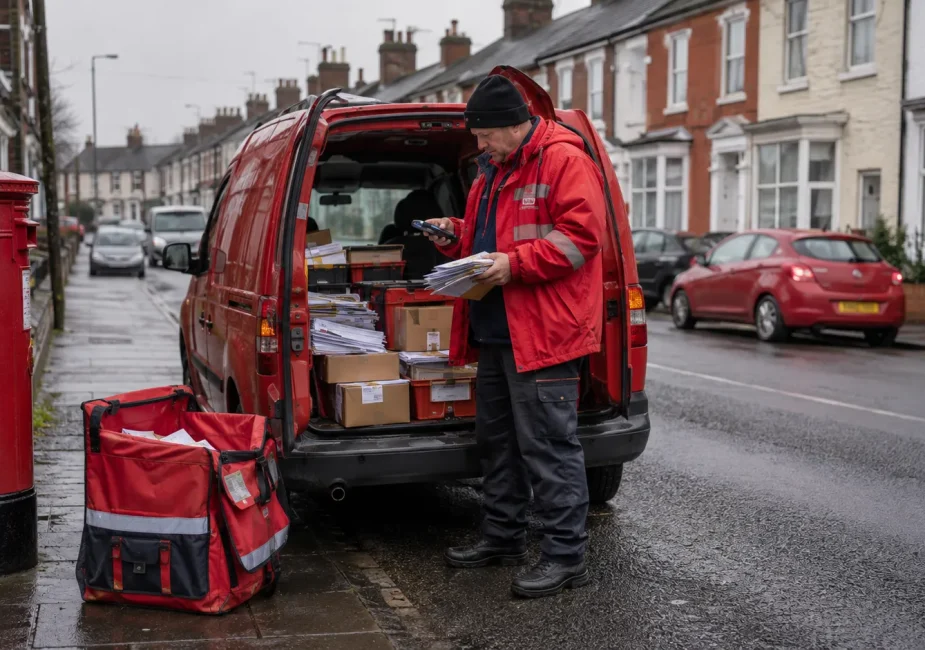
Royal Mail says its national air, road and mail-centre networks are operating to schedule.
However, its latest service notice identifies 43 local delivery offices covering 118 postcode districts where deliveries may be disrupted.
Separate temporary restrictions are also affecting parts of Belfast during the Fleadh Cheoil event.
Last Updated: 6 August 2026
Royal Mail’s most recent published service notice is dated 5 August 2026. Postcode information can change as local offices recover or new operational problems develop.
Royal Mail Delivery Status Today
Royal Mail says delivery and collection services are taking place across the UK. Its air network, road network and mail centres operated to schedule during the 24 hours covered by the latest update.
The disruption is concentrated at individual delivery offices rather than across the whole national network.
Service area
Current status
Air network
Operating to schedule
Road network
Operating to schedule
Mail centres
Operating to schedule
Local delivery offices
Disruption reported in selected areas
Belfast event areas
Temporary access restrictions
Royal Mail says some local offices may temporarily be unable to deliver to every address because of sickness absence, staffing levels or other local operational issues.
In these cases, deliveries may be rotated to reduce the time individual households go without post.
The latest local status should be confirmed through the Royal Mail service update, particularly when an important letter or parcel is expected.
Royal Mail Postcodes Affected Today
The following delivery offices appear in Royal Mail’s latest list of locations experiencing the most significant local disruption.
Being included in the table does not necessarily mean every address or every item in that postcode will be delayed.
Problems may affect particular delivery rounds, streets or types of mail rather than the whole postcode district.
Delivery Office
Affected Postcodes
Region
Abergavenny DO
NP7, NP8
Wales
Barry DO
CF63
Wales
Bedford MK40 DO
MK40–MK45
East of England
Bicester DO
OX25–OX27
South East
Blyth DO
NE24
North East
Brierley Hill DO
DY5
West Midlands
Burslem DO
ST6
West Midlands
Calderway DO
WF12–WF14
Yorkshire
Cambridge DO
CB1–CB5, CB21–CB25
East of England
Carmarthen DO
SA17, SA31–SA33
Wales
Carterton DO
OX18
South East
Coalville DO
LE6, LE67
East Midlands
Deal DO
CT14
South East
Dudley DO
DY1–DY3
West Midlands
Ebbw Vale DO
NP23
Wales
Gosforth DO
NE3, NE13
North East
Heswall DO
CH31, CH60, CH61
North West
Huntingdon DO
PE26–PE29
East of England
Ilfracombe DO
EX34
South West
Llangefni DO
LL62–LL78
Wales
Margate DO
CT7–CT9
South East
Milton Keynes Kiln Farm DO
MK8, MK11–MK14, MK19
South East
Minehead DO
TA22–TA24
South West
Mold DO
CH7
Wales
Mumbles DO
SA3
Wales
New Ferry DO
CH32, CH62, CH63
North West
Penarth DO
CF64
Wales
Pontefract DO
WF7–WF9, WF11
Yorkshire
Portslade DO
BN41, BN42
South East
Rugeley DO
WS15
West Midlands
Shrewsbury DO
SY1–SY5
West Midlands
Sidmouth DO
EX10
South West
St Helens DO
WA9–WA11
North West
Southam DO
CV47
West Midlands
Stourport-on-Severn DO
DY13
West Midlands
Syston SPDO
LE7
East Midlands
Tiverton DO
EX16, EX18
South West
Wallingford DO
OX10, OX49
South East
Wednesbury DO
WS10
West Midlands
West Park DO
PL5
South West
Wolverhampton NE DO
WV11, WV12
West Midlands
Woolton DO
L25–L27
North West
Yeovil DO
BA20–BA22
South West
Temporary Belfast Disruption
Temporary delivery and collection restrictions are also affecting BT1–BT3 and BT7–BT9 during the Fleadh Cheoil na hÉireann, which runs from 2 to 9 August 2026.
Road closures and restricted vehicle access mean deliveries in these areas may take place between 4am and 8am.
When Royal Mail cannot access an address, it says another delivery attempt will be made when access becomes available.
How to Check Royal Mail Delays in Your Postcode?
Start by identifying the outward part of the postcode. For example, the outward code for an address in OX25 2AA is OX25.
Use the following steps:
Search the postcode table for the outward code.
Confirm which local delivery office serves the address.
Review the date shown on Royal Mail’s official service notice.
Enter the tracking number when the item was sent through a tracked service.
Contact the sender when tracking shows that Royal Mail has not yet received the item.
A postcode appearing in an official notice is a warning of possible disruption, not confirmation that a particular item is delayed.
Tracking information should take priority when Royal Mail has provided item-level scans. However, an untracked First Class or Second Class letter cannot normally be located individually while it is travelling through the network.
Why Is Royal Mail Delayed?
Staff Shortages and Sickness
Royal Mail identifies high levels of sickness absence and insufficient local resourcing as common reasons an office may be unable to complete every scheduled delivery round.
The impact can vary within the same delivery office. One part of a postcode may receive mail normally while another round is postponed because the required staff are unavailable.
Local Delivery Office Problems
Operational problems at a delivery office can include backlogs, reduced staffing, unusually high volumes or difficulty covering particular routes.
Royal Mail says it may rotate deliveries in affected areas. Under this approach, available staff cover different streets or rounds on different days instead of repeatedly serving only the easiest routes.
Transport and Mail Centre Disruption
Letters and parcels normally pass through several parts of Royal Mail’s network before reaching the local delivery office.
A problem involving road transport, air services or a mail centre can affect several regions.
However, the current national update says all three parts of the network operated to schedule during the latest reporting period. The disruption listed above is therefore primarily local.
Weather and Access Restrictions
Snow, flooding, unsafe roads and other severe conditions can prevent postal workers from reaching individual streets.
Local events can have a similar effect. The temporary Belfast disruption demonstrates how road closures and access restrictions can delay deliveries even when the wider Royal Mail network is operating normally.
Royal Mail Delays by Service
A local delivery-office problem can affect letters, parcels and business correspondence. Royal Mail does not publish a standard number of additional days that applies to every disrupted postcode.
Service
Normal delivery position
Possible effect of local disruption
First Class letters
Next-working-day delivery aim, including Saturday
The letter may miss its delivery aim when the local round is incomplete
Second Class letters
Delivery within three weekdays
Delivery depends on the local Second Class schedule and any additional disruption
Tracked parcels
Service-specific delivery aim with tracking
Tracking may show the item being held at a mail centre or delivery office
Special Delivery
Guaranteed time selected by the sender, subject to terms
A missed guarantee may create a right to a refund or compensation
Business mail
Depends on the service purchased
Invoices, statements and customer communications may arrive later than planned
Customers expecting weekend post should distinguish a genuine service problem from the normal timetable for Royal Mail Saturday deliveries.
First Class letters continue to have a next-working-day delivery aim, including Saturday.
Second Class letters are being moved to a different delivery model, while parcels remain subject to the terms of the service selected by the sender.
What Has Royal Mail Announced About Delivery Delays in 2026?
Royal Mail and Ofcom have issued several important updates during 2026 covering delivery targets, service performance and local disruption.
Date
Announcement
1 April 2026
New First Class and Second Class delivery targets took effect.
29 May 2026
Royal Mail confirmed it had missed its 2025/26 delivery targets.
1 June 2026
Ofcom opened an investigation into Royal Mail’s performance.
5 August 2026
Royal Mail reported disruption at 43 local delivery offices.
Royal Mail is also introducing alternate-weekday delivery for Second Class letters, with the rollout expected to be completed by December 2026. First Class letters will continue to be delivered six days a week.
Royal Mail Delay or Normal Second Class Schedule
Not every letter that takes longer than expected has been caught in a local delivery-office backlog.
Ofcom has allowed Royal Mail to deliver Second Class letters on alternate weekdays from Monday to Friday. First Class letters continue to be delivered six days a week, while the universal-service requirements for parcels remain unchanged.
Royal Mail has started introducing the new model gradually across approximately 1,200 delivery offices. It expects implementation to be completed by December 2026.
Under the revised schedule:
First Class letters retain a next-working-day delivery aim.
First Class letters continue to be delivered Monday to Saturday.
Second Class letters are delivered on alternate weekdays.
Second Class letters retain a three-weekday delivery aim.
Second Class letters are not part of the normal Saturday letter schedule under the new model.
Parcels can continue to be delivered separately from Second Class letters.
This distinction matters when a postcode is not on the disruption list. A Second Class letter may still arrive on a later weekday because of the planned delivery pattern rather than an unexpected operational failure.
What to Do If Your Post Has Not Arrived?
Check the Expected Delivery Date
Confirm which postal service the sender used and the date on which Royal Mail accepted the item.
An online retailer creating a postage label does not necessarily mean the parcel has entered Royal Mail’s network. Tracking may initially show that the sender has advised Royal Mail of the item but has not handed it over.
First Class is a delivery aim rather than a guarantee. A next-working-day aim does not mean every ordinary First Class item is guaranteed to arrive the following day.
Check Royal Mail Tracking
Enter the tracking or reference number exactly as it appears in the dispatch confirmation.
Tracking may show that the item:
Has been accepted from the sender
Is moving through a mail centre
Has reached the local delivery office
Is out for delivery
Could not be delivered
Has been delivered to a neighbour or safe place
Not every Royal Mail service provides full end-to-end tracking. Ordinary stamped First Class and Second Class letters may have no item-level tracking available.
Contact the Sender
Ask the sender to confirm:
The posting date
The delivery address
The postcode
The service used
The tracking number
Whether proof of posting is available
When an online order has not arrived, the retailer normally remains responsible for getting the goods to the customer. The customer should not be sent back and forth between the retailer and courier without a clear resolution.
Royal Mail Delivery CheckerReader delivery tool
What should you do when post has not arrived?
Create a practical next-step plan, understand the service used and work through a clear delivery checklist.
1
Build your next-step plan
Choose what you are waiting for and whether tracking is available.
✓
Select your options above
Your personalised checklist will appear here without claiming a live delivery status.
2. Choose your service
See the most useful next step for the type of item you are expecting.
3. Complete your delay check
Tick each step as you complete it.
0 of 3 checks completed
This interactive guide does not provide live Royal Mail status information. It helps readers decide which checks and contacts may be most relevant based on the item and service used.
Check for a Delivery Card or Safe Place
A delayed item is different from an unsuccessful delivery attempt.
Royal Mail may leave a “Something for you” card when an item cannot be delivered. Depending on the item, the recipient may be able to arrange redelivery or collect it from a customer service point.
Customers should use official tracking rather than payment links received in unexpected messages. Similar precautions apply across courier networks, particularly where supposed DPD redelivery charges are used in scam texts.
Contact Royal Mail
Contact Royal Mail when:
Tracking has stopped updating for an unusual period
The expected delivery date has passed
The item is shown as delivered but cannot be found
A guaranteed service has missed its deadline
The item may qualify as delayed or lost
Important medical, legal or financial correspondence is involved
When a delayed letter could affect an appointment, payment, application or legal deadline, contact the organisation that sent it. Do not rely solely on waiting for the post to arrive.
When Is Royal Mail Post Considered Lost?
Royal Mail compensation rules distinguish between an item that is delayed and one that is considered lost.
Citizens Advice gives the following waiting periods for domestic claims:
Service
Delay claim can usually begin
Lost-item claim can usually begin
First Class
Four working days after posting
11 working days after posting
Second Class
Six working days after posting
14 working days after posting
Special Delivery
One working day after the due date
Five working days after the due date
Redirected mail can have longer waiting periods. Additional time may also apply to items sent during the Christmas period.
These periods determine when a compensation claim may be considered. They do not guarantee that every item will arrive within that timeframe.
Proof of posting should be retained until the item has arrived and any claim period has ended.
Can You Claim Compensation for Delayed Post?
A customer may be able to claim when a Royal Mail item is lost, damaged or delayed, but eligibility depends on the postal service and available evidence.
The claimant may need:
A receipt or certificate of posting
The original packaging and postmark
The tracking or reference number
Evidence showing the item’s value
Photographs when the item arrived damaged
Evidence of the promised delivery date
For Tracked 24 and Tracked 48 items, only the sender can make a compensation claim.
Citizens Advice also states that these services do not provide compensation solely because an item was delayed, although different rules apply when the item is lost or damaged.
For delayed ordinary letters and large letters, compensation may be limited to the postage cost. Special Delivery has separate terms depending on the guarantee selected and how late the item arrived.
Where a retailer arranged the delivery, the customer should usually pursue the retailer for a missing order. The retailer can then raise its own claim with Royal Mail under the applicable contract.
Impact on UK Businesses
Royal Mail delays can affect more than customer parcels. Businesses may also rely on the postal network for invoices, payment reminders, bank documents, signed contracts, statements, returns and official notices.
Customer Orders
Online sellers should avoid promising a fixed arrival date when they are using a service with a delivery aim rather than a guarantee.
During local disruption, businesses should:
Keep proof of posting
Give customers the tracking number promptly
Monitor undelivered orders
Communicate delays before complaints escalate
Avoid marking an order as delivered without carrier confirmation
Invoices and Payments
A delayed paper invoice can postpone approval and payment, particularly when the receiving business has not been given a digital copy.
Businesses can reduce the risk by sending time-sensitive invoices electronically while retaining the postal copy where required.
Contracts and Important Documents
Legal documents, signed agreements and regulatory notices should be sent using a service appropriate to their value and urgency.
Businesses should not assume that ordinary First Class post proves the exact date or time of delivery. When evidence of arrival is important, a tracked or guaranteed service may be more suitable.
Alternative Delivery Options
Businesses experiencing repeated disruption may compare Royal Mail with other networks for time-sensitive parcels.
The availability of Evri weekend delivery may suit lower-value consumer orders, while DHL Saturday delivery may be considered for shipments requiring a different courier timetable.
An alternative courier does not automatically eliminate delays. Coverage, tracking, compensation, collection times and delivery commitments should be compared before moving important shipments.
Are Royal Mail Delays Getting Worse?
Local postcode alerts provide only a daily snapshot, but Royal Mail’s national performance data shows a wider reliability problem.
For the 2025/26 regulatory period:
75.7% of First Class mail was delivered within one working day.
90.2% of Second Class mail was delivered within three working days.
The applicable targets were 93% for First Class and 98.5% for Second Class.
Ofcom opened an investigation on 1 June 2026 to determine whether Royal Mail failed to comply with its obligations and whether a financial penalty would be appropriate.
These annual figures should not be used to predict the exact delay affecting an individual postcode.
They measure national performance across the reporting year, while the current service list identifies particular offices experiencing immediate operational pressure.
Why Is Royal Mail Changing Its Delivery Network?
The UK sends substantially fewer letters than it did when the current universal postal system was established. Royal Mail must still serve addresses across the country even as the volume of letters passing through the network falls.
The reforms are intended to consolidate non-urgent letters into fewer delivery rounds while preserving the next-day First Class option.
The principal changes include:
Alternate weekday delivery for Second Class letters
Continued six-day delivery for First Class letters
New targets covering mail that arrives substantially late
Greater separation between urgent letters, non-urgent letters and parcels
Changes to delivery routes and staffing arrangements
Customers are also paying more to send mail, with a standard First Class stamp rising to £1.80 and a Second Class stamp prices increasing to 91p in April 2026.
The combination of changing delivery patterns and local disruption makes it important to identify the service used before assuming that an item is late.
How Often Is the Delay List Updated?
Royal Mail describes its service page as a daily operational round-up and says it regularly updates the list of the offices most affected.
However, the page may still display the previous working day’s notice early in the morning. Customers should therefore examine the date shown above the official update rather than assuming the list was published that day.
An accurate live-update article should:
Display the date on Royal Mail’s source notice
State when the article was last reviewed
Remove offices no longer listed
Add newly affected delivery offices
Keep event disruption separate from operational disruption
Avoid carrying old postcode lists into a new update
Make clear that the list does not confirm a delay at every address
Frequently Asked Questions
Is Royal Mail delayed in my postcode today?
Search the affected-postcode table and compare it with the date on Royal Mail’s official notice. A listed postcode indicates possible disruption but does not mean every address or item is delayed.
Why has my Royal Mail tracking not updated?
The item may be moving between locations without receiving a new scan, waiting at a mail centre or not yet handed to Royal Mail by the sender. Contact the sender when tracking shows only that a label has been created.
How long can a Royal Mail delivery be delayed?
Royal Mail does not provide one standard additional timeframe for locally disrupted postcodes. The delay depends on the delivery office, service used, backlog and whether the item has reached the local office.
Does Royal Mail prioritise parcels over letters?
Royal Mail’s current local service notice does not say that every affected office is prioritising parcels. Customers should avoid assuming a parcel will arrive normally simply because it has tracking.
Does an affected postcode mean every address is delayed?
No. Disruption may affect only certain delivery rounds, streets or items within the postcode district. Some households in a listed area may continue receiving post normally.
Can I claim compensation for a late Royal Mail delivery?
A claim may be possible depending on the service, length of delay and available proof of posting. Tracked 24 and Tracked 48 do not normally provide compensation solely for delay.
Who should report a missing item: the sender or recipient?
Either party may be able to claim for some services, but only the sender can claim for Tracked 24 or Tracked 48. For a retail purchase, the customer should normally contact the retailer responsible for delivering the order.