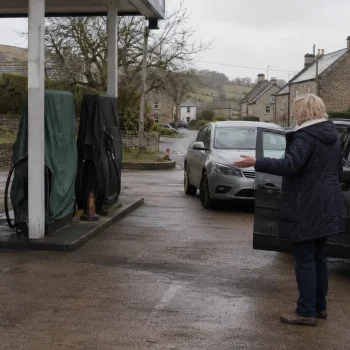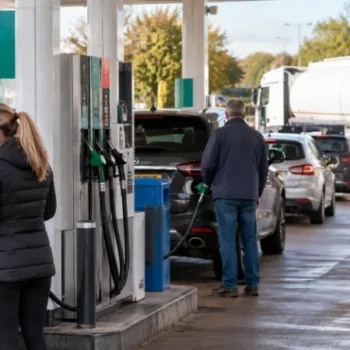
Up 28.18p per litre from the pre-conflict benchmark.
Are Gas Prices Going Up Because of Iran in the UK?
 • March 3, 2026
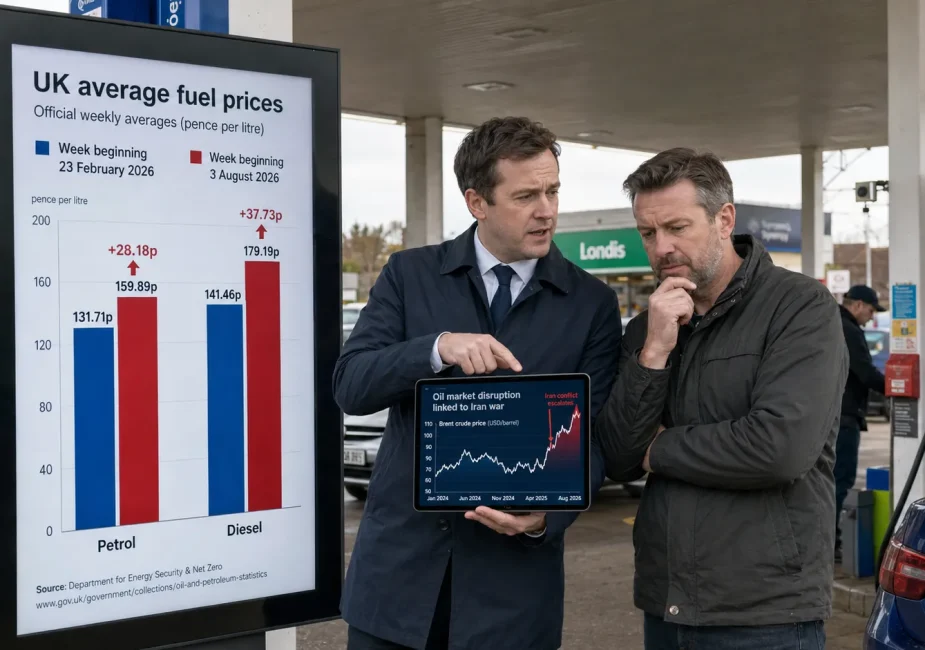
Petrol and diesel prices are rising because the US/Israel–Iran conflict disrupted Middle Eastern oil production and shipping through the Strait of Hormuz.
Higher crude prices, restricted refined-fuel supplies and renewed geopolitical uncertainty have raised UK wholesale costs. For the week beginning 3 August 2026, the official UK average was 159.89p per litre for petrol and 179.19p per litre for diesel.
Compared with the final full week before the conflict began, petrol was around 28.18p more expensive per litre, while diesel was 37.73p higher.
Last Updated: 6 August 2026
Latest Petrol and Diesel Prices in London and the UK
The latest official weekly road fuel prices cover the week beginning Monday, 3 August 2026.
| Fuel type | UK average | Weekly increase | Increase since 6 July 2026 | Official London average |
|---|---|---|---|---|
| Petrol | 159.89p per litre | 3.76p | 10.09p | Not published separately |
| Diesel | 179.19p per litre | 5.22p | 14.42p | Not published separately |
The government dataset provides a national average rather than a separate London-wide figure. Prices across London can vary considerably depending on the borough, retailer, local competition and whether the station is in central or outer London.
Motorists should therefore treat the national figure as a benchmark rather than the exact amount they will pay at a particular London forecourt.
Airport locations, major roads and stations with limited nearby competition can be more expensive, while supermarket forecourts may charge less.
UK Petrol Prices Before the Iran War
The US and Israel began strikes against Iran on 28 February 2026. The closest complete weekly UK fuel-price benchmark before the conflict is the week beginning 23 February.
| Fuel type | Price before the conflict | Price in August 2026 | Increase per litre | Percentage increase |
|---|---|---|---|---|
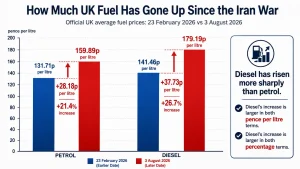
| Petrol | 131.71p | 159.89p | 28.18p | 21.4% |
| Diesel | 141.46p | 179.19p | 37.73p | 26.7% |
The figures show that diesel has experienced the larger increase. It was already more expensive than petrol before the conflict, but disruption to international diesel production and exports widened that difference further.
How Much Has Fuel Gone Up in the UK Since the Iran War?
UK petrol has risen by approximately 28.18p per litre since the final full week before the conflict, while diesel has increased by around 37.73p per litre.
The increase was not steady. Prices rose sharply during March and April, eased during June after progress towards reopening the Strait of Hormuz, and then began climbing again in July and early August as supply concerns returned.
The House of Commons Library’s analysis of petrol and diesel prices found that petrol increased by 12p per litre and diesel by 25p during the first three weeks of March alone.
Why Do Petrol Prices Rise Globally and in the UK?
Petrol prices increased because the conflict pushed crude oil and refined petrol costs higher at the same time.
Crude oil is the principal raw material used to make petrol.
When shipping through the Strait of Hormuz slowed, and Middle Eastern producers reduced output, traders expected less oil to be available to the global market. Brent crude moved sharply higher as buyers competed for alternative supplies.
Refineries also had to deal with higher crude purchasing, shipping and insurance costs. These pressures raised the wholesale price paid by UK fuel suppliers.
The UK effect was amplified because crude oil and refined fuel are traded in US dollars. When the pound weakens against the dollar, British buyers must pay more even when the dollar price of oil remains unchanged.
Why Do Diesel Prices Rise Globally and in the UK?
Diesel rose more sharply because its supply was tighter than petrol supply.
The Middle East exports both crude oil and substantial volumes of refined petroleum products. Disruption affected not only the oil delivered to refineries but also shipments of ready-made diesel.
Diesel is used heavily by haulage firms, delivery fleets, agriculture, construction and industry.
Demand from these sectors is less flexible than demand from private motorists, which means businesses cannot immediately reduce consumption when prices increase.
Global refinery restrictions and competition for middle-distillate fuels also pushed wholesale diesel margins higher.
This helps explain why the UK diesel increase since February has been substantially larger than the increase in petrol.
What Is the Average Fuel Price Per Litre in August 2026?
Based on the latest official weekly figures, UK motorists can expect an average price of approximately:
- £1.60 per litre for petrol
- £1.79 per litre for diesel
These are national averages rather than fixed prices. A London driver may find lower supermarket prices or considerably higher prices at stations with limited local competition.
Drivers should also expect prices to move during August because wholesale costs can take several days to reach forecourts. A rise in crude oil does not appear immediately at every petrol station, and individual retailers purchase supplies at different times.
How Much Is the Fuel Price Rise Costing You?
Select your fuel type and enter how many litres you normally purchase each week to estimate the effect on your household or business fuel budget.
Up 37.73p per litre from the pre-conflict benchmark.
Calculate Your Additional Fuel Spending
The result compares the latest average with the final complete weekly price recorded before the conflict.
Current weekly cost
£63.96
Extra each month
£48.85
Extra each year
£586.14
At 40 litres per week, petrol costs around £11.27 more each week
than it did at the pre-conflict average.
Calculations use national weekly averages. The price at an individual London or UK forecourt may be higher or lower.
Your Fuel-Saving Checklist
Select the actions you could use to reduce unnecessary spending.
0 of 4 fuel-saving actions selected
Why Are UK Fuel Prices Rising Right Now?
The current fuel-price increase is being driven by several connected pressures rather than one isolated event.
The most important factors are:
- Higher crude oil prices
- Restricted Middle Eastern oil production
- Disruption to shipping through the Strait of Hormuz
- Reduced exports of refined petrol and diesel
- Higher tanker insurance and freight costs
- Exchange-rate movements
- Delays between wholesale and retail price changes
Prices may continue rising even after oil markets stabilize because forecourts can still be working through fuel purchased at a higher wholesale price.
How Is the Iran War Affecting UK Fuel Prices?
The conflict began on 28 February 2026 when the US and Israel launched strikes against Iran. Iran responded with attacks across the region and restrictions on commercial shipping through the Strait of Hormuz.
The disruption affected several major oil-producing states, not only Iran.
Producers around the Persian Gulf faced difficulties exporting oil while storage capacity filled and tankers were unable or unwilling to use the normal route.
Global oil markets react to expected shortages before motorists experience an actual lack of fuel. When traders believe production or shipping may be interrupted, oil futures and physical cargo prices can rise immediately.
That increase then moves through refineries, wholesalers and retailers before reaching UK forecourts.
Iran’s Role in the Global Oil Market
Iran is a major oil producer, but its greatest influence during the conflict came from its position beside the Strait of Hormuz.
The waterway is used by Saudi Arabia, Iraq, Kuwait, the UAE, Qatar, Bahrain and Iran to move energy exports into international markets. Restrictions therefore affect a much larger volume of oil than Iran’s exports alone.
The conflict also raised the cost of insuring tankers and made shipping companies more cautious about entering the region. Even vessels that continued operating faced delays, additional security requirements and higher freight costs.
How Conflict Adds a Risk Premium to Oil?
Oil prices reflect both available supply and the risk that future supply may be disrupted.
During a conflict, buyers may pay more to secure cargoes in advance. Traders also add a risk premium because production facilities, pipelines, ports or tankers could be damaged.
That premium can fall when ceasefire negotiations progress, but it can return quickly when talks weaken or new attacks occur.
This explains why UK fuel prices have remained volatile throughout 2026 rather than moving consistently in one direction.
Why Is the Strait of Hormuz Important for Fuel Prices?
The Strait of Hormuz is one of the most important oil transit routes in the world. Before the 2026 conflict, approximately 20 million barrels of oil and petroleum products passed through it each day, equivalent to roughly one-fifth of global petroleum consumption.
| Period | Oil and shipping position | Effect on global markets |
|---|---|---|
| Before the conflict | Around 20 million barrels per day passed through the strait under normal conditions | Stable access to Middle Eastern exports |
| After 28 February 2026 | Most commercial traffic stopped or became heavily restricted | Oil production was shut in and prices rose sharply |
| March 2026 | Approximately 7.5 million barrels per day of regional production was estimated to be shut in | Global supply tightened |
| April 2026 | Estimated shut-ins increased to around 9.1 million barrels per day | Crude and refined-fuel prices remained elevated |
| After the 18 June agreement | Tanker traffic began increasing, but supplies and inventories had not fully recovered | Prices fell before rising again as uncertainty returned |
The production shut-in figures are not the same as the amount passing through the strait. They show how much regional production could not reach the market because storage and export routes were constrained.
The US Energy Information Administration’s House of Commons Library’s analysis of petrol and diesel prices said traffic increased after the 18 June memorandum, but it expected production and trade flows to take until the end of 2026 to return close to their pre-conflict position.
How Shipping and Insurance Costs Affect UK Fuel Prices?
When tanker routes become dangerous, insurers raise the premiums charged to shipowners. Companies may also hold vessels outside the affected area, delay journeys or use longer routes.
Those additional costs become part of the price paid for each cargo. UK suppliers may therefore face higher costs even when the fuel itself was produced outside Iran.
The result is a global increase in the delivered cost of crude oil, petrol and diesel.
How Do Oil Prices Reach London Forecourts?
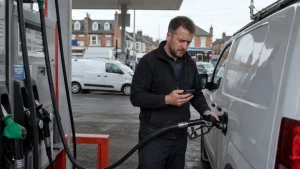
Higher crude oil prices first affect refineries and wholesale fuel markets. UK distributors then purchase petrol and diesel at the new wholesale rate before supplying individual forecourts.
Retail prices usually respond more slowly because stations may still have stocks purchased at an earlier price. Contracts, delivery schedules and local competition also influence when a retailer changes its pump price.
This delay means oil prices can begin falling while forecourt prices are still increasing. The same process can work in reverse when crude prices rise but retailers initially continue selling cheaper stock.
Are London Fuel Prices Higher Than the UK Average?
London is not guaranteed to have higher fuel prices in every location, but many drivers face higher prices because of land costs, wages, operating expenses and limited forecourt space.
Central London has relatively few petrol stations, giving motorists fewer opportunities to compare prices. Outer-London areas generally have more supermarket and independent forecourts, which can create stronger competition.
Prices also vary according to:
- Retailer purchasing contracts
- Delivery and storage costs
- Local competition
- Property and staffing expenses
- Whether the forecourt is near an airport or major road
- The speed at which wholesale increases are passed on
A London-wide average should not be quoted without a dated and clearly explained local data sample.
Why Is Diesel More Expensive Than Petrol?
Diesel is more expensive because global diesel supplies remain tighter, while demand from freight, farming, construction and industry remains strong.
The conflict disrupted both crude oil and refined-diesel exports. Limited refinery capacity and strong commercial demand then increased the wholesale premium attached to diesel.
UK fuel duty is the same for petrol and diesel, so the difference at the pump is largely created before tax through wholesale market conditions.
How Do Fuel Duty, VAT and the Pound Affect Pump Prices?
Fuel duty is currently 52.95p per litre for both petrol and diesel. VAT is then charged at 20% on the total selling price, including the fuel duty.
This means higher wholesale prices also increase the amount of VAT paid. Fuel duty remains fixed per litre, but VAT rises and falls with the retail price.
Currency movements also matter because international oil is priced in dollars. A weaker pound raises the sterling cost of crude and refined fuel, while a stronger pound can soften the effect of an international oil-price increase.
Retail and distribution margins make up the remaining portion of the pump price. These margins differ between supermarkets, independent garages and major fuel brands.
Are Petrol Prices and Household Gas Prices Connected?
Petrol, diesel and household natural gas are separate products with different supply chains and pricing systems.
Petrol and diesel are refined from crude oil and sold through forecourts. Household gas is supplied through the energy network and is affected by wholesale gas contracts, storage, regulation and the Ofgem price cap.
The same Middle Eastern conflict can affect both markets because the Strait of Hormuz also carries liquefied natural gas.
However, an increase in petrol does not automatically mean household gas bills will rise by the same amount or at the same time.
The wider UK household energy price outlook should therefore be considered separately from road-fuel prices.
Is the UK at Risk of a Petrol or Diesel Shortage?
Higher prices do not necessarily mean the UK is about to run out of petrol or diesel.
The present pressure is mainly about the higher cost and reduced availability of international supplies. The UK can obtain fuel from different markets, while suppliers and refiners can adjust trading routes when one source becomes restricted.
However, prolonged disruption could create local or temporary problems, particularly if deliveries are delayed or motorists begin panic buying.
The broader question of whether there is a risk of a UK petrol shortage is different from the question of why prices are increasing.
London forecourts may experience individual delivery or stock issues without this representing a nationwide shortage.
Could Fuel Prices Fall Again?
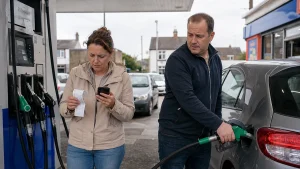
Fuel prices could fall if shipping through the Strait of Hormuz continues recovering, Middle Eastern production returns and crude oil supplies increase.
A stronger pound and lower wholesale refining margins would also help UK prices. However, forecourt reductions would not necessarily appear immediately because retailers may still be selling stock purchased when wholesale prices were higher.
Prices could rise further if fighting escalates, tanker traffic declines again or regional oil facilities remain offline.
The direction during August will therefore depend heavily on political developments and the pace at which production and inventories recover.
What Do Higher Fuel Prices Mean for London?
Higher petrol and diesel prices affect businesses and households beyond the amount motorists pay at the pump.
| Area affected | Likely impact | Most affected |
|---|---|---|
| Commuting | Higher weekly travel expenditure | Outer-London workers who rely on cars |
| Taxis and private hire | Increased operating costs | Drivers and passengers |
| Delivery services | Higher last-mile distribution expenses | Retailers, couriers and customers |
| Small businesses | Increased vehicle, supplier and contractor costs | Tradespeople and mobile businesses |
| Food and consumer goods | Higher transport and supply-chain costs | Households and retailers |
| Public services | Higher fleet expenditure | Councils and service providers |
Businesses operating company vehicles also need to distinguish everyday pump prices from tax and reimbursement rules.
The current HMRC fuel charges for 2026 can affect employees who receive employer-provided fuel for private travel.
Fuel is only one part of the wider cost of operating a vehicle. The latest car tax changes in 2026 may add further pressure for motorists and businesses managing vehicle fleets.
How Can London Drivers Reduce Fuel Costs?
Drivers can reduce their exposure by comparing nearby forecourt prices, combining journeys and avoiding stations in high-cost locations where possible.
Smooth acceleration, correct tyre pressure and regular vehicle maintenance can also reduce unnecessary fuel consumption.
London motorists may benefit from using public transport for suitable journeys, particularly where congestion and parking make driving more expensive.
Businesses should monitor fuel expenditure by vehicle and route rather than relying only on monthly totals. This makes it easier to identify inefficient journeys and decide when mileage policies need updating.
Conclusion
Petrol and diesel prices are rising in London because the 2026 US/Israel–Iran conflict has disrupted oil production, refined-fuel exports and shipping through the Strait of Hormuz.
Official figures for the week beginning 3 August show petrol averaging 159.89p per litre and diesel 179.19p across the UK. Compared with the final full week before the conflict, petrol is approximately 28.18p higher and diesel is 37.73p more expensive.
Diesel has experienced the sharper increase because supplies of refined diesel remain tight while demand from freight, industry and agriculture continues.
Prices could ease if Middle Eastern production and tanker traffic recover. However, inventories and supply chains will take time to normalise, meaning London drivers may continue facing volatile forecourt prices throughout August 2026.
FAQs About Rising Petrol and Diesel Prices
Why have petrol prices risen since the Iran war?
The conflict disrupted oil production and shipping through the Strait of Hormuz, increasing crude, refining, freight and insurance costs across global markets.
What was the UK petrol price before the Iran war?
The official UK petrol average was 131.71p per litre during the week beginning 23 February 2026, the final complete week before the conflict started.
How much has UK petrol increased since the conflict began?
By the week beginning 3 August 2026, petrol had increased by approximately 28.18p per litre, or 21.4%, compared with the pre-conflict weekly figure.
Why has diesel risen more sharply than petrol?
Diesel supplies are tighter, and the fuel is heavily used by freight, agriculture, construction and industry. Disruption to refined-diesel exports has therefore had a particularly strong effect.
Are London fuel prices higher than the UK average?
Some London forecourts charge more because of higher operating costs and limited competition, but there is no single official London-wide average in the government’s weekly dataset.
Could the Strait of Hormuz cause a UK fuel shortage?
A prolonged closure could restrict supplies and cause temporary disruptions, but higher prices alone do not mean the UK is about to run out of fuel.
Will petrol and diesel prices fall later in 2026?
Prices could fall if shipping and production recover, wholesale costs decline and the pound strengthens. Forecourt reductions may take several days or weeks to appear.