

Employment Tribunal Decisions: How UK Employers Can Find, Read And Respond To Judgments In 2026?
 • August 31, 2026
•
1 Comment
• August 31, 2026
•
1 Comment

Employers can search employment tribunal decisions for England, Wales and Scotland through the official GOV.UK Employment Tribunal decisions database. It contains published decisions from February 2017 onwards and can be searched by names, keywords, jurisdiction and date.
For decisions made before February 2017, GOV.UK directs users to Norwich Magistrates’ Court and Family Court for England and Wales, or Glasgow Tribunals Centre for Scotland. Northern Ireland operates a separate tribunal system.
The database is useful for researching previous cases involving employers, particular types of claims and workplace disputes. However, employers should read individual employment tribunal judgments carefully before drawing conclusions from them.
What Are Employment Tribunal Decisions?
Employment tribunal decisions are judgments made by an Employment Tribunal after considering a workplace dispute within its jurisdiction.
Cases can involve issues such as unfair dismissal, discrimination, redundancy, whistleblowing, unlawful deductions from wages, breach of contract and working-time rights.
A judgement establishes the tribunal’s decision in the particular case. Depending on how the proceedings developed, the published material may also contain detailed written reasons explaining the evidence considered, factual findings and legal reasoning.
For employers, these judgements can provide useful insight into how tribunals examine workplace procedures and evidence. They should not, however, be treated as simple templates for predicting the outcome of another dispute.
What Information Can An Employment Tribunal Judgement Contain?
The contents vary depending on the case and the type of decision.
A published employment tribunal judgement may identify:
- The Claimant and Respondent involved in the proceedings
- The Case Number assigned to the claim
- The Claims that the tribunal was required to determine
- The Evidence considered during the proceedings
- The Findings of Fact reached by the tribunal
- The Relevant Legal Tests applied to those findings
- The Tribunal’s Conclusions on each issue
- The Outcome of the claim
- Any Remedy ordered following a successful claim
Employers researching employment tribunal decisions should pay particular attention to the distinction between what a party alleged and what the tribunal actually found.
A claimant’s allegation being recorded in a judgement does not establish that the allegation was accepted as fact.
Judgement, Written Reasons, and Remedy Decisions: What Is The Difference?
A judgement records the tribunal’s formal decision. It may determine the whole case or only particular issues.
Written reasons explain why the tribunal reached its judgment. They can be especially important for employers researching tribunal cases because they provide greater detail about the evidence, findings and legal reasoning.
A remedy judgement deals with what should happen after liability has been established. Depending on the type of successful claim, this may include financial compensation or another remedy available to the tribunal.
Employers should therefore check exactly what document they are reading. A remedy judgement, preliminary decision or judgment dealing with only part of a case may not explain the entire dispute.
Where Can Employers Search Employment Tribunal Decisions In The UK?
The main employment tribunal decisions database covers cases from England, Wales and Scotland from February 2017 onwards.
Employers can use the search function when researching a named business, a particular workplace issue or tribunal decisions within a date range.
As of 31 August 2026, the register contained more than 133,000 decisions, although the total changes as new judgments are published.
Using The GOV.UK Employment Tribunal Decisions Database
A useful search normally starts with the most specific information available.
If an employer is researching a particular organisation, searching its company or trading name may identify judgments where it appeared as a respondent.
Different versions of a company name may need to be tried where a business has changed its legal or trading name.
The database also provides jurisdiction filters covering employment issues, including unfair dismissal, breach of contract, discrimination, time limits and other categories.
Employers can narrow their search further by date and country.
Searching is only the first step. The full decision should then be opened and read because a result appearing under a relevant keyword does not necessarily mean the case decided the legal question the employer is researching.
How To Search By Employer Name, Claim Type Or Older Decision?
For a company-specific search, employers should try the full legal company name and any recognisable trading name.
For subject research, using the relevant jurisdiction can be more effective.
For example, an employer considering dismissal procedures may examine unfair dismissal decisions, while an employer investigating pay disputes could search decisions relating to unlawful deductions or breach of contract.
Searches can also be refined by decision date.
For employment tribunal judgements issued before February 2017, the online register does not provide the same coverage.
GOV.UK advises contacting Norwich Magistrates’ Court and Family Court for England and Wales or Glasgow Tribunals Centre for Scottish decisions.
What About Employment Tribunal Cases In Northern Ireland?
Northern Ireland does not use the same Employment Tribunal structure as England, Wales and Scotland.
Employment disputes there are dealt with through the Industrial Tribunals and Fair Employment Tribunal, with separate Northern Ireland judicial arrangements.
Employers operating across different parts of the UK should therefore establish which jurisdiction applies before relying on a tribunal search or procedural rule.
Are Employment Tribunal Decisions Public?
Yes. Employment tribunal judgements are generally entered into a public register.
Under the Employment Tribunal Procedure Rules 2024, a copy of a judgement and any written reasons must generally be entered into the register, subject to specified exceptions and privacy restrictions.
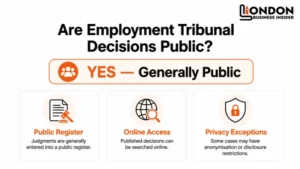
This means an employer involved in tribunal proceedings should consider from an early stage that a resulting judgement could become publicly accessible.
Why Are Employment Tribunal Judgements Published?
Publication supports the principle of open justice by allowing the public to see decisions reached by the tribunal system.
HMCTS guidance states that judgements issued to parties from February 2017 are published on the online public register.
Written full reasons must also generally be entered into the register under Rule 65 of the Employment Tribunal Procedure Rules 2024.
For businesses, this means tribunal proceedings can have consequences beyond the immediate legal dispute.
Prospective employees, journalists, customers, investors and other parties may potentially find a published judgement when searching an organisation’s name.
That does not mean readers should assume everything stated in a judgement represents a finding against the employer. Judgements can record disputed allegations, submissions and evidence alongside the tribunal’s eventual conclusions.
Can An Employment Tribunal Decision Be Removed From GOV.UK?
Employers should not assume an unfavourable decision can simply be removed under data protection rules.
The official Employment Tribunal database states that decisions are not affected by GDPR rules in a way that allows them simply to be removed from GOV.UK.
Where publication causes concern, the relevant tribunal rules and any existing restriction or privacy order need to be considered.
Can Names Be Anonymised Or Publication Restricted?
There are circumstances in which an Employment Tribunal can restrict public disclosure.
Rule 49 of the Employment Tribunal Procedure Rules 2024 allows the tribunal to make certain privacy and disclosure restriction orders where the relevant legal conditions are satisfied. This can include anonymising names in appropriate cases.
These restrictions are not automatic simply because publication may be inconvenient or damaging to an employer or another party.
HMCTS describes the conditions for such orders as strict.
Are Employment Tribunal Decisions Binding On Other Employers Or Tribunals?
An Employment Tribunal judgement is binding on the parties in that case, but a first-instance Employment Tribunal decision does not create binding precedent for every other Employment Tribunal.
This distinction is particularly important for employers conducting an employment tribunal case search.
A previous case involving similar facts may be informative, but another tribunal is not automatically required to reach the same result.
Employment Tribunal judgements themselves have expressly recognised that decisions of one Employment Tribunal are not binding on another.
Why First-Instance Tribunal Decisions Are Not Binding Precedent?
Employment disputes are often highly dependent on their individual facts.
Two cases that initially appear similar may differ because of:
- Different Employment Contracts
- Different Workplace Policies
- Different Evidence
- Different Management Decisions
- Different Timelines
- Different Witness Evidence
- Different Legal Issues
The tribunal must decide the case actually before it.
Employers should therefore avoid treating another company’s successful or unsuccessful tribunal result as proof that their own dispute will end in the same way.
When Can An Employment Tribunal Decision Still Be Useful To Employers?
Published decisions can still be valuable.
They can show how evidence and workplace procedures were examined in real disputes, particularly where the written reasons provide detailed findings.
For example, employers can identify issues surrounding investigation records, disciplinary correspondence, reasonable adjustments, consultation processes, witness credibility and decision-making.
A judgment can therefore be used as a learning resource without being treated as binding legal authority.
Employment Tribunal Vs Employment Appeal Tribunal Decisions
The Employment Appeal Tribunal, commonly known as the EAT, hears appeals involving alleged errors of law arising from Employment Tribunal decisions.
This makes the distinction between Employment Tribunal decisions and Employment Appeal Tribunal decisions important when researching employment law.
An employer should check whether a first-instance judgement was subsequently appealed or whether there is higher authority dealing with the same legal point.
The EAT is not simply a second opportunity to rerun the factual case because one party disagrees with the Employment Tribunal’s findings. An appeal generally needs to identify an alleged error of law.
How Should Employers Read An Employment Tribunal Judgement?
Employment tribunal judgements should be read as legal decisions arising from specific facts, rather than as headlines about who won or lost.
Check The Parties, Claims And Tribunal Findings
Start by confirming who the claimant and respondent were and which claims the tribunal was actually asked to determine.
Then distinguish between:
- Claims Made By The Parties
- Evidence Presented To The Tribunal
- Findings Of Fact
- Claims That Succeeded
- Claims That Failed Or Were Dismissed
This prevents allegations from being mistaken for established facts.
Review The Legal Reasoning, Outcome And Any Appeal
The reasons section can be more valuable than the result itself.
Employers should identify the legal test applied, the evidence the tribunal considered important and the reasoning that connected the factual findings to the outcome.
It is also sensible to establish whether the case was appealed or whether later appellate decisions have changed the relevant legal position.
What Can Employment Tribunal Decisions Teach Employers?
Published decisions can help employers identify patterns in the types of workplace practices that attract tribunal scrutiny.
They should not be viewed as a complete picture of employment disputes, however. Acas employment tribunal statistics published in August 2026 show that 80% of Employment Tribunal cases with an outcome between January and March 2026 did not progress to a hearing.
Many disputes are settled or withdrawn before a hearing produces the kind of judgement employers may later find online.
Type Of Decision What Employers Can Learn
Unfair Dismissal How the tribunal assessed the reason for dismissal, investigation, procedure and employer decision-making
Discrimination How workplace treatment, evidence, protected characteristics and equality obligations were examined
Unlawful Deductions How contracts, pay arrangements and payroll evidence affected wage disputes
Whistleblowing How alleged protected disclosures, knowledge and subsequent treatment were considered
Redundancy How selection methods, consultation and the employer's reasoning were assessed
Working Time How evidence relating to working hours, breaks and holiday rights was evaluated
Remedy Judgements How the tribunal approached compensation or another remedy after liability was established
EAT Decisions How alleged errors of law in Employment Tribunal decisions were examined on appeal
The most useful lesson is often not that an employer won or lost. It is why the tribunal accepted or rejected particular evidence and how the employer’s process stood up to scrutiny.
What Should An Employer Do After Receiving An Employment Tribunal Decision?
An employer receiving a tribunal judgement should review it promptly because important procedural deadlines can begin running from when the relevant documents are sent.

Review The Judgement, Written Reasons And Any Remedy Requirements
Check exactly what the tribunal has decided and whether the document includes full written reasons.
An employer should establish whether:
- The Entire Case Has Been Determined
- A Remedy Hearing Is Still Required
- Money Must Be Paid
- Another Order Must Be Complied With
- Written Reasons Need To Be Requested
Under the current rules, a monetary judgement or order must generally be complied with within 14 days unless another date applies or the tribunal has stayed, or in Scotland, the judgment.
Consider Reconsideration Or An Employment Appeal Tribunal Appeal.
A party can ask an Employment Tribunal to reconsider a judgement where reconsideration is necessary in the interests of justice.
Rule 69 of the Employment Tribunal Procedure Rules 2024 generally requires a written reconsideration application within 14 days of the later relevant date specified by the rule. The application must explain why reconsideration is necessary.
An appeal to the Employment Appeal Tribunal is different. The employer normally needs to identify an alleged legal error rather than simply arguing that the tribunal should have preferred different evidence.
Check Deadlines And Review Relevant Workplace Policies
The usual EAT appeal deadline is 42 days, calculated under the applicable rules according to when the judgment or qualifying written reasons were sent. The appeal must arrive by 4 pm on the final day.
Employers considering both reconsideration and appeal should take particular care. Applying for reconsideration does not stop the normal 42-day EAT appeal period from running.
Once the immediate legal position has been assessed, the judgement may also highlight wider employment practices that require attention.
Depending on the case, this could include disciplinary procedures, redundancy processes, equality training, record keeping, grievance handling, payroll controls or management training.
Professional legal advice should be considered where an employer is deciding whether to seek reconsideration, lodge an appeal or respond to another significant tribunal order.
Conclusion: What Employers Should Know About Employment Tribunal Decisions?
Employment tribunal decisions are a valuable source of information for UK employers, but finding a judgment is only the beginning.
The official database makes it possible to search thousands of published employment tribunal judgments involving unfair dismissal, discrimination, whistleblowing, pay disputes and other workplace issues.
Those decisions can help employers understand how procedures, evidence and management decisions have been scrutinised in real cases.
They should not be treated as automatic precedent or as a guarantee that another dispute with similar facts will produce the same outcome.
Employers researching tribunal cases should establish exactly what the tribunal decided, separate allegations from factual findings, understand the legal reasoning and check whether the judgement was later appealed.
Where a decision concerns the employer’s own case, acting promptly is particularly important because reconsideration and appeal deadlines can be short.
Used carefully, employment tribunal decisions can help businesses identify employment risks, strengthen workplace procedures and make better-informed decisions without treating individual judgements as universal rules.
Frequently Asked Questions About Employment Tribunal Decisions
Where Can I Find Employment Tribunal Decisions Online?
You can search published Employment Tribunal decisions for England, Wales and Scotland through the official GOV.UK database.
Are All Employment Tribunal Decisions Published?
Most judgments and written reasons are entered into the public register, although privacy restrictions or anonymisation may apply in some cases.
How Do I Search For An Employer In Employment Tribunal Decisions?
Search the employer’s legal or trading name in the GOV.UK database and use filters such as jurisdiction and date to narrow the results.
Are Employment Tribunal Decisions Binding On Other Tribunals?
First-instance Employment Tribunal decisions are not binding precedent on other tribunals, although they may still be informative in similar cases.
How Long Do Employment Tribunal Decisions Stay Online?
There is no standard fixed removal period for published Employment Tribunal decisions on GOV.UK.
Can An Employment Tribunal Decision Be Removed From GOV.UK?
A decision cannot normally be removed simply because a party requests it, although privacy or restriction orders may apply in limited circumstances.
How Long Does An Employer Have To Appeal An Employment Tribunal Decision?
The normal Employment Appeal Tribunal deadline is 42 days from the relevant date, so employers should check the applicable deadline immediately.



[…] Employment […]