
EU Entry Exit System Problems: What UK Travellers Need to Know?
 • February 13, 2026
Last updated: 2 October 2026
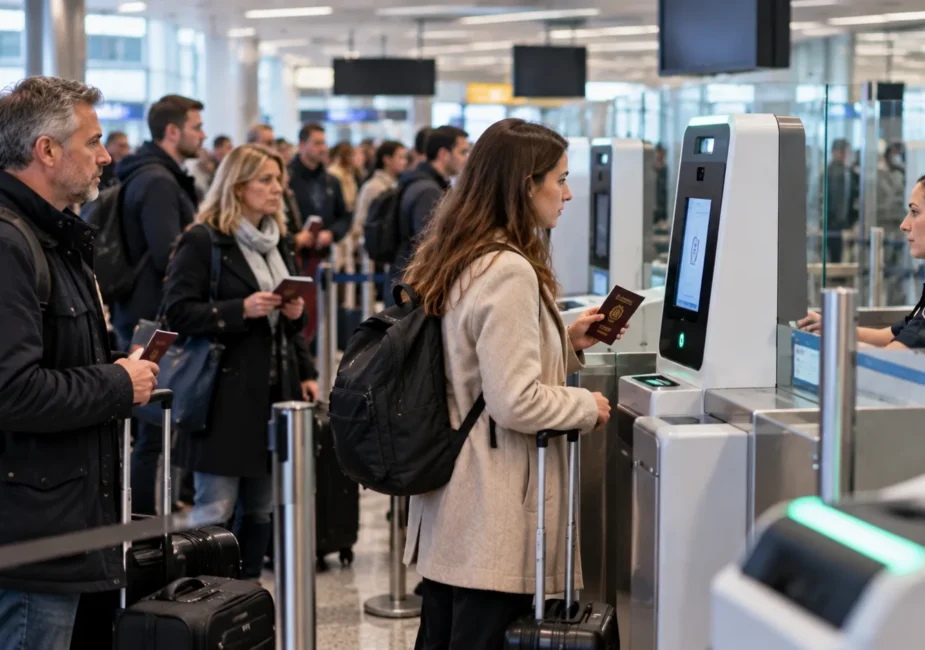
EU Entry Exit System problems remain a concern for UK travellers even though the new digital border system has been fully operational in principle since 10 April 2026.
The transition from passport stamping to biometric entry and exit records has exposed differences in technology, staffing, airport capacity and border-control procedures across Europe.
The situation has also changed significantly since the spring. A temporary legal safeguard that allowed biometric collection to be eased during exceptional congestion expired on 6 September 2026.
Yet implementation remains uneven, while some passengers at Brussels Airport faced waits of up to five hours in late September.
For travellers, the main issue is no longer simply when EES will launch. It is understanding how the system works in practice, how to protect an accurate travel record and how to allow for disruption.
What Changed for EES After 6 September 2026?
EES began its progressive introduction on 12 October 2025 and reached its formal full-operation date on 10 April 2026.
During the transition, participating countries had limited flexibility to reduce biometric processing when severe congestion developed.
A post-rollout safeguard allowed a border crossing facing exceptional traffic and excessive waits to suspend biometric collection for up to six hours while continuing other registration processes.
The initial period could be extended by 60 days if the required proportion of traveller records did not contain biometric data. That temporary mechanism ultimately ran until 6 September 2026.
Nine countries had pushed for greater flexibility beyond that date:
- Belgium
- France
- Germany
- Greece
- Italy
- Malta
- Netherlands
- Portugal
- Switzerland
Reports since the deadline indicate that full biometric processing is still not being applied continuously at every crossing in those countries.
No equivalent formal extension of the expired temporary safeguard had been publicly established by early October.
This explains why two passengers visiting different European airports can still have very different EES experiences.
Why Are EU Entry Exit System Problems Still Causing Long Queues?
The difficulties are not caused by one fault. EES adds technology, biometric capture and database checks to border processes that already operate under heavy passenger pressure.
At Brussels Airport, some non-Schengen arrivals waited up to five hours at border control during the final week of September.
Technical EES problems and greater reliance on staffed passport-control desks contributed to the disruption.
The main operational pressures include:
| Problem | How It Affects Travellers |
|---|---|
| Biometric registration | First registrations can take longer than traditional passport checks |
| Technical failures | Kiosks, scanners or database connections can require manual intervention |
| Staffing shortages | More passengers may be directed to a limited number of staffed desks |
| Airport design | Older terminals may lack space for additional registration and queueing areas |
| Training requirements | Border staff need to manage new equipment, exceptions and record issues |
| Arrival peaks | Several non-Schengen flights landing together can quickly overwhelm capacity |
| Fingerprint problems | Unsuccessful scans can require repeated attempts or officer assistance |
This means a small delay per passenger can turn into a substantial queue when hundreds of travellers arrive together.
Where Is EES Implementation Still Uneven?
Travellers should not assume that every European country, airport or border point is using exactly the same process.
| Location or Group | Position Travellers Should Know |
|---|---|
| Belgium, France, Germany, Greece, Italy, Malta, Netherlands, Portugal and Switzerland | Some border points have continued to experience incomplete or variable biometric implementation |
| Ireland | Does not operate EES |
| Cyprus | Does not operate EES |
| Sweden | Supports passport data, facial image and questionnaire pre-registration through the Travel to Europe app |
| Portugal | App support currently covers the entry-conditions questionnaire |
| Dover, Folkestone and St Pancras | EES checks take place before departure from the UK because French border controls are carried out on UK soil |
Ireland and Cyprus remain outside EES, although different immigration requirements still apply when travelling there.
The Channel crossings also require special attention. Earlier in 2026, technical integration delayed full biometric use at Dover, Folkestone and St Pancras.
Travellers should therefore avoid relying on old reports saying fingerprints will definitely be taken or definitely skipped. Current instructions from the relevant operator should take priority.
What Actually Happens During an EES Border Check?
EES electronically records short-stay travellers who are subject to the system.
For a visa-exempt UK visitor, the process can include:
- Scanning the passport.
- Recording passport and personal information.
- Taking a facial image.
- Scanning four fingerprints for travellers aged 12 and over.
- Recording the date and location of entry or exit.
- Checking the traveller’s remaining permitted stay.
Children under 12 are still subject to EES where applicable, but their fingerprints are not scanned.
Later journeys should normally rely on the existing digital record plus biometric verification rather than repeating the complete initial enrolment process.
Can the Travel to Europe App Skip the EES Kiosk?
No. The app does not replace border control and should not be described as a way to bypass EES.
Eligible travellers with biometric passports can use it within 72 hours of a journey at supported border points to pre-register certain information. Its functionality currently varies by country.
Sweden supports passport information, a facial image and the travel questionnaire. Portugal currently supports the questionnaire. Other participating countries may add support later.
The app is optional. Travellers must still follow the instructions given by border officers.
How Does EES Affect the 90/180-Day Rule?
EES does not create a new short-stay allowance. British visitors are generally still limited to 90 days in any rolling 180-day period across the countries covered by the Schengen short-stay rules.
What changes is enforcement. Entries and exits are now recorded electronically, making it easier for authorities to identify possible overstays.
The common misunderstanding is that leaving the Schengen area resets the 90 days. It does not.
For example, imagine a traveller spends:
- 30 days in Europe during May
- 30 days from mid-June to mid-July
- 30 days during August
That traveller has used 90 days within the relevant rolling 180-day window. Leaving for several days does not automatically create another 90-day allowance.
Travellers should also be careful when relying on automated day counters during the transition.
The current EES online calculation does not include time spent in the Schengen area before 10 April 2026, even where those days may still fall inside a traveller’s relevant 180-day period.
What Should You Do If Your EES Record Is Wrong?
Missing or incorrect entry and exit records matter because they can make a lawful stay appear longer than it actually was.
Travellers should retain useful evidence such as boarding passes, flight confirmations, ferry or rail tickets, hotel bookings and other records showing when they entered or left the Schengen area.
People covered by EES have the right to request access to their personal data and to ask for inaccurate or incomplete information to be corrected.
Unlawfully processed information can also be challenged. Requests should normally be made to the relevant authority in a participating country, preferably one connected with the journey concerned.
Do not wait until the next holiday if an error is already known. A disputed exit record is easier to address when supporting travel evidence is still available.
Who Does Not Normally Need EES Registration?
EES mainly concerns non-EU nationals entering participating European countries for short stays.
People outside its normal scope include many:
- EU, Icelandic, Liechtenstein, Norwegian and Swiss nationals
- Holders of valid residence permits
- Holders of qualifying long-stay visas
- Certain family members holding recognised residence cards
- Withdrawal Agreement beneficiaries carrying the required residence documentation
- Travellers covered by specific border-control exemptions
British citizens legally resident in an EU country should carry the residence document that establishes their status.
For example, eligible UK residents in Spain should travel with their valid residence documentation rather than assuming their passport alone will demonstrate exemption from EES registration.
Children under 12 should not be described as exempt from EES entirely. They are generally exempt from fingerprint collection, not necessarily from the system itself.
What Happens If EES Delays Cause You to Miss a Flight?
Border-control delays can create problems both when entering Europe and when travelling home.
For the return journey, allow enough time for exit immigration procedures as well as airline check-in and security. Once a gate is announced, avoid leaving passport control until the final moment.
If a serious border delay causes a missed departure:
- Contact the airline or transport operator immediately.
- Ask whether rebooking is available.
- Keep boarding passes and booking confirmations.
- Record the length of the queue where practical.
- Retain receipts for replacement travel, food or accommodation.
- Check the exact wording of the travel insurance policy.
Travel insurance does not automatically cover every missed flight caused by immigration queues. Some policies include missed-departure protection, while others apply exclusions or narrowly defined qualifying events.
Airport fast-track products and lounge access should also not be treated as a way around EES. They may speed up security or improve waiting time, but they do not remove immigration requirements.
Are Fake EES and ETIAS Websites Becoming a Risk?
Travellers should be cautious about websites asking for payment to complete an EES registration.
EES registration itself is free and takes place as part of the border process. There is no mandatory paid EES travel authorisation that a British holidaymaker needs to purchase before travelling.
ETIAS is a separate system.
As of 2 October 2026, ETIAS is not operational and applications are not being collected. Current information still lists an eventual application fee of €20, with applicants under 18 or over 70 exempt from that fee. An exact launch date has not yet been announced.
| System | Purpose | Current Fee | Status on 2 October 2026 |
|---|---|---|---|
| EES | Records border entry and exit | Free | Operational |
| ETIAS | Pre-travel authorisation | €20 | Not yet accepting applications |
| UK ETA | Permission to travel to the UK for eligible visitors | £20 | Operational |
| US ESTA | US Visa Waiver travel authorisation | $40.27 | Operational |
Avoid websites that imitate official application services or claim that paying an additional fee can guarantee approval or faster EES processing.
What Should Travellers Do for October Half-Term and Winter 2026?
October half-term, Christmas travel and the winter ski season will put further pressure on busy border points.
Travellers can reduce avoidable problems by checking the latest instructions for both directions of the journey rather than focusing only on departure from the UK.
Allow additional time where the airline, railway company, ferry operator or airport recommends it. Avoid very tight onward connections after entering the Schengen area, particularly when several flights are scheduled to arrive close together.
It is also important to separate EES from airport security. EES is an immigration procedure, while cabin-baggage screening follows separate rules. Travellers preparing to fly from Britain should check current UK airport liquid rules as part of their wider airport planning.
For flights from Britain to the Schengen area, the main EES entry check normally occurs after arrival in Europe, so arriving at a UK airport four hours early will not prevent a long EES queue at the destination.
The position is different at Dover, Folkestone and London St Pancras because French border checks are carried out before passengers leave the UK.
Is EES Delivering Any Benefits Despite the Problems?
The operational problems do not mean the system has no border-control effect.
By 10 April 2026, more than 52 million entries and exits had already been recorded. More than 27,000 refusals of entry had been registered, including almost 700 cases involving people identified as posing a security threat.
The long-term objective is to replace manual passport stamps with a more consistent digital record, improve overstay detection and make identity checks more reliable.
The immediate challenge is making those benefits work without creating unacceptable delays for legitimate travellers.
Conclusion
EU Entry Exit System problems have shifted from an April rollout issue into a wider operational challenge involving technology, staffing, biometric capacity and inconsistent implementation between border points.
For UK travellers, preparation now means more than simply allowing extra time.
They should understand the 90/180-day rule, keep evidence of previous journeys, carry residence documents where relevant and check procedures for both entry and departure.
The temporary congestion safeguard has expired, but the practical rollout is still uneven.
With autumn half-term, Christmas journeys and winter travel approaching, checking current border and transport instructions before every trip remains the safest approach.
FAQs About EU Entry Exit System Problems
Can airports still pause EES when queues become too long?
The specific temporary mechanism that permitted a short partial suspension of biometric collection because of exceptional congestion expired on 6 September 2026. Actual processing can still differ between borders because of technology, local procedures and operational conditions.
Can an incorrect EES record affect future travel?
Potentially, yes. Entry and exit records are used to determine compliance with short-stay rules. Travellers have rights to request access to their data and correction of inaccurate information.
Is ETIAS required for British travellers now?
No. As of 2 October 2026, ETIAS is not operational and applications are not currently being accepted.
Do British residents in the EU have to register with EES?
Many holders of qualifying residence permits, long-stay visas or Withdrawal Agreement residence documents are outside normal EES registration requirements. They should carry valid evidence of their residence status when crossing the border.
Does EES apply when travelling to Ireland or Cyprus?
No. Ireland and Cyprus do not operate EES.