Andy Burnham Property Tax Proposals: Stamp Duty and Council Tax Overhaul Explained
 • June 30, 2026

Editorial and financial-information notice: This article distinguishes current law from political statements, historical proposals, third-party campaign modelling and media reporting. It provides general information only and is not personalised tax, legal, mortgage or investment advice. Readers should check current GOV.UK guidance and obtain advice from a suitably qualified professional before making a significant property or financial decision.
Policy status at 30 June 2026: No detailed Burnham property-tax policy, draft legislation or implementation date has been published. Existing Council Tax and Stamp Duty Land Tax rules remain in force.
Andy Burnham’s public statements could eventually influence major changes to Council Tax, Stamp Duty and the taxation of land or property in England. However, several ideas discussed in recent coverage remain undeveloped, uncosted or attributable to campaign organisations rather than to a published government policy.
Burnham has publicly called Council Tax “highly regressive” and questioned whether it remains justifiable to base English bills on 1991 property values. He has also supported land-based taxation in the past, including replacing Stamp Duty with a Land Value Tax.
Recent reports have linked him with Fairer Share’s 0.48% annual Proportional Property Tax, but that precise rate and model should not be treated as a final Burnham policy unless he publishes and adopts it.
This guide separates Burnham’s documented statements from historical positions, third-party campaign modelling and political speculation. It then explains the possible implications for homeowners, first-time buyers, landlords, tenants and households in Preston and the wider North West.
Quick Answer: What Are Andy Burnham’s Property Tax Proposals?
Andy Burnham has publicly supported substantial reform of property taxation. His clearest recent position is that Council Tax is regressive and that continued reliance on 1991 property valuations in England is difficult to justify. He has also previously advocated replacing Stamp Duty with an annual Land Value Tax.
Fairer Share, a property-tax reform campaign, proposes replacing Council Tax and Stamp Duty on most owner-occupied home purchases with a Proportional Property Tax charged at 0.48% of a home’s current value.
Recent reporting has linked Burnham with the campaign’s approach, but no Burnham-authored policy document has confirmed that he would introduce its model unchanged.
There is currently no confirmed Burnham policy setting out:
- A final annual property tax rate
- A definite date for abolishing Council Tax
- A definite date for abolishing Stamp Duty
- Exemptions, discounts or transitional protections
- The valuation and appeals process
- How revenue would be distributed between local authorities
- The territorial scope and whether separate devolved legislation would be required
Key Takeaways:
- Andy Burnham has clearly supported reforming Council Tax and has previously advocated replacing Stamp Duty with a Land Value Tax.
- However, the frequently quoted 0.48% annual property tax is Fairer Share’s Proportional Property Tax model. It is not yet a fully confirmed Burnham policy.
- A move from transaction taxes to annual property taxation could reduce upfront moving costs and help some owners of lower-value homes. It could also create higher recurring bills for owners of expensive properties and cash-flow problems for people with valuable homes but modest incomes.
- For Preston households, a nationally proportional system could produce lower illustrative bills than the current Band D Council Tax charge in some examples. Actual outcomes would depend on valuations, local funding arrangements and transitional protections.
- Current Council Tax and Stamp Duty Land Tax rules remain in force; campaign rates should not be used as a substitute for an official calculation.
What Has Andy Burnham Actually Said About Property Tax?
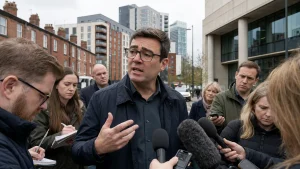
During his Makerfield by-election campaign launch on 22 May 2026, Burnham said he was keen to see Council Tax reform, described the tax as highly regressive and argued that reliance on 1991 property valuations was not justifiable. He also said there was a strong case for changing the taxation of land, business and property.
That is a clear expression of support for reform. It is not, by itself, a complete plan to replace Council Tax with one particular system.
A final proposal would need to answer difficult questions about property valuations, local government funding, discounts, payment collection, appeals and protection for households whose bills increased.
As of 30 June 2026, no detailed Burnham manifesto or draft legislation has answered those questions. HomeOwners Alliance has likewise noted the absence of detailed property-tax proposals.
Why does Burnham consider Council Tax regressive?
A tax is generally described as regressive when lower-income households or owners of less valuable homes pay a larger proportion of their income or property value than wealthier households.
Council Tax bills vary by local authority and valuation band, but the differences between bands are relatively narrow compared with the large differences in present-day property values. A modest home in one part of England can therefore face a bill similar to, or higher than, a property worth several times more in another area.
This regional imbalance is central to Burnham’s argument. It is also why reform attracts interest in northern towns and cities where Council Tax can represent a comparatively high proportion of household income or property value.
Why are 1991 property values still being used?
GOV.UK confirms that Council Tax bands in England are based on what a property would have sold for on the open market on 1 April 1991. Properties are placed in bands A to H, with Band A covering values of up to £40,000 and Band H covering values above £320,000 at that valuation date. Wales uses a different valuation date and different bands.
A newly built or recently purchased home is not simply placed into a band using its current sale price. The Valuation Office assesses what its value would have been at the relevant historical valuation date.
This system creates understandable confusion. House prices have not risen uniformly across England since 1991, meaning current market values and historical Council Tax bands do not always move together.
Does Andy Burnham Want to Replace Stamp Duty?
Burnham has supported replacing Stamp Duty with a Land Value Tax in the past.
In an article he wrote during the 2010 Labour leadership campaign, Burnham proposed an annual tax on the market rental value of land and said it could allow Stamp Duty to be abolished.
That historical position remains relevant because Burnham has continued to argue that land is undertaxed and property taxation requires reform. However, a policy proposed in 2010 should not automatically be presented as the exact scheme he would implement in 2026.
The important distinction is that Burnham has expressed support for land-based taxation and Stamp Duty reform, but the rate, tax base and implementation process remain unsettled.
What Is the Reported 0.48% Annual Property Tax?
The widely reported 0.48% figure comes from Fairer Share’s Proportional Property Tax proposal.
Fairer Share’s published materials propose replacing Council Tax, Stamp Duty on owner-occupied home purchases and the so-called Bedroom Tax with an annual charge equal to 0.48% of a property’s current value.
The campaign would make property owners responsible for the bill rather than occupiers, use sales data and an algorithm-supported valuation process, and permit owners unable to pay to defer the liability.
Fairer Share says its model would lower property-tax costs for most households. Those figures are campaign estimates produced by the organisation advocating the policy; they are not an independent government forecast, a Treasury costing or evidence of what Burnham would ultimately adopt.
Is the 0.48% rate a confirmed Burnham policy?
No detailed Burnham policy document has confirmed that every owner would pay exactly 0.48% of their property’s value.
Recent media reports have associated Burnham with Fairer Share or its wider approach, but his documented public comments have focused more broadly on reforming Council Tax and changing the taxation of land and property.
HomeOwners Alliance describes the Fairer Share model as a possible direction while emphasising that detailed proposals have not been published.
It is therefore safer to describe 0.48% as an influential proposal under discussion rather than a guaranteed future tax rate.
Is a Proportional Property Tax the Same as a Land Value Tax?
A Proportional Property Tax and a Land Value Tax are related ideas, but they are not identical.
Proportional Property Tax
A Proportional Property Tax is normally calculated using the current value of the entire residential property. That includes the land and the building standing on it.
Under the Fairer Share model, a home valued at £300,000 would generate an illustrative annual bill of £1,440 because £300,000 multiplied by 0.48% equals £1,440.
Land Value Tax
A Land Value Tax is based on the value of the underlying land rather than the total combined value of the land and buildings.
In theory, improving a property by renovating or extending it would not necessarily increase the Land Value Tax by the same amount as a tax on the whole property. Location, planning permission, transport connections and development potential would have a greater influence.
Why Does the Difference Matter?
The two systems require different valuation methods and can distribute tax liabilities differently.
A national Proportional Property Tax could be easier for readers to understand because it applies a percentage to a whole property value. A Land Value Tax could create different results for flats, large rural properties, city-centre plots and homes where the building represents most of the overall value.
Articles that use “Land Value Tax” and “property tax” interchangeably can therefore give readers an inaccurate impression of what has been proposed.
How Much Could a 0.48% Property Tax Cost?

The following examples show the arithmetic behind Fairer Share’s 0.48% model. They are illustrations rather than confirmed future tax bills.
| Current property value | Illustrative annual tax at 0.48% | Monthly equivalent |
|---|---|---|
| £150,000 | £720 | £60 |
| £200,000 | £960 | £80 |
| £250,000 | £1,200 | £100 |
| £300,000 | £1,440 | £120 |
| £500,000 | £2,400 | £200 |
| £750,000 | £3,600 | £300 |
| £1 million | £4,800 | £400 |
These calculations should not be used alone to decide whether a household would gain or lose.
A proper comparison would also need to consider:
- The household’s existing Council Tax bill
- Council Tax discounts or support
- Whether the person rents or owns
- How frequently the owner expects to move
- Any Stamp Duty saving
- Transitional limits on bill increases
- Deferral eligibility, interest and repayment terms
- Treatment of second homes, empty homes and non-resident ownership
- The final valuation, review and appeals method
Fairer Share proposes capping an immediate increase at £1,200 a year and allowing owners unable to pay to defer the liability, potentially until the property is sold. Its FAQ says a modest interest rate would apply to deferred amounts. These are features of Fairer Share’s campaign model, not confirmed legislative protections.
What Could Happen to Stamp Duty?
Stamp Duty Land Tax is currently charged when a person buys property or land above the relevant threshold in England or Northern Ireland. Scotland uses Land and Buildings Transaction Tax, while Wales uses Land Transaction Tax.
Under the GOV.UK rates in force on 30 June 2026, a standard purchase of one residential property in England or Northern Ireland is charged at 0% on the first £125,000, 2% on the portion from £125,001 to £250,000, and 5% on the portion from £250,001 to £925,000.
Higher bands apply above that level, while different reliefs or surcharges can apply to first-time buyers, additional properties and certain non-UK resident transactions.
Supporters of Stamp Duty reform argue that the tax increases the upfront cost of moving. It may particularly affect households seeking to move for work, families needing a larger property and older owners considering downsizing.
Replacing a transaction tax with an annual property tax would move the cost from the moment of purchase to the entire period of ownership. Buyers might face a smaller upfront tax bill but a higher recurring cost.
Would First-time Buyers Benefit?
Qualifying first-time buyers currently pay no SDLT on the first £300,000 of a purchase and 5% on the portion between £300,001 and £500,000. No first-time buyer relief is available when the purchase price exceeds £500,000.
Abolishing Stamp Duty would therefore provide the greatest immediate benefit to first-time buyers who would otherwise pay it. Someone buying below the existing relief threshold might receive little or no upfront tax saving but would still become responsible for an annual property tax after purchasing.
Whether a first-time buyer gained overall would depend on the purchase price, length of ownership and final annual rate.
Would Stamp Duty Remain for Second Homes?
Fairer Share proposes retaining Stamp Duty for second-home and non-resident purchases. It also proposes a higher annual rate of 0.96% for empty, second and non-resident-owned homes.
These rates are campaign proposals. They should not be described as confirmed Burnham tax rules.
Who Could Benefit From a Property Tax Overhaul?
The winners would depend on the final design, but several groups could potentially benefit.
Owners of Lower-value Homes
Owners whose existing Council Tax bill is high relative to the current value of their home could pay less under a nationally proportional system.
This is one reason the debate has attracted support in parts of northern England. A fixed percentage of current value could shift some of the overall burden towards higher-value properties, particularly in London and the South East.
Home Movers and Downsizers
People who move frequently can pay Stamp Duty more than once during their lives. Removing or reducing the tax could lower the upfront cost of changing homes.
Older homeowners who want to downsize might find it easier to move without a large transaction-tax bill. However, they would still need to compare the annual tax on their existing property with the annual tax on a smaller home.
Some First-time Buyers
First-time buyers purchasing above the current relief thresholds could save a substantial upfront amount if Stamp Duty were abolished.
The trade-off would be a recurring annual liability based on the property’s value.
Tenants
Fairer Share proposes transferring legal liability for the new tax from tenants to property owners. Under that model, tenants would no longer receive a Council Tax bill directly.
That would not necessarily insulate tenants from the economic cost. Fairer Share’s own FAQ acknowledges that landlords might pass on some or all of the charge through rent, although their ability to do so would depend on local demand, housing supply, affordability and tenancy regulation.
Who Could Pay More?

Owners of High-value Properties
A percentage-based charge produces a larger bill as a property’s current value rises.
An owner of a £1 million home would face an illustrative annual charge of £4,800 at 0.48%, before considering discounts, caps or other rules.
Property-rich but Cash-poor Homeowners
Some pensioners and lower-income owners live in valuable homes but have limited disposable income. A recurring tax based on current property value could create cash-flow pressure even when the owner has no intention of selling.
Deferral arrangements could help with cash flow, but deferred bills could accumulate, attract interest and eventually be paid from sale proceeds or an estate. Any final legislation would need to define eligibility, interest, repayment triggers, protections and the effect on inheritance.
Landlords and Second-home Owners
A higher tax on additional properties could increase landlords’ costs. Possible responses could include accepting lower returns, increasing rents where the market allows, selling properties or changing investment plans.
The final effect on tenants and rental supply would depend on the wider housing market and the precise policy design.
How Could Andy Burnham’s Property Tax Proposals Affect Preston Homeowners?
Preston provides a useful example because the impact of a national property tax could look very different from the impact in high-value parts of London.
Preston City Council states that the total 2026/27 Council Tax bill for a Band D property is £2,564.22. The council retains only part of that amount, with the remainder allocated to Lancashire County Council, policing and fire services.
Under a simple 0.48% calculation:
- A £200,000 home would produce a bill of £960 a year.
- A £250,000 home would produce a bill of £1,200 a year.
- A £300,000 home would produce a bill of £1,440 a year.
Those figures appear lower than Preston’s published Band D total, but the comparison is not straightforward. A home’s present market value does not determine its current Council Tax band directly, and households can receive discounts or Council Tax Support. A national reform would also need to decide how local services continued to receive adequate funding.
Real-life Example: A Preston Homeowner Planning to Move
Consider a fictional homeowner named Sarah.
Sarah owns a home in Preston worth approximately £200,000. Assume it is in Council Tax Band D and she currently pays the standard published Band D amount before any discounts. She is considering selling it and buying a £275,000 home as her replacement main residence.
Under current SDLT rates, the tax on a standard £275,000 purchase would be:
- 0% on the first £125,000
- 2% on the next £125,000, producing £2,500
- 5% on the remaining £25,000, producing £1,250
- Total SDLT: £3,750
Under Fairer Share’s illustrative 0.48% model, a £275,000 home would instead produce an annual charge of £1,320.
Sarah might therefore avoid a £3,750 upfront transaction tax but accept an annual property-tax liability. Whether she saved money over five, ten or twenty years would depend on what happened to Council Tax, how the property was valued, future tax rates and whether transitional protections applied.
This example is deliberately simplified. It does not account for reliefs, valuation changes, local supplements or personal circumstances.
Could Property Reform Affect Preston House Prices?
It is possible, but no reliable house-price forecast can be made from an undeveloped campaign proposal.
Lower transaction costs could encourage more people to move, potentially increasing the number of homes entering the market. Lower annual taxes on some Preston properties could also make them more attractive relative to similarly sized homes in higher-value areas.
On the other hand, buyers consider total monthly housing costs. Mortgage rates, wages, deposits, insurance, maintenance and annual property taxes would all affect affordability.
Any house-price effect would therefore sit alongside much larger economic influences, including interest rates, employment, construction levels and mortgage availability.
Would the Proposals Be Fairer Than Council Tax?
There are credible arguments on both sides.
Arguments in Favour of Reform
Supporters argue that a new system could:
- Link bills more closely to present property values
- Reduce regional inequalities
- Lower the upfront cost of moving
- Remove tenants from direct property-tax liability
- Replace outdated valuation bands
- Make owners of highly valuable properties contribute more
- Encourage more efficient use of property and land
Arguments Against Reform
Critics may argue that it could:
- Produce large annual bills for some homeowners
- Penalise people whose homes rose in value without their incomes rising
- Create disputes over automated valuations
- Place additional pressure on landlords and tenants
- Introduce uncertainty into the housing market
- Require complex transitional arrangements
- Disrupt the funding received by individual local authorities
The central challenge is not simply deciding whether Council Tax is flawed. It is designing a replacement that raises sufficient revenue, protects vulnerable households and remains practical to administer.
Confirmed Facts, Proposals and Speculation
| Claim | Current status |
|---|---|
| Andy Burnham supports Council Tax reform | Confirmed public position |
| Burnham has called Council Tax highly regressive | Confirmed public statement |
| Burnham has questioned the use of 1991 valuations | Confirmed public statement |
| Burnham previously supported replacing Stamp Duty with a Land Value Tax | Confirmed historical position |
| Fairer Share proposes a 0.48% Proportional Property Tax | Confirmed campaign proposal |
| Every homeowner will pay 0.48% under Burnham | Not confirmed |
| Council Tax and Stamp Duty have already been abolished | False |
| A new Burnham property tax has passed through Parliament | False |
| A definite implementation date has been announced | Not confirmed |
| The policy would apply identically throughout the UK | Not confirmed and unlikely without separate legislation |
The most misleading claim is that a 0.48% charge has already been finalised. The figure is real, but it comes from Fairer Share’s model. No complete Burnham proposal has yet established that the campaign’s design would be adopted without changes.
How Is This Different From Current Government Council Tax Changes?

The Burnham and Fairer Share debate should not be confused with changes already being developed by the government.
A separate High Value Council Tax Surcharge is planned for owners of residential properties in England worth £2 million or more. The government consultation published on 19 May 2026 proposes four annual charges: £2,500, £3,500, £5,000 and £7,500, depending on the property-value band.
Existing Council Tax would continue alongside the surcharge, which is intended to begin in April 2028. The consultation remains open until 14 July 2026, so details may still change.
This is not the same as replacing Council Tax with a universal 0.48% annual tax.
The government has also announced administrative Council Tax reforms. Newly liable taxpayers are intended to move to default 12-month billing from April 2027, with the wider default applying from April 2028; households will retain the right to request 10-month billing.
Other enforcement and support changes are intended to begin from April 2027. None of these measures amounts to abolishing Council Tax.
Misinformation and False Claims to Avoid
“Burnham has confirmed a 0.48% tax on every home”
This is not supported by a published, detailed Burnham policy. The 0.48% rate belongs to Fairer Share’s proposal.
“Every homeowner in the North will save money”
Not necessarily. Results would vary according to property value, current Council Tax, discounts, ownership status and final transition rules.
“Tenants would have no housing-tax costs”
Fairer Share would remove tenants’ direct legal liability, but its own materials acknowledge that landlords might pass on some or all of the cost through rent.
“A Land Value Tax and Proportional Property Tax are identical”
They are different. One focuses on the value of land; the other generally taxes the value of the entire property.
“The plan would automatically apply across the UK”
Property taxation is devolved and differs between the nations. SDLT applies in England and Northern Ireland, while Scotland and Wales use separate transaction taxes. Council Tax valuation systems also differ.
“The reform is already law”
It is not. Homeowners, landlords, tenants and buyers must continue to follow the existing rules.
What Should Homeowners and Buyers Do Now?
No one should make an immediate property, mortgage or investment decision solely because of these proposals.
For now, readers should:
- Budget using the current Council Tax and Stamp Duty rules.
- Treat online property-tax calculators as illustrations rather than forecasts.
- Check whether a report describes Burnham’s own policy or Fairer Share’s campaign.
- Look for a formal policy document, Treasury costing, consultation or Bill.
- Check whether any announcement applies to England, Northern Ireland, Scotland or Wales.
- Use the current GOV.UK calculator or published rates when estimating Stamp Duty.
- Seek suitably qualified tax, legal, mortgage or financial advice before making a major decision.
Political proposals can change substantially during consultations and parliamentary scrutiny. Rates, exemptions and implementation dates may all be revised before legislation is passed.
Conclusion
The Andy Burnham property tax proposals have opened an important debate about whether England should continue relying on Council Tax bands based on 1991 values and Stamp Duty charges that arise whenever people move home.
Burnham’s confirmed position is that substantial reform is needed. His historical support for Land Value Tax also shows that he has considered moving taxation away from property transactions and towards land or property ownership.
What remains uncertain is the final structure. The 0.48% Proportional Property Tax provides one possible model, but readers should not assume that its rate, exemptions or transition rules are guaranteed.
Until a formal proposal is published, the most accurate conclusion is that a Stamp Duty and Council Tax overhaul is possible, but its cost to individual households cannot yet be known.
Frequently Asked Questions
Has Andy Burnham confirmed a 0.48% annual property tax?
No complete Burnham policy has confirmed that every owner would pay 0.48% of their home’s value. That rate comes from Fairer Share’s Proportional Property Tax model, which has been linked to the wider debate around Burnham’s support for property-tax reform.
Would the new property tax replace both Council Tax and Stamp Duty?
Fairer Share proposes replacing Council Tax and most ordinary residential Stamp Duty with one annual tax. Burnham has supported reform of both taxes, but he has not yet published a final plan confirming that exact replacement structure.
How would my property be valued?
Fairer Share proposes valuations based largely on sales data, local market movements and an algorithm-supported process administered through the Valuation Office Agency. No official Burnham valuation methodology, appeals process or revaluation timetable has been published.
Would pensioners be forced to sell their homes?
Fairer Share proposes allowing owners unable to pay to defer the liability, with its FAQ indicating that interest would apply. There is no final Burnham policy, so there is no guarantee about eligibility, interest, repayment triggers or protection from a forced sale.
Could landlords pass the tax on to tenants?
Landlords could attempt to reflect additional costs in rents, but their ability to do so would depend on local rental demand, affordability, supply and tenancy rules. Legal liability and the eventual economic cost are not always borne by the same person.
Would first-time buyers be better off without Stamp Duty?
Some would benefit from a lower upfront purchase cost, particularly those buying above the existing relief threshold. Others already pay little or no Stamp Duty and could face a new annual property charge, so the long-term outcome would depend on the property value and ownership period.
Would the proposals apply in Scotland and Wales?
Not automatically. Scotland and Wales operate separate property-transaction taxes, and Council Tax rules differ between the UK nations. Separate legislation or decisions by devolved governments would probably be required.
Sources and Editorial Standards
Fact-checking method: This article was reviewed on 30 June 2026 using current GOV.UK tax guidance, local-authority data, Burnham’s own historical writing, reputable reporting of his May 2026 statements and Fairer Share’s primary campaign documents. Official sources were prioritised for current law and tax rates; campaign claims were clearly attributed and were not treated as government forecasts.
Update policy: The article should be reviewed immediately after any Burnham manifesto, Treasury costing, formal consultation, draft Bill, enacted legislation or change to Council Tax or Stamp Duty Land Tax rates. It should also be checked after the High Value Council Tax Surcharge consultation closes on 14 July 2026.
- GOV.UK: How domestic properties are assessed for Council Tax bands.
- GOV.UK: Stamp Duty Land Tax residential property rates.
- GOV.UK: Stamp Duty Land Tax overview and geographical scope.
- GOV.UK: High Value Council Tax Surcharge consultation.
- GOV.UK: Modernising and improving the administration of Council Tax – government response.
- Andy Burnham in The Guardian: Land value tax – not old or New but true Labour.
- Financial Times: Andy Burnham says land in the UK is undertaxed.
- Fairer Share: Introducing the Proportional Property Tax manifesto.
- Fairer Share: Property-tax FAQs, proposed rates, landlord effects and deferrals.
- HomeOwners Alliance: Andy Burnham’s potential policies for homeowners.
- Preston City Council: Council Tax rates for 2026/27 and how the Band D bill is spent.