

HMRC Director’s Loan Tax Tribunal: History, Latest Updates and What UK Business Owners Need to Know
 • August 22, 2026
•
1 Comment
• August 22, 2026
•
1 Comment

The HMRC directors loan tax tribunal search commonly refers to disputes over how tax rules apply to overdrawn director’s loan accounts.
There is not a separate tribunal formally called the “HMRC Director’s Loan Tax Tribunal”. These disputes are normally heard in the First-tier Tribunal and, on appeal, the Upper Tribunal (Tax and Chancery Chamber).
The latest significant case is HMRC v Gary Quillan [2026] UKUT 300 (TCC). On 6 August 2026, the Upper Tribunal allowed HMRC’s appeal and ruled that an outstanding director’s loan balance of £382,456 had been written off for tax purposes in the 2018/19 tax year.
The decision is particularly important because the First-tier Tribunal had reached the opposite conclusion in April 2025.
The Upper Tribunal found that, for section 415 purposes, whether a loan has been written off depends on the substance of what happened to the debt rather than simply on the existence of a formal document expressly recording a write-off.
Current Position Detail
Latest Tribunal Ruling HMRC v Quillan [2026] UKUT 300 (TCC)
Decision Date 6 August 2026
Outstanding Loan £382,456
Tribunal Finding Loan was written off
Relevant Tax Year 2018/19
Key Principle Formal write-off wording is not necessarily required
Current Status Upper Tribunal decision is the latest published appellate decision identified as of 22 August 2026
When Were Director’s Loan Tax Rules Introduced in the UK?

Tax rules dealing with loans made by close companies to shareholders and other participators existed before the current Corporation Tax Act 2010 regime.
Before 1 April 2010, the principal company-side provision was section 419 of the Income and Corporation Taxes Act 1988. Section 455 of the Corporation Tax Act 2010 then replaced the earlier provision for loans made from 1 April 2010.
HMRC states that this legislative rewrite did not change the substance or application of the previous regime.
The separate income tax treatment of a loan that is subsequently released or written off appears in section 415 of the Income Tax (Trading and Other Income) Act 2005, commonly shortened to ITTOIA 2005.
This means the modern director’s loan tax system is not a new HMRC policy created by the Quillan case. Quillan instead clarifies how the established concept of a loan being “written off” should be interpreted in a liquidation.
Period Director’s Loan Tax Development
Before April 2010 Section 419 ICTA 1988 applied to relevant close-company loans
2005 Section 415 ITTOIA 2005 established the current income tax framework for released or written-off qualifying loans
From 1 April 2010 Section 455 Corporation Tax Act 2010 applies to relevant loans and advances
From 20 March 2013 Rules were extended and anti-avoidance provisions were strengthened
2016/17 to 2021/22 Section 455 rate was generally 32.5% for relevant new loans
From 6 April 2022 Section 455 rate became 33.75%
From 6 April 2026 Section 455 rate increased to 35.75% for relevant loans made from that date
HMRC’s current guidance confirms that the section 455 rate is linked to the dividend upper rate and increased to 35.75% from 6 April 2026.
History of HMRC Rules on Overdrawn Director’s Loan Accounts
A director’s loan account records transactions between a company and its director. When the director owes money to the company, the account is normally described as overdrawn.
The tax rules become particularly important where the director is also a shareholder or other participator in a close company.
Section 455 can impose a company-side tax charge where a close company makes a qualifying loan or advance to a participator and the relevant statutory conditions are met. HMRC normally considers the position reported through the company’s Corporation Tax return.
The tax position can change again when the director repays the loan, when the company releases it, or when it is written off.
That final category is where the HMRC director’s loan tax tribunal ruling in Quillan becomes especially important.
What Was the HMRC v Quillan Director’s Loan Tax Tribunal Case?
Gary Quillan was the sole director and shareholder of BOH Investments Ltd.
On 16 January 2017, BOH passed a resolution to enter voluntary winding up. At that point, Mr Quillan’s director’s loan account was overdrawn by £439,954.
The liquidator initially sought payment. Following correspondence and the threat of legal proceedings, Mr Quillan offered £57,500 towards the debt.
Between February and July 2018, six payments of £9,583 were made, totalling £57,498. That left an outstanding balance of £382,456.
Quillan Case Fact Detail
Company BOH Investments Ltd
Director And Shareholder Gary Quillan
Liquidation Started 16 January 2017
Original Overdrawn Loan £439,954
Amount Repaid £57,498
Balance Remaining £382,456
Liquidator’s Final Account 18 March 2019
Company Dissolved 15 April 2020
Upper Tribunal Judgment 6 August 2026
The liquidator’s final account dated 18 March 2019 recorded that no further funds were expected in relation to the director’s loan account. The Upper Tribunal ultimately treated that document as the crucial evidence establishing the write-off.
What Did the First-Tier Tribunal Decide in 2025?

The First-tier Tribunal released its decision on 10 April 2025.
It decided that the outstanding balance had not been written off for the purposes of section 415 ITTOIA 2005.
One important issue was the absence of what the FTT considered to be the appropriate formal process for writing off or releasing the debt.
Because the FTT concluded that there had been no write-off, it did not need to determine when any write-off occurred.
This was the position described in the ICAS article supplied as the original reference for this blog.
However, that 2025 ruling is no longer the latest tribunal outcome.
HMRC obtained permission to appeal on 10 July 2025, and the dispute proceeded to the Upper Tribunal.
What Changed at the Upper Tribunal in 2026?
The Upper Tribunal heard the appeal on 23 June 2026 and issued its judgment on 6 August 2026.
It allowed HMRC’s appeal, set aside the relevant First-tier Tribunal decision and dismissed Mr Quillan’s appeal against HMRC’s closure notice for 2018/19.
The tribunal rejected the idea that section 415 required a prescribed formal procedure before a debt could be treated as written off.
It concluded that, in a creditors’ voluntary liquidation, a debt may be written off when the liquidator reaches the conclusion that there is no recoverable value in the debt and records that position in the final report.
The tribunal also explained that a section 415 write-off is fundamentally concerned with substance rather than form. The theoretical possibility that a debt could later be recovered did not prevent it from having been written off for section 415 purposes.
Issue First-Tier Tribunal 2025 Upper Tribunal 2026
Was The £382,456 Written Off? No Yes
Was Formal Process Important? FTT considered the available formal process significant UT held no prescribed formal method was required
Did Potential Future Recovery Prevent Write-Off? Supported the argument against write-off Did not prevent a tax write-off
Relevant Date Not determined 18 March 2019
Relevant Tax Year Not determined 2018/19
Outcome Mr Quillan succeeded HMRC succeeded
HMRC Director’s Loan Tax Tribunal Position Right Now
The Upper Tribunal judgment of 6 August 2026 is the latest published appellate decision identified in this case as of 22 August 2026.
Its practical significance is that directors should not assume an outstanding loan remains outside section 415 simply because:
- No Formal Deed Was Signed
- The Liquidator Did Not Use The Words “Written Off”
- The Debt Technically Continued To Exist
- Future Recovery Remained Theoretically Possible
The facts and substance of what happened to the debt can be more important.
In Quillan, the decisive event was the liquidator’s final account dated 18 March 2019, which made clear that no further funds were expected from the director’s loan. The Upper Tribunal held that this was when the outstanding balance was written off.
The decision therefore creates an important distinction between the legal existence of a debt and whether that debt has nevertheless been written off for tax purposes.
Latest HMRC Director’s Loan Tax Updates and Announcements
There are two particularly relevant developments for UK company owners in 2026.
First, the Upper Tribunal issued the Quillan decision on 6 August 2026, strengthening HMRC’s position on loans that have effectively ceased to be recoverable during liquidation.
Second, the section 455 rate applicable to relevant loans made from 6 April 2026 increased to 35.75%, following the increase in the dividend upper rate.
HMRC’s current guidance on insolvent liquidations and director’s loans in the Company Taxation Manual was updated on 4 August 2026. It states that even where a liquidator has not expressly released or written off an outstanding balance,
HMRC may still argue that a write-off has occurred if the company or liquidator has effectively stopped trying to recover the debt.
There is no basis, however, for saying that the August manual date represents a Quillan-specific policy change. The tribunal judgment and HMRC manual should be treated as separate sources unless HMRC formally states otherwise.
What Does Section 415 ITTOIA 2005 Mean for Director’s Loans?

Section 415 ITTOIA 2005 can impose income tax where the relevant conditions are met and a loan or advance within the close-company loans regime is subsequently released or written off.
The Upper Tribunal summarised the rule in Quillan and confirmed that section 415 was engaged because BOH was a close company, Mr Quillan was a participator and the outstanding debt was treated as written off.
For many owner-managed businesses, a participator will commonly include a shareholder.
A close company is broadly a company controlled by five or fewer participators or by participators who are directors, although the statutory rules contain further detail and exceptions.
The important point for business owners is that section 415 concerns the individual’s tax position when an eligible debt is released or written off. It should not be confused with the company-side section 455 charge.
How Section 455 Corporation Tax Applies to Director’s Loans?
Section 455 operates at company level.
Where a close company makes a qualifying loan or advance to a participator or certain connected persons, a tax charge may arise for the company.
For relevant loans made from 6 April 2026, HMRC’s current section 455 guidance for loans to participators confirms that the tax rate is 35.75%, up from 33.75% for loans made from 6 April 2022.
UK business owners reviewing older articles should therefore check the date carefully, as some guidance may still refer to the previous 33.75% rate.
Provision Who It Primarily Affects What It Does
Section 455 CTA 2010 Company Can impose a tax charge when a close company makes a qualifying loan
Section 458 CTA 2010 Company Can provide relief when qualifying conditions are met after repayment, release or write-off
Section 415 ITTOIA 2005 Borrower Or Participator Can impose income tax when the qualifying loan is released or written off
Class 1 NIC Rules Company And Individual Where Relevant May apply if a write-off is remuneration or profit derived from employment
HMRC confirms that relief under section 458 can arise where a qualifying loan is subsequently repaid, released or written off.
The existence of company relief does not mean there is no personal tax consequence for the director.
Director’s Loan Release vs Write-Off
One of the most important lessons from the HMRC director’s loan tax tribunal decision is that “release” and “write-off” should not automatically be treated as identical concepts.
In the Upper Tribunal, it was common ground that there had been no release of Mr Quillan’s debt. The case therefore focused on whether the balance had nevertheless been written off.
The Upper Tribunal held that it had.
Point Release Write-Off
General Effect Creditor gives up the debtor’s obligation in the relevant legal sense Debt is treated as having no further recoverable value for the relevant purpose
Formal Documentation May involve an express agreement No prescribed formal method was required in Quillan
Can Section 415 Apply? Yes, subject to statutory conditions Yes, subject to statutory conditions
Does Debt Need To Be Legally Extinguished? Depends on nature of release Quillan shows legal enforceability and tax write-off are not necessarily identical
Evidence To Examine Agreements, correspondence and resolutions Recovery activity, liquidator reports, final accounts and surrounding facts
The exact result depends on the facts of each case. Quillan does not establish that every unpaid director’s loan automatically becomes a section 415 write-off.
What Happens to a Director’s Loan During Company Liquidation?
An overdrawn director’s loan does not simply disappear because a company enters liquidation.
HMRC describes an overdrawn director’s loan account as an asset of the company. A liquidator can therefore seek repayment for the benefit of creditors.
The Insolvency Service also states that money borrowed through a director’s loan remains repayable following insolvency and that a liquidator may take legal action to recover amounts owed.
The outcome can depend on:
- Whether The Liquidation Is Solvent Or Insolvent
- Whether Assets Are Available For Distribution
- Whether The Director Repays Any Part Of The Loan
- Whether A Settlement Is Reached
- Whether The Balance Is Released
- Whether The Balance Is Written Off
- Whether Recovery Efforts Have Effectively Ended
Quillan is important because the Upper Tribunal rejected the argument that the write-off occurred only when BOH was dissolved on 15 April 2020.
It instead found that the operative date was 18 March 2019, when the liquidator issued the final account stating that no further funds were expected.
Company dissolution and tax write-off therefore should not automatically be treated as the same event.
What Should UK Business Owners With an Overdrawn Director’s Loan Do Now?
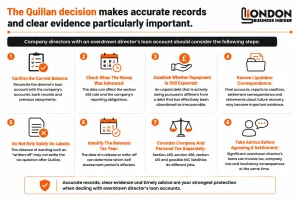
The Quillan decision makes accurate records and clear evidence particularly important.
Company directors with an overdrawn director’s loan account should consider the following steps:
- Confirm the Current Balance: Reconcile the director’s loan account with the company’s accounts, bank records and previous repayments.
- Check When The Money Was Advanced: The date can affect the section 455 rate and the company’s reporting obligations.
- Establish Whether Repayment Is Still Expected: An unpaid debt that is actively being pursued is different from a debt that has effectively been abandoned as irrecoverable.
- Review Liquidator Correspondence: Final accounts, reports to creditors, settlement correspondence and statements about future recovery may become important evidence.
- Do Not Rely Solely On Labels: The absence of wording such as “written off” may not settle the tax question after Quillan.
- Identify The Relevant Tax Year: The date of a release or write-off can determine which Self Assessment period is affected.
- Consider Company And Personal Tax Separately: Section 455, section 458, section 415 and possible NIC liabilities do different jobs.
- Take Advice Before Agreeing A Settlement: Significant overdrawn director’s loans can involve tax, company law and insolvency consequences at the same time.
Future Developments in HMRC Director’s Loan Tax Tribunal Cases
The immediate future issue is how the Quillan Upper Tribunal reasoning is applied to other director’s loan disputes.
The judgment does not mean that HMRC automatically wins every case involving an unpaid loan. Whether a write-off has occurred will remain dependent on the evidence.
Future cases are likely to place particular attention on when a creditor or liquidator objectively concludes that recovery is no longer expected and what documents record that decision.
There is also scope for disputes about timing. Quillan demonstrates that determining whether a debt was written off and determining when it happened can be separate questions.
As of 22 August 2026, the Upper Tribunal judgment remains the latest published appellate decision identified in the Quillan proceedings. No later Court of Appeal judgment has been identified in the official public record reviewed for this article.
Business owners and advisers should therefore monitor:
- Any Further Published Appeal In Quillan
- Future Upper Tribunal Or Court Of Appeal Cases Applying Section 415
- Changes To HMRC’s Company Taxation Manual
- Future Changes To Section 455 Rates
- Legislative Amendments Affecting Close-Company Loans
- HMRC Compliance Activity In Insolvency Cases
Until another higher-court decision or legislative amendment changes the position, the 6 August 2026 Upper Tribunal ruling is the key current authority in the Quillan dispute.
Conclusion: What the HMRC Director’s Loan Tax Tribunal Means for UK Business Owners?
The HMRC directors loan tax tribunal dispute in HMRC v Quillan has become an important case for UK directors, shareholders, accountants and insolvency practitioners dealing with overdrawn director’s loan accounts.
The First-tier Tribunal found in 2025 that the £382,456 outstanding balance had not been written off.
The Upper Tribunal reversed that conclusion on 6 August 2026 and held that the debt was written off on 18 March 2019, when the liquidator’s final account established that no further recovery was expected.
The wider lesson is that tax treatment may depend on what happened in substance, not simply whether a document expressly states that a director’s loan has been written off.
Directors should also keep the different tax rules separate.
Section 455 concerns the company-side loans-to-participators charge, section 458 can provide relief in qualifying circumstances and section 415 can create an income tax charge when a relevant loan is released or written off.
Class 1 NIC may also require consideration in appropriate employment circumstances.
This article provides general information and does not constitute tax, accounting, insolvency or legal advice. Individual circumstances should be reviewed with an appropriately qualified adviser.
Frequently Asked Questions
What Is the HMRC Director’s Loan Tax Tribunal Case?
The main recent case is HMRC v Gary Quillan [2026] UKUT 300 (TCC). It concerned whether an outstanding overdrawn director’s loan was written off for section 415 ITTOIA 2005 purposes during a creditors’ voluntary liquidation.
Did HMRC Win the Quillan Appeal?
Yes. The Upper Tribunal allowed HMRC’s appeal on 6 August 2026, overturned the relevant First-tier Tribunal conclusion and held that the outstanding £382,456 balance had been written off.
When Was the Quillan Director’s Loan Written Off?
The Upper Tribunal held that the operative date was 18 March 2019, when the liquidator’s final account recorded that no further funds were expected. The write-off therefore occurred in the 2018/19 tax year.
Does a Director’s Loan Need a Formal Write-Off Agreement?
Not necessarily for section 415 purposes. The Upper Tribunal held in Quillan that a write-off is a matter of substance and that there is no prescribed formal method that must always be followed.
Does Liquidation Automatically Write Off a Director’s Loan?
No. An overdrawn director’s loan remains an asset of the company, and a liquidator can pursue repayment. Whether a balance is eventually released or written off depends on the facts.
Does Company Dissolution Automatically Cancel a Director’s Loan?
Dissolution should not automatically be treated as the date of tax write-off. In Quillan, the company was dissolved in April 2020, but the Upper Tribunal held that the loan had already been written off in March 2019.
What Is Section 415 ITTOIA 2005?
Section 415 is an income tax provision applying where qualifying conditions are satisfied and a relevant close-company loan or advance is released or written off.
What Is the Current Section 455 Rate in 2026?
For relevant loans made from 6 April 2026, HMRC states that the section 455 rate is 35.75%. It increased from 33.75% because the rate is linked to the dividend upper rate.






[…] Ireland does not use the same Employment Tribunal structure as England, Wales and […]