UK energy prices are going up overall right now. Household energy costs fell in April 2026, but Ofgem increased the Energy Price Cap by 13% from 1 July to 30 September 2026 after wholesale gas prices rose sharply.
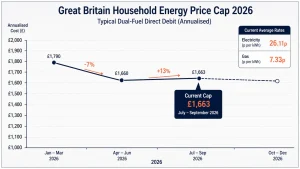
Using Ofgem’s revised definition of typical household consumption, the current annualised figure is around £1,663 for a dual-fuel household paying by Direct Debit.
More importantly, the actual capped rates have risen to an average of 26.11p per kWh for electricity and 7.33p per kWh for gas. The next October-to-December cap has not yet been confirmed, although the latest forecasts point to another modest increase.
Last Updated: 11.08.2026
What Is the Current UK Energy Price Cap?
The current Ofgem Energy Price Cap covers 1 July to 30 September 2026. The regulator announced a 13% increase after the April-to-June cap had fallen by 7%.
The cap does not mean that every household will pay £1,663 or £1,862 a year. It limits the amount suppliers can charge for each unit of gas or electricity and the daily standing charge.
Your actual bill depends on how much energy you use, where you live, your meter and how you pay.
The biggest movement has therefore been in gas. Ofgem said the July change translated into an increase of around 5% in electricity costs but roughly 24% for gas for a typical household.
Why Did Energy Prices Go Up in July 2026?
Energy Price Update 2026
UK Energy Prices: Current Price Cap and Rates
UK household energy prices are going up overall, with Ofgem increasing the Energy Price Cap by 13% for 1 July to 30 September 2026 after wholesale gas prices rose sharply.
Typical Annualised Cost
£1,663
dual-fuel Direct Debit
Electricity Rate
26.11p
average per kWh
Gas Rate
7.33p
average per kWh
📌
Energy Price Reminder:
Ofgem’s July-to-September 2026 Energy Price Cap is 13% higher after the previous cap fell by 7%. The October-to-December cap has not yet been confirmed, although the latest forecasts point to another modest increase.
The main reason energy prices went up in July was higher wholesale energy costs, particularly gas.
Ofgem reported that the wholesale-cost allowance incorporated into the price cap increased by around 28% between the April and July cap periods.
Wholesale costs consequently accounted for about 45% of the July cap, compared with roughly 40% in the previous quarter.
The regulator identified the Middle East conflict that began in late February as the primary driver of recent wholesale-market movements. Concerns surrounding liquefied natural gas supply pushed European and UK gas prices higher.
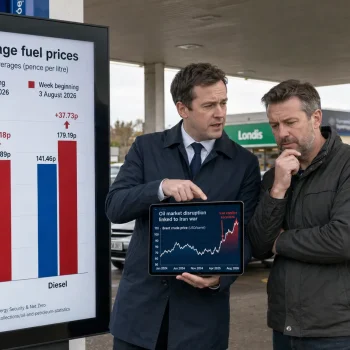
The impact has not been restricted to household energy. Oil and road-fuel markets have also been affected, although petrol and household gas have different pricing systems. The wider effect of the conflict on UK fuel markets is covered in analysis of gas and fuel prices following the Iran conflict.
What Recent Energy Price Announcements Have Been Made in 2026?
Energy policy has changed several times during 2026, which partly explains why households have seen bills move down and then back up.
Date
Announcement
What It Means
25 February 2026
Ofgem announced a 7% fall in the April cap
Typical bills fell from April
18 March 2026
Government published the Warm Homes Plan
More long-term home-efficiency investment
27 May 2026
Ofgem announced a 13% July cap rise
Higher wholesale gas costs pushed bills up
1 July 2026
New Ofgem TDCV figures took effect
Headline “typical bill” calculations changed
21 July 2026
Government announced 0% VAT on domestic electricity from October
Expected to reduce electricity costs
By 26 August 2026
Ofgem will publish the Oct–Dec cap
Next confirmed direction for bills
Ofgem has confirmed that the cap for 1 October to 31 December 2026 will be published by 26 August, meaning households will soon have a confirmed figure for winter rather than relying on forecasts.
What Action Has the Government Taken to Reduce Energy Bills in 2026?
One major intervention took effect in April.
Changes announced in the 2025 Autumn Budget removed the Energy Company Obligation’s funding from household bills and shifted 75% of Renewables Obligation costs into general taxation.
The government estimated that the measures would remove around £150 of costs from average household energy bills, although the effect on the Ofgem price cap for a typical dual-fuel household was calculated differently.
These measures helped the April-to-June price cap fall by £117.
Electricity VAT Will Fall to 0% From October
A newer announcement came on 21 July 2026.
The government said VAT on domestic electricity will be reduced from 5% to 0% from 1 October 2026. It estimates the change could remove around £45 from the annualised Ofgem price-cap figure.
However, the VAT reduction does not automatically mean overall bills will fall in October. Wholesale gas costs have been rising strongly enough that they could offset the tax saving.
What Has Happened to UK Energy Prices From 2021 to 2026?
The current energy-price situation is the result of several years of unusually volatile wholesale markets, government intervention and changes to Ofgem’s price cap.
Wholesale gas prices began climbing during 2021 as global demand recovered and energy supplies tightened.
The situation became significantly worse after Russia’s invasion of Ukraine in February 2022, which disrupted European energy markets and pushed household bills sharply higher.
The government subsequently introduced the Energy Price Guarantee to protect households from the full impact of wholesale prices. From 2023 onwards, energy costs gradually fell from their crisis peaks, although they remained well above pre-crisis levels.
In 2026, the direction has changed again. The price cap fell in April before rising by 13% in July as wholesale gas costs increased.
Period
Energy Price Trend
What Happened
2021
Prices started rising
Global energy demand recovered while gas supplies remained tight, pushing wholesale prices higher.
2022
Prices rose sharply
Russia’s invasion of Ukraine intensified the European energy crisis and caused wholesale gas and electricity costs to surge.
Oct 2022–Jun 2023
Household prices were restricted by government support
The Energy Price Guarantee limited the amount households paid despite extremely high wholesale costs.
Late 2023
Prices began falling
Wholesale energy markets eased and the price cap started coming down from crisis-era levels.
2024
Prices generally declined but continued to fluctuate
Changes in wholesale gas prices resulted in several adjustments to the Ofgem Energy Price Cap.
Apr–Jun 2026
Prices fell
Ofgem reduced the price cap by 7%, helped by lower policy costs and changes to how some energy schemes were funded.
Jul–Sep 2026
Prices increased again
Ofgem raised the price cap by 13% after wholesale gas prices increased significantly.
Oct–Dec 2026
Prices are currently expected to increase slightly
Current forecasts indicate a modest rise, but the final price cap has not yet been confirmed by Ofgem.
Overall, UK energy prices have fallen substantially from the extreme levels seen during the energy crisis, but they have not returned to their pre-2021 levels.
The renewed increase in 2026 also shows that household energy costs remain vulnerable to wholesale gas prices and international events.
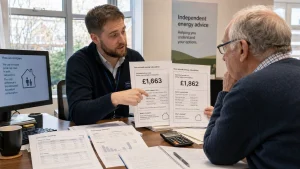
Why Are £1,663 and £1,862 Both Being Reported as the Energy Price Cap?
This is one of the most confusing parts of the 2026 energy-price story.
Neither figure represents a different tariff. They use the same underlying capped rates but different assumptions about household consumption.
Before July, Ofgem’s typical household calculation assumed annual consumption of:
Fuel
Previous TDCV
New 2026 TDCV
Electricity
2,700 kWh
2,500 kWh
Gas
11,500 kWh
9,500 kWh
Using the old consumption assumptions, the July cap is equivalent to £1,862.
Using Ofgem’s revised consumption assumptions, introduced from July, the same cap is presented as approximately £1,663.
The change does not mean households suddenly received a £199 discount. Ofgem revised the calculation because typical household energy consumption has declined.
For that reason, unit rates are a better way to compare what has actually happened to energy prices.
Will Energy Prices Go Down in October 2026?
At the moment, a meaningful fall looks unlikely.
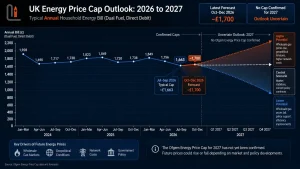
The latest Cornwall Insight Energy Price Cap forecast published after the electricity VAT announcement estimates that the October-to-December cap could be around £1,700 under Ofgem’s new consumption assumptions.
That would be roughly 2% above the current £1,663 figure.
Period
Typical Annualised Figure
Status
Apr–Jun 2026
£1,477 under new TDCV equivalent
Confirmed
Jul–Sep 2026
£1,663
Confirmed
Oct–Dec 2026
Around £1,700
Forecast only
The October number should therefore be treated as a forecast, not a confirmed price. Ofgem will publish the final cap by 26 August 2026.
What Could Make Energy Prices Rise or Fall Again?
Wholesale gas remains the biggest short-term risk.
A sustained reduction in Middle East tensions, more secure LNG supplies, lower European gas demand and stronger storage levels could reduce wholesale prices and eventually feed through to household bills.
Further disruption to production or shipping could do the opposite.
There is also a delay between movements in wholesale markets and Ofgem’s cap. That means today’s fall in gas prices does not necessarily result in cheaper household bills tomorrow, and a sudden market spike may not immediately appear on a domestic bill either.
The long-term picture is also affected by network investment, supplier operating costs, government policy and the cost of upgrading Britain’s electricity system.
Interactive UK Energy Outlook
Where Could Your Energy Bill Be Heading?
Follow the 2026 price-cap journey, test what the latest forecast
could mean for your monthly bill and explore the forces that
could move prices next.
Current typical figure£1,663
July–September 2026
October forecast≈ £1,700
Not yet confirmed
Forecast movement≈ +2.2%
£1,663 → £1,700
The 2026 Energy Price Journey
Household energy prices have not moved in one direction this year.
↓
April 2026Cap Fell 7%
Household costs moved lower.
↑
July 2026Cap Rose 13%
Wholesale gas costs pushed prices higher.
£
Now£1,663
Current typical annualised figure.
?
October 2026≈ £1,700
Latest forecast, not the final cap.
Current£1,663
Latest Forecast≈ £1,700
!
The October figure is a forecast. Ofgem has not yet
confirmed the final October-to-December 2026 Energy
Price Cap.
See What the Forecast Could Mean for Your Bill
Move the slider to your approximate current monthly energy
payment. The tool applies the same percentage movement as
the current £1,663 figure rising to the £1,700 forecast.
£140
£50£400
Your current monthly bill£140.00
Illustrative bill at forecast movement£143.12
Illustrative yearly difference+£37.44
This is an illustrative comparison, not a prediction of your
actual bill. The Energy Price Cap limits unit rates and
standing charges rather than setting a household’s total bill.
What Could Push Energy Prices Up or Down?
Select a factor to see why it matters for future household bills.
Wholesale gas remains the biggest short-term risk.
Falling wholesale prices could eventually reduce household
costs, while renewed supply disruption or market shocks could
put upward pressure on future caps.
Network charges help pay for maintaining and upgrading Britain’s
electricity and gas infrastructure. These costs mean household
bills do not simply rise and fall by exactly the same percentage
as wholesale energy prices.
Government decisions can remove costs from bills or change how
energy-related costs are funded. Policy changes therefore affect
the final price-cap calculation alongside market prices.
The price cap does not cap your total annual bill. It limits
supplier rates, so households that use more gas or electricity
will still normally pay more overall.
Current Average Direct Debit Rates
Electricity26.11p/kWh
Gas7.33p/kWh
26August
The next important date:
Ofgem is due to publish the confirmed Energy Price Cap for
1 October to 31 December 2026 by 26 August.
Are Energy Prices Still Higher Than Before the Energy Crisis?
Yes. Although today’s capped electricity price is well below its crisis peak, gas remains particularly expensive compared with 2021.
House of Commons Library figures show current electricity unit prices at roughly 26.1p/kWh, compared with a crisis peak of around 34p/kWh.
Gas is about 7.3p/kWh, compared with a peak of around 10.3p/kWh. More importantly, current gas unit rates remain around 120% above their mid-2021 level, while electricity is around 38% higher.
This explains why many households do not feel that the energy crisis has completely ended even though headline bills are substantially below their 2022 highs.
Is the Middle East Conflict Affecting UK Energy Prices?
Yes, particularly through wholesale gas.
Ofgem explicitly linked the July price-cap increase to higher wholesale gas costs associated with the Middle East conflict. Wholesale prices used in the cap calculation increased significantly during the relevant observation period.
The House of Commons Library reported that wholesale gas prices doubled in early March following the escalation before falling back from their initial highs. Prices have remained volatile.
The same geopolitical disruption has affected oil and transport fuels, although household gas prices and petrol prices should not be treated as interchangeable. They operate through different markets and reach consumers at different speeds.
What Makes UK Energy Prices Go Up or Down?
Wholesale costs remain the dominant driver of large movements in household energy prices, but they are only one part of a bill.
Network charges pay for maintaining and upgrading electricity and gas infrastructure. Supplier operating costs cover areas such as billing, metering and customer service.
Government policies can also either add costs to bills or remove them, as demonstrated by the April 2026 policy-cost changes.
House of Commons Library analysis estimates that network costs now represent almost 30% of the overall cap, while wholesale energy remains the largest component.
The result is that wholesale prices can fall without household bills dropping by exactly the same percentage.
How Do Energy Prices in London Compare With the Rest of Great Britain?
London does not have a completely separate energy-price system, but capped unit rates and standing charges can vary between regions.
Ofgem sets regional rates because costs differ according to factors such as network infrastructure, regional consumption and the expense of delivering energy through different distribution systems.
Property type can matter more to the final bill than small regional variations. A London flat using relatively little gas may spend substantially less than a large detached property elsewhere, even if its unit price is slightly higher.
Standing charges can also represent a larger share of the total bill for low-use households because they are payable regardless of consumption.
For social housing residents, alternative models are also emerging. The Octopus Energy Social Housing Tariff combines solar generation, battery storage and specialist electricity pricing in participating properties.
Does the Ofgem Energy Price Cap Apply in Northern Ireland?
No. Ofgem’s domestic Energy Price Cap applies to England, Scotland and Wales. Northern Ireland has its own energy market and regulatory arrangements.
This distinction is particularly important because many Northern Irish households also use heating oil rather than mains gas.
Anyone comparing costs should therefore avoid assuming that the Great Britain price-cap figures apply directly to Belfast or elsewhere in Northern Ireland.
Should You Fix Your Energy Tariff in 2026 or Stay on the Price Cap?
There is no single answer that works for every household.
A fixed tariff can provide protection if the price cap rises further. However, a household could lose out if wholesale prices fall and Ofgem subsequently reduces the cap.
The important comparison is not simply whether a supplier advertises a deal “below the cap”. Households need to compare the actual electricity and gas unit rates, standing charges, contract length and exit fees against what they currently pay.
The October cap is also close enough that households considering a long fixed deal may want to factor the upcoming Ofgem announcement into their decision. The official cap will be published by 26 August.
Are Energy Prices Expected to Go Down in 2027?
It is too early to give a reliable 2027 price-cap figure.
Domestic prices will depend heavily on wholesale gas markets, geopolitical conditions, network costs and future government decisions. The sharp change between early-2026 forecasts and the eventual July price cap demonstrates how quickly the outlook can move.
The safer conclusion is that prices remain volatile rather than being on a clear long-term downward path.
A sustained reduction in wholesale gas prices would improve the prospects for lower bills, but there is currently no confirmed Ofgem cap for any part of 2027.
What Help Is Available If You Cannot Afford Your Energy Bill?
Households struggling with bills should contact their supplier before arrears become harder to manage.
Ofgem rules require suppliers to work with customers to agree an affordable payment plan, and support can include repayment reviews, payment breaks, additional time to pay and access to hardship funds.
The £150 Warm Home Discount has also been expanded, with the government saying almost six million households will be eligible.
Households checking wider financial assistance should distinguish energy support from the old national Cost of Living Payment scheme.
What Can Households Do to Reduce Energy Bills in 2026?
Because the price cap limits rates rather than the total bill, reducing consumption still reduces what a household pays.
The most useful actions are improving insulation and draught-proofing, using heating controls effectively, checking whether Direct Debit is cheaper than standard credit, comparing current tariffs, cutting unnecessary electricity use and checking eligibility for efficiency grants or supplier support.
Longer term, government policy is increasingly focused on making homes more efficient. The Warm Homes Plan announced £15 billion of public investment and aims to upgrade as many as five million homes by 2030 through measures including insulation, solar panels, batteries and cleaner heating.
Frequently Asked Questions
Are energy prices going up or down right now?
They are currently up. Ofgem increased the Energy Price Cap by 13% from 1 July 2026 after it had fallen by 7% in April.
What is the current UK Energy Price Cap?
Using Ofgem’s new typical-consumption assumptions, the July-to-September 2026 cap is represented by an annual bill of around £1,663 for a dual-fuel Direct Debit household. Under the previous consumption assumptions, the equivalent figure is £1,862.
Will energy prices go down in October 2026?
Current forecasts suggest they may instead rise slightly. Cornwall Insight’s latest estimate is around £1,700, but Ofgem has not confirmed the October cap yet.
When will the next Energy Price Cap be announced?
Ofgem says the cap covering 1 October to 31 December 2026 will be published by 26 August 2026.
Why have gas prices gone up so much in 2026?
Higher wholesale gas prices linked to Middle East supply risks have been the main cause. Ofgem said wholesale costs rose by around 28% during the period used for calculating the July cap.
Has the government cut VAT on energy bills?
The government has announced that VAT on domestic electricity will fall from 5% to 0% from 1 October 2026. It estimates this could take about £45 off the annualised Ofgem price-cap figure. The announcement applies to electricity rather than household gas.
Will energy prices ever return to 2021 levels?
There is no confirmed timetable. Current household gas and electricity prices remain above their mid-2021 levels, and future reductions will depend heavily on wholesale markets, government policy and network costs.


 • March 4, 2026
•
1 Comment
• March 4, 2026
•
1 Comment




[…] Difficulty Paying Essential Energy Costs […]