
London Liverpool Street Station Closure March 2026: What Dates Are Affected?
 • March 6, 2026
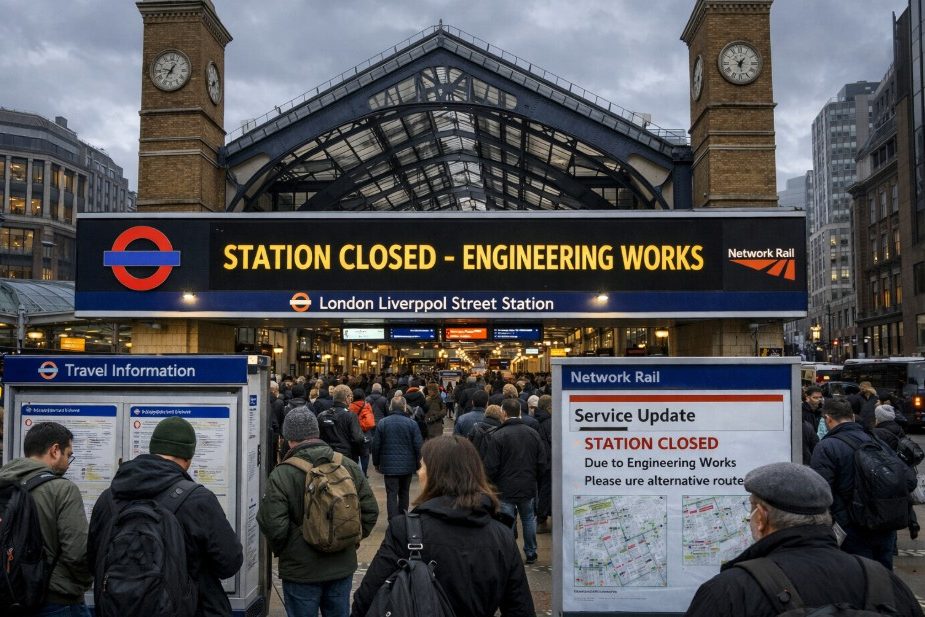
🚆 LONDON LIVERPOOL STREET STATION CLOSURE – MARCH 2026 TRAVEL UPDATE
Essential weekend engineering works affecting rail services across London and the East of England
March 2026
Current Status:
London Liverpool Street mainline station will close on five weekend days in March 2026 for major roof, drainage, track and infrastructure upgrades.
Affected Closure Dates:
Sunday 15 March, Saturday 21 March, Sunday 22 March, Saturday 28 March and Sunday 29 March 2026.
📍 What Is Closed:
The Liverpool Street mainline station and concourse will be shut on affected dates, disrupting Greater Anglia, Stansted Express, c2c, London Overground and parts of the Elizabeth line.
🚌 Alternative Travel:
Passengers are being directed towards Stratford station, London Underground connections, and rail replacement bus services running between key interchange points such as Romford, Shenfield, Newbury Park and Seven Sisters.
Important Note:
The low-level Elizabeth line station at Liverpool Street is expected to remain open on some closure days, but it will be closed on Sunday 22 March 2026. Travellers should check operator updates before setting off.
Key Highlights:
- Station Affected: London Liverpool Street
- Type of Disruption: Mainline station closure during engineering works
- Closure Dates: 15, 21, 22, 28 and 29 March 2026
- Main Cause: Roof renewal, drainage upgrades and track maintenance
- Major Services Impacted: Greater Anglia, Stansted Express, London Overground, c2c and Elizabeth line
- Alternative Travel Hub: Stratford station with Underground connections
- Passenger Advice: Check National Rail, TfL or train operator updates before travelling
London Liverpool Street station is one of the busiest rail hubs in the UK, meaning these planned weekend closures will affect a wide range of routes across Essex, Suffolk, Norfolk, Hertfordshire and Cambridgeshire.
Below, you’ll find a full breakdown of the closure dates, affected train services, journey changes, alternative routes and the best ways to check travel updates before you travel.
Why Is There a Liverpool Street Station Closure in March 2026?

The upcoming Liverpool Street station closure is part of a wider programme of railway improvements being carried out by Network Rail. These upgrades aim to maintain the reliability, safety and efficiency of some of the busiest railway routes in the UK.
Because Liverpool Street serves as a major terminus for the Great Eastern Main Line and the West Anglia Main Line, any essential engineering work must occasionally involve temporary closures to allow engineers to safely access tracks, infrastructure and station facilities.
Major Engineering Works Taking Place
Several large-scale projects are being undertaken during the March closures to improve the railway network and ensure the station continues to operate efficiently for millions of passengers.
The planned works include:
- Roof renewal and drainage improvements at London Liverpool Street station
- Track and rail renewal near Ilford and Gidea Park
- Infrastructure upgrades at Ilford depot
- Platform and station works at locations including Stratford, Rayleigh, Wickford and Hockley
- Overhead line maintenance and removal of redundant structures
- Surveys and inspections of bridges, tunnels, canopies and railway structures
- Vegetation management and litter clearance along railway corridors
- Track maintenance including rail grinding, tamping and ballast cleaning
These works are part of a long-term investment in the rail network that supports routes between London and key regions across East England.
Network Rail officials emphasise that while closures are inconvenient, they are necessary to keep the railway functioning safely.
“There is never a good time to close the railway, but our planned work will deliver an extensive amount of renewals, repairs, maintenance and necessary inspections on these busy routes into London Liverpool Street,” said Katie Frost, Network Rail’s route director for Anglia.
Why Weekend Closures Were Chosen?
The closures have been scheduled specifically for weekends to reduce disruption for weekday commuters who rely on the station for work travel.
Carrying out engineering work during weekends allows engineers to:
- Perform complex repairs without trains operating
- Reduce safety risks for railway workers
- Complete multiple upgrades within a limited time window
- Avoid disrupting weekday commuter traffic into London
As Frost explained:
“Much of the work needs to be done while trains are not running to keep our staff safe, and we are maximising the time we have to do as much as we can.”
Although weekday commuters will largely avoid disruption, weekend travellers, including shoppers, tourists and airport passengers, should plan their journeys carefully.
What Dates Will Liverpool Street Station Be Closed in March 2026?
The Liverpool Street station closure will take place across five weekend days in March 2026. During these dates, the mainline station and concourse will be completely closed, meaning trains will not arrive at or depart from the main terminal.
The closures will affect several rail operators and routes across the East of England.
Liverpool Street Station Closure Dates
| Date | Day | Closure Details |
|---|---|---|
| 15 March 2026 | Sunday | Full mainline station closure |
| 21 March 2026 | Saturday | Station and concourse closed |
| 22 March 2026 | Sunday | Full closure including Elizabeth line disruption |
| 28 March 2026 | Saturday | Mainline station closed |
| 29 March 2026 | Sunday | Station closed with service changes |
During these dates:
- No trains will run to or from the Liverpool Street mainline station
- Rail services will be diverted or terminated at other stations
- Rail replacement buses will operate on several routes
However, the Elizabeth line’s low-level Liverpool Street station will remain open on some days, allowing limited services between Paddington and Abbey Wood.
On Sunday 22 March, the Elizabeth line section at Liverpool Street will also be closed for renovation work. Travellers should expect significant service changes across the network during these weekends.
Which Train Services Are Affected by the Liverpool Street Station Closure?
The closure of such a major London terminal will affect multiple train operators and routes across southern and eastern England.
Several rail services rely on Liverpool Street as their final destination, meaning closures will require trains to terminate at alternative stations or operate modified routes.
The main services affected include:
- Greater Anglia services connecting London with Essex, Suffolk and Norfolk
- Stansted Express airport trains serving London Stansted Airport
- c2c services that occasionally operate via Liverpool Street
- London Overground Weaver Line services running from Chingford, Enfield Town and Cheshunt
- Elizabeth line services on the eastern branch between Stratford and Shenfield
Passengers using the Great Eastern Main Line and West Anglia Main Line will experience the most disruption because these routes feed directly into Liverpool Street.
Despite the inconvenience, rail operators say the improvements will ultimately benefit passengers by improving long-term reliability.
“These projects will help improve and maintain very busy parts of the network, which will help to maintain our high standards of punctuality and reliability,” said Martin Beable, Managing Director of Greater Anglia.
How Will Train Journeys Change During the Liverpool Street Station Closure?
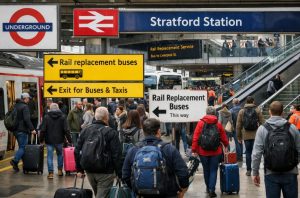
Because trains cannot enter Liverpool Street during the closure periods, several routes will be redirected or terminated at other stations. This means many passengers will need to change trains, take replacement buses or use alternative Underground routes.
Some Greater Anglia services, for example, will start or end at Stratford station instead of Liverpool Street. Stratford is a major interchange with connections to the Central line, Jubilee line, Elizabeth line and London Overground.
Rail replacement buses will also be used extensively during the closures, connecting stations along the affected routes.
For many travellers, journeys that normally take less than two hours may take significantly longer due to the additional transfers required.
Example Journey Changes:
| Route | Normal Journey Time | During Closures |
|---|---|---|
| Clacton-on-Sea → Liverpool Street | 1 hr 22 mins | Up to 4 hrs with bus and Underground transfer |
| Colchester → Liverpool Street | 45–60 mins | 2 hrs 30 mins or longer |
| Braintree → Liverpool Street | Around 1 hr | Approx. 2 hrs 30 mins |
In many cases, passengers will need to travel by train to an intermediate station such as Ingatestone or Shenfield, then transfer to rail replacement buses before continuing their journey via the London Underground.
These changes will especially affect weekend travellers heading into London for shopping, entertainment or flights from Stansted Airport.
How Will the Liverpool Street Station Closure Affect Essex and East England Travellers?
The Liverpool Street station closure will have the biggest impact on passengers travelling between London and the East of England. Counties such as Essex, Suffolk, Norfolk, Hertfordshire and Cambridgeshire rely heavily on rail connections into Liverpool Street.
Weekend travellers from towns such as Colchester, Chelmsford, Southend, Braintree and Bishop’s Stortford may experience significantly longer journeys and more complex travel routes.
In many cases, travellers will need to:
- Transfer between train services and rail replacement buses
- Change onto London Underground services at Stratford or Newbury Park
- Allow extra travel time due to congestion on replacement routes
Airport passengers travelling to London Stansted Airport may also face delays because the Stansted Express service normally runs directly to Liverpool Street.
Because the closures affect several routes simultaneously, some rail replacement buses are expected to be busy, particularly during peak weekend travel times.
What Are the Best Alternative Routes During the Liverpool Street Closure?
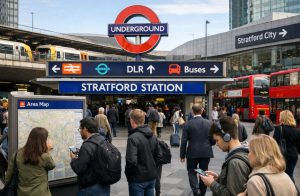
While the closure will cause disruption, several alternative routes will allow passengers to reach central London or continue their journeys.
Travelling via Stratford Station
Stratford will become the main interchange for many affected rail services during the closures. Passengers arriving here can transfer to multiple transport options.
Key connections from Stratford include:
- Central line services into central London
- Jubilee line connections towards Westminster and Canary Wharf
- Elizabeth line services westbound
- London Overground connections across East London
Because Stratford is well connected, many passengers will find it the easiest alternative route when Liverpool Street is closed.
Using London Underground Alternatives
Passengers travelling from areas such as Chingford, Enfield Town or Hertfordshire may also benefit from Underground connections instead of rail services.
Possible alternatives include:
- The Victoria line from Walthamstow Central or Seven Sisters
- The Central line from Stratford into central London
- Connections via Tottenham Hale
Using these Underground routes can help passengers bypass some of the rail replacement bus routes.
Rail Replacement Bus Services
Rail replacement buses will operate across several parts of the affected network. These services will run between stations such as:
- Stratford and Romford
- Newbury Park and Shenfield
- Seven Sisters and Chingford
- Seven Sisters and Enfield Town or Cheshunt
While buses will allow journeys to continue, passengers should expect slower travel times and potential crowding during busy periods.
How Much Longer Will Journeys Take During the Liverpool Street Closure?
For many passengers travelling from Essex or East Anglia, the Liverpool Street station closure could dramatically increase travel times.
Under normal circumstances, routes such as Clacton-on-Sea to Liverpool Street offer fast direct services into central London. However, during the engineering works, those direct routes will be unavailable.
Instead, travellers may need to combine multiple transport modes, including trains, buses and Underground services.
For example, a typical journey from Clacton may involve:
- Taking a train to Ingatestone
- Boarding a rail replacement bus to Newbury Park
- Transferring onto the Central line Underground service
This multi-stage journey could increase travel time from around 1 hour 22 minutes to more than four hours.
Similar delays are expected on routes from Colchester, Chelmsford and Braintree, especially on the busiest closure weekends.
How Can Passengers Check Travel Updates Before Their Journey?

Because the disruption involves several operators and routes, passengers are strongly encouraged to check journey planners before travelling.
Several online platforms provide real-time updates and journey planning tools. The most reliable sources include:
- National Rail Enquiries website
- Greater Anglia travel information pages
- Transport for London journey planner
- TfL Go mobile application
Passengers should also check operator announcements in the days leading up to their journey, as additional service changes may occur.
Transport authorities emphasise the importance of planning ahead.
“We’re sorry for any disruption caused by weekend engineering work impacting London Overground and Elizabeth line services during March. Customers are advised to check before they travel and allow a little extra time for their journeys,” said Trish Ashton, Director of Rail at Transport for London.
Travel Tips to Avoid Disruption During the Liverpool Street Station Closure
Although the closures cannot be avoided entirely, careful planning can help reduce the impact on your journey.
Passengers travelling during affected weekends should consider checking travel routes in advance and allowing extra time for connections.
Some practical tips include travelling earlier in the day, using alternative stations such as Stratford where possible and monitoring service updates from train operators.
For airport travellers or those attending events in London, planning additional travel time is particularly important because rail replacement buses and Underground services may be busier than usual.
When Will Liverpool Street Station Fully Reopen?
The closures scheduled for March 2026 are temporary and part of a planned engineering programme. After the final closure weekend on 29 March 2026, Liverpool Street station is expected to return to normal operation.
Once completed, the improvements will support better infrastructure reliability and help maintain punctual train services across the East of England.
Although the short-term disruption may inconvenience travellers, the long-term benefits include improved safety, modernised railway infrastructure and better performance across several key routes.
Conclusion
The Liverpool Street station closure in March 2026 will cause major weekend disruption for passengers travelling into London from Essex, East Anglia and nearby areas.
The station will close on 15, 21, 22, 28 and 29 March, leading to diverted, shortened or bus-replaced services.
Travellers should expect longer journeys and additional transfers affecting Greater Anglia, Stansted Express, London Overground and the Elizabeth line.
Planning ahead, using alternative stations like Stratford, and checking official journey planners can help passengers reduce disruption and travel more smoothly.
FAQs About Liverpool Street Station Closure
Why is Liverpool Street station closing in March 2026?
The closures are part of planned engineering works by Network Rail, including roof repairs, drainage improvements, track maintenance and infrastructure upgrades designed to improve safety and reliability.
What dates will Liverpool Street station be closed?
The mainline station will close on 15, 21, 22, 28 and 29 March 2026, primarily affecting weekend travel.
Will the Elizabeth line operate during the closures?
The Elizabeth line will operate partially on some days, but services between Stratford and Shenfield will be affected, and the Liverpool Street Elizabeth line station will close on 22 March.
Which train operators are affected by the closure?
The disruption will affect Greater Anglia, Stansted Express, London Overground, c2c services and parts of the Elizabeth line network.
Can passengers still travel into London during the closures?
Yes. Many services will terminate at Stratford or other stations, and passengers can continue their journeys using Underground connections or rail replacement buses.
How long will the disruption last?
The main disruption will occur on the five closure days across March 2026, with normal operations expected to resume after the final weekend.
Where can I check updates before travelling?
Passengers should check National Rail Enquiries, the Greater Anglia website, the TfL journey planner or the TfL Go app for the latest travel information.