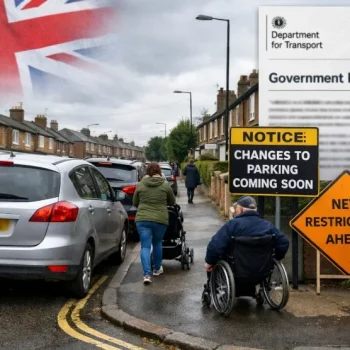
England Pavement Parking Ban 2026 – UK Road Rules Update
 • May 4, 2026
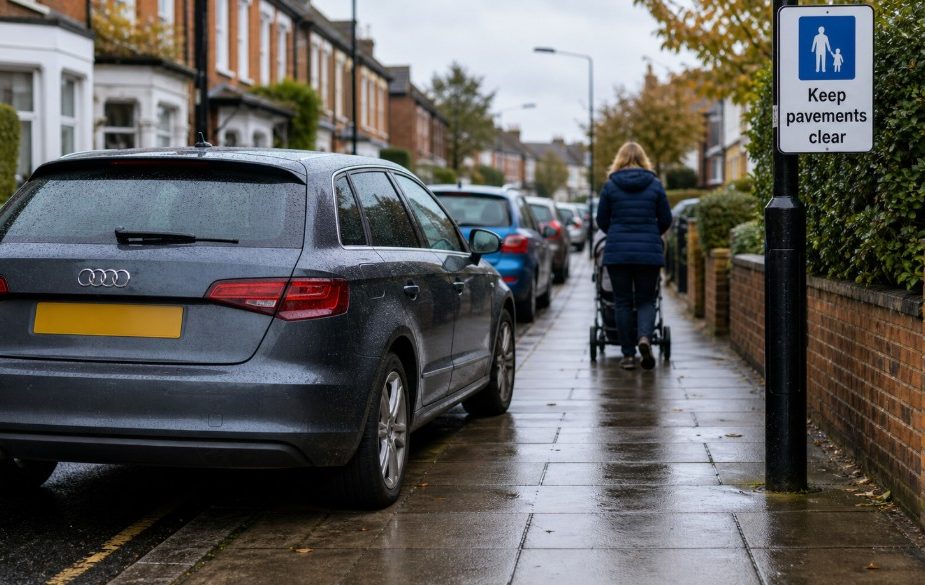
The England pavement parking ban is set to reshape how drivers use public roads, with new nationwide rules expected to restrict vehicles from mounting pavements.
Following the Royal Assent of the English Devolution and Community Empowerment Bill, local authorities now have stronger powers to enforce penalties quickly and efficiently.
This move aims to improve pedestrian safety, especially for vulnerable groups such as the visually impaired and wheelchair users.
Key highlights of the new rules include:
- A nationwide shift towards banning pavement parking
- Faster enforcement through local councils
- Fixed penalty notices for offenders
- Increased focus on accessibility and safety
These changes mark a significant update in UK road rules, affecting drivers across England and particularly in urban areas like London.
Understanding the law early will help motorists avoid fines and adapt to safer parking habits.
What Is the England Pavement Parking Ban and What Has Recently Changed?
The England pavement parking ban refers to a proposed nationwide restriction on vehicles parking partially or fully on pavements. Historically, this practice has existed in a legal grey area outside London, where it has long been prohibited unless explicitly permitted.
The major shift comes from the English Devolution and Community Empowerment Bill, which has now received Royal Assent.
This legislation introduces new enforcement powers, allowing local councils to take direct action without navigating the previously complex legal framework.
The reform follows years of consultation, including a 2020 government review, which identified pavement parking as a widespread issue affecting pedestrian safety.
The updated law simplifies enforcement and gives local transport authorities the flexibility to decide where restrictions should apply.
“The move towards clearer pavement parking laws reflects a broader shift in prioritising pedestrian-first urban planning,” notes a UK transport policy analyst.
This legislative change is not just about restricting drivers but about redefining how public space is shared.
Why Is Pavement Parking Being Banned Across England?
The England pavement parking ban is being introduced to improve pedestrian safety and accessibility across public spaces. Vehicles parked on pavements often block walkways, forcing people into the road and increasing accident risks.
The policy aims to create safer, more inclusive streets while allowing local councils to manage practical challenges.
Safety and Accessibility Concerns for Pedestrians
The main driver behind the ban is the need to protect pedestrians, especially vulnerable groups. Obstructed pavements can make everyday travel difficult and dangerous for many people.
Key reasons behind the ban:
- Protection for blind and partially sighted individuals
- Safer movement for wheelchair users and parents with pushchairs
- Reduction in pedestrian accidents
- Better accessibility in busy urban areas
Transport Minister Lilian Greenwood stressed that these rules are vital to ensure safe movement for everyone. Charities like Guide Dogs have also supported the changes, noting the daily risks caused by blocked pavements.
“It’s essential these rules are enforced quickly so people are not forced into the road,” said a senior representative from Guide Dogs.
This highlights the urgency behind the new enforcement measures.
Balancing Public Safety with Real-World Challenges
While the safety benefits are clear, the ban also raises practical concerns, particularly in areas where infrastructure limits parking options.
Narrow roads, especially in rural villages or older urban layouts, often leave drivers with little choice but to partially mount the kerb.
Real-time example:
I recently came across a comment from a resident, Frances Hartley, who raised a valid concern about rural living. She said,
“If the road is narrow, you have to park at least on the kerb, otherwise emergency vehicles could not get past.”
This reflects a common dilemma faced by drivers in constrained environments.
Such perspectives highlight the need for a balanced approach. While the England pavement parking ban prioritises pedestrian safety, it also allows local councils to apply flexibility where necessary.
By giving authorities the power to decide which roads are included, the policy aims to address safety issues without ignoring real-world challenges faced by communities.
When Will the Pavement Parking Ban Be Enforced in England?
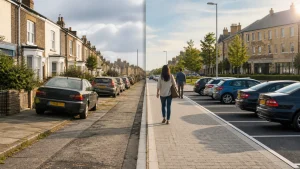
The timeline for enforcement is expected to accelerate following the Royal Assent of the legislation. Government statements suggest that the rules could be “enforced quickly”, signalling a faster rollout than previous road law updates.
Although 2026 is widely referenced as the target year, implementation will depend on how quickly local councils adopt and apply the new powers. Unlike previous systems, councils no longer need to go through lengthy approval processes, which significantly reduces delays.
This means drivers could start seeing enforcement in certain areas sooner than expected, particularly in cities where pavement obstruction is a persistent issue.
How Will the New Pavement Parking Rules Work in Practice?
The updated system introduces a more flexible, locally controlled approach. Instead of a rigid nationwide rule applied uniformly, councils will determine which roads fall under the ban.
This allows authorities to balance safety with practicality, especially in areas where road width or infrastructure makes pavement parking unavoidable.
How enforcement will operate:
- Local councils identify restricted zones
- Fixed penalty notices were issued for violations
- Use of civil enforcement officers and surveillance
- Clear signage to inform drivers
This structure ensures that enforcement is both targeted and effective, addressing problem areas without imposing unnecessary restrictions where they may not be feasible.
The system marks a significant improvement over the previous approach, which was widely criticised as slow and overly complicated. It also aligns with broader urban planning goals focused on accessibility and safety.
What Fines and Penalties Will Drivers Face Under the New UK Rules?
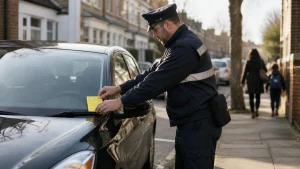
Drivers who ignore the England pavement parking ban will face financial penalties through fixed penalty notices. While exact fines may vary by council, they are expected to fall within a similar range to existing parking offences.
Expected Pavement Parking Fines Comparison:
Region Typical Fine Early Payment Discount Enforcement
London £80–£130 Yes Local Councils
England (New Rules) £70–£130 Likely Local Authorities
Scotland £100 £50 (within 14 days) Local Councils
The introduction of consistent penalties across England aims to deter unsafe parking behaviour while ensuring fairness.
Real-time example (author insight):
In discussions I’ve reviewed, Phil Wrigley pointed out a broader issue, stating,
“The problem is also that mum has a car, dad has one and each child has one.”
This reflects how increasing car ownership contributes to parking pressure, which in turn leads to pavement parking.
Ultimately, fines are not just punitive; they are designed to encourage behavioural change.
Is Pavement Parking Already Illegal in London and How Does It Differ?
London has long enforced strict rules against pavement parking, making it illegal unless explicitly permitted by signage. This has created a clearer framework compared to the rest of England, where regulations have historically been inconsistent.
The nationwide rollout will bring other regions in line with London’s approach, although with added flexibility for local authorities.
This alignment is expected to reduce confusion among drivers and create a more uniform understanding of parking laws across England.
What Powers Do Local Authorities Now Have to Enforce the Ban?
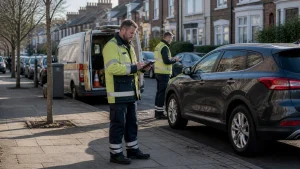
The new legislation significantly strengthens the role of local authorities. Councils are now empowered to enforce pavement parking restrictions without relying on complex legal procedures.
Direct Enforcement Through Fixed Penalties
One of the most important powers granted is the ability to issue fixed penalty notices (FPNs) directly. This means civil enforcement officers can take immediate action when vehicles are found obstructing pavements, improving compliance and deterrence.
In many areas, councils may also integrate digital tools such as handheld devices or camera-based evidence collection to streamline the process.
This not only speeds up enforcement but also reduces disputes by providing clear documentation of violations.
Control Over Local Road Restrictions
Councils now have the authority to determine which roads are included under pavement parking restrictions. This is particularly important because road layouts vary widely across England, from narrow village streets to busy urban centres.
Key enforcement powers:
- Issuing fixed penalty notices directly
- Selecting roads where restrictions apply
- Deploying enforcement officers and monitoring systems
- Implementing community-specific solutions
By allowing councils to define restriction zones, the law ensures a balanced approach, protecting pedestrians while still accommodating areas where limited parking space makes strict enforcement impractical.
Improved Monitoring and Community-Based Solutions
Local authorities can also deploy enforcement officers, use monitoring systems, and introduce tailored solutions that suit their areas. This flexibility helps address both urban congestion and rural challenges effectively.
“Empowering local authorities is crucial for effective enforcement, as they understand the unique challenges of their areas,” explains a local government policy expert.
Overall, these enhanced powers allow for quicker action, better resource allocation, and more targeted enforcement strategies, making the system both efficient and locally relevant.
Are There Any Exceptions to the Pavement Parking Ban in England?
While the England pavement parking ban introduces stricter rules, it will not apply universally in every situation. Exceptions are expected to reflect real-world conditions, especially in rural areas and older towns where space is limited.
On narrow streets, partial pavement parking may be necessary to allow emergency vehicles like ambulances and fire engines to pass. Local councils will have the authority to designate zones where limited pavement parking is permitted.
Clear signage and road markings will help drivers understand where exceptions apply. Temporary allowances may also be introduced during roadworks or busy periods.
This flexible approach balances pedestrian safety with practical needs, ensuring the law remains effective without causing unnecessary disruption
How Does Pavement Parking Impact Communities and Urban Living?
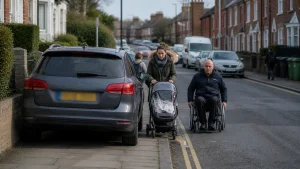
Pavement parking has long been a source of frustration in densely populated areas. It affects not only safety but also the overall quality of urban life.
Obstructed pavements limit accessibility, increase congestion, and create tension between road users and pedestrians. The new rules aim to address these issues by promoting more responsible use of space.
Impact of Pavement Parking on Communities:
Issue Impact Long-Term Effect
Obstructed pavements Reduced accessibility Social exclusion
Forced road walking Increased accident risk Safety concerns
Congestion Traffic inefficiency Urban stress
Visual clutter Poor streetscape Reduced quality of life
Beyond safety, pavement parking can also create tension between residents, drivers, and local authorities. By addressing these challenges, the England pavement parking ban supports broader goals of creating safer, more inclusive, and better-organised communities.
It encourages more responsible use of shared space while improving everyday mobility for pedestrians.
How Does England’s Pavement Parking Ban Compare to Scotland?
Scotland introduced a comprehensive ban under the Transport (Scotland) Act 2019, which came into force in December 2023. The law prohibits pavement parking, double parking, and parking at dropped kerbs.
England vs Scotland Pavement Parking Rules:
Feature England (Proposed) Scotland
Enforcement Local authority-led Local authority-led
Fine £70–£130 £100 (£50 early)
Flexibility High Moderate
Coverage Expanding nationwide Fully implemented
Scotland’s experience demonstrates that clear rules combined with public awareness campaigns can significantly improve compliance.
What Should Drivers Do to Prepare for the New Parking Laws in England?
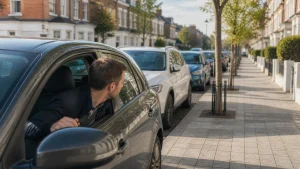
As the England pavement parking ban approaches, drivers will need to adjust their habits to stay compliant. Preparation is key, especially as enforcement may begin quickly in some areas.
Start by checking local council guidance, as rules can vary by location, and always pay attention to road signs and markings.
To stay on the safe side:
- Use off-street parking, designated bays, or car parks whenever possible
- Plan ahead and allow extra time to find legal parking spaces
- Avoid parking on pavements, even partially, unless clearly permitted
In tighter areas, consider alternatives like walking or public transport for short trips. Taking these steps early will help you avoid fines and contribute to safer, more accessible streets for everyone.
What Does the Future Hold for UK Parking and Transport Regulations?
The pavement parking ban is part of a broader shift in UK transport policy. The same legislation also introduces new rules for rental e-bikes, highlighting a move towards more structured and sustainable urban mobility.
Future developments are likely to focus on smart city planning, improved infrastructure, and reduced reliance on private vehicles.
These changes reflect a long-term vision of safer, more efficient, and more inclusive transport systems.
Conclusion
The England pavement parking ban represents a significant evolution in UK road rules. By prioritising pedestrian safety and empowering local authorities, the new law addresses long-standing concerns about accessibility and road use.
For drivers, the message is clear: adapt to the new rules or face penalties. For pedestrians, the changes promise safer and more accessible streets.
As enforcement begins, the success of the policy will depend on public awareness, local implementation, and a collective shift towards responsible parking behaviour.
FAQs About England Pavement Parking Ban 2026
Can drivers still park partially on pavements in England?
In most cases, no. The new rules aim to restrict pavement parking unless explicitly allowed by local councils.
How quickly will the new pavement parking fines be enforced?
Enforcement could begin rapidly, as councils now have streamlined powers to issue penalties.
Who decides which roads are included in the ban?
Local authorities are responsible for determining which roads fall under the restrictions.
Are rural areas exempt from pavement parking rules?
Not entirely, but councils may allow exceptions where road conditions require flexibility.
What is the penalty for blocking a pavement in the UK?
Fines are expected to range between £70 and £130, depending on the location.
How does the new law help visually impaired pedestrians?
It prevents obstructions that force them into the road, significantly improving safety and mobility.
Can drivers appeal a pavement parking fine?
Yes, drivers can challenge penalties through the standard appeals process set by local councils.