
EU Entry Exit System Problems: Why Travellers Face Four-Hour Passport Control Waits?
 • February 13, 2026
🚨
Urgent Travel Alert: April 10 Mandatory Rollout
Current Status: The “phased” introduction of the EU Entry/Exit System (EES) ends this week. As of Friday, 10 April 2026, the system becomes fully operational and mandatory across all 29 Schengen-area countries.
10 April 2026
No more “temporary flexibility” for airports.
Biometric Mandate
Manual passport stamping is officially retired.
Last Updated: 07.04.2026
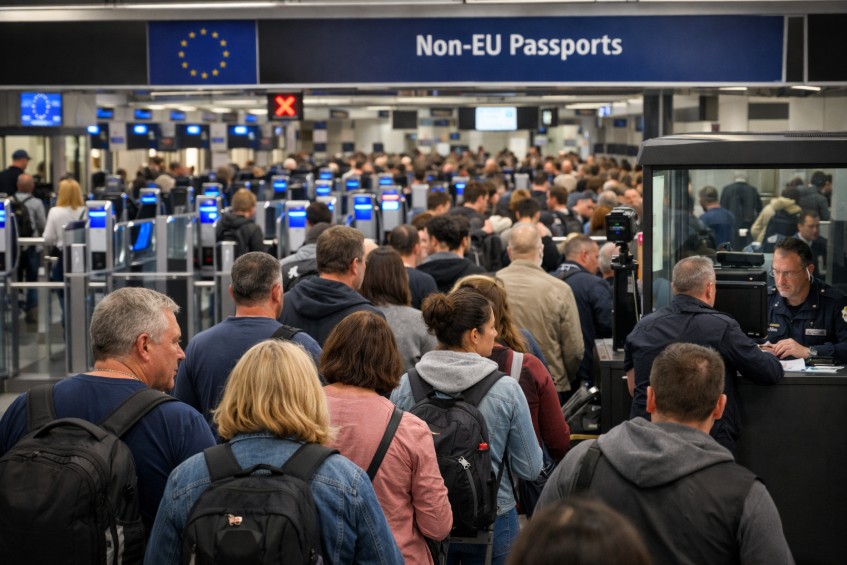
EU Entry Exit System (EES) problems have reached a critical point as the mandatory 10 April 2026 rollout deadline arrives. While intended to modernize borders, technical glitches and the shift from passport stamping to full biometric registration are causing significant bottlenecks. For London travellers departing from Heathrow, Gatwick, Stansted, and Luton, understanding the current “Triple Queue” risk is now essential for avoiding missed connections.
Quick Summary: The EES replaces manual stamps with digital biometric data. System crashes and “double red tape” (manual checks alongside digital scans) remain the primary causes of delay.
- Applies To: All non-EU/Schengen citizens (including UK passport holders).
- The Mandate: Mandatory facial and fingerprint registration for first-time entries.
- Current Risk Level: CRITICAL (due to the 10 April full implementation).
- High-Risk Hubs: Palma de Mallorca, Alicante, Paris CDG, and Geneva.
- Expected Delays: 1–3 hours during off-peak; up to 5+ hours during peak weekend waves.
Urgent Advice: Travellers are now advised to arrive at least three to four hours before departure and ensure they have downloaded the official ‘Travel to Europe’ app to pre-register data where possible.
What Is the EU Entry/Exit System (EES), and Why Has It Been Introduced?
The EU Entry/Exit System (EES) is a digital border management system designed to record the entry and exit of non-EU travellers entering the Schengen Area. As a UK passport holder, you are now categorised as a “third-country national” when entering most European destinations.
Instead of having your passport stamped manually every time, the EES records:
- Your passport details
- Facial biometric data
- Fingerprints (initial registration)
- Date and location of entry and exit
The purpose is to improve border security, prevent overstaying and modernise EU external border management.
A European Commission spokesperson described it as:
“A very big step forward for the EU in our collective security”
The system has already logged millions of crossings. However, while the objective is long-term efficiency, the short-term reality is far more complicated, particularly for UK holidaymakers departing from London Heathrow, Gatwick, Stansted and Luton.
Why Are EU Entry Exit System Problems Causing Long Queues at Passport Control?
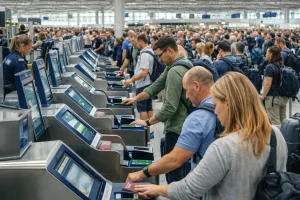
The delays you are experiencing are not caused by one single issue. They are the result of multiple operational pressures converging at busy travel hubs.
Industry bodies representing airlines and airports have warned of waiting times potentially reaching four hours during peak summer months. Even during partial rollout phases, queues of up to two hours have already been reported.
The Three Core Causes Behind EU Entry Exit System Problems:
- Chronic border control understaffing: Many Schengen airports are operating with limited border officers, particularly during peak travel waves.
- Unresolved technology and automation issues: Biometric kiosks and e-gates have experienced crashes, slow processing times and inconsistent compatibility with UK passports.
- Limited uptake of pre-registration systems: The Frontex pre-registration app has not been widely adopted, meaning most biometric capture still happens at the airport.
As one industry letter bluntly put it:
“There is a complete disconnect between the perception of EU institutions that EES is working well, and the reality travellers are experiencing.”
For London travellers heading to Spain, France, Italy or Greece, this means queues build quickly when multiple flights land simultaneously.
What Exactly Happens When You Go Through EES at an Airport Border?
Understanding the process in detail helps you anticipate where delays may occur and why queues build up more quickly than before. While the system is designed to streamline border management in the long term, the transitional phase has introduced additional steps that directly affect UK travellers.
Step 1: Biometric Registration
If it’s your first crossing under EES, you will complete a biometric registration process at a designated kiosk or border desk. This stage replaces the traditional passport stamp with a digital entry record linked to your biometric data.
You will typically be asked to:
- Scan your passport at a kiosk
- Provide fingerprints (usually four fingers, sometimes repeated if scans fail)
- Submit a facial image via camera recognition
- Confirm data permissions on-screen
Although the process itself may take under a minute per person when everything works smoothly, minor technical hiccups, such as unreadable fingerprints or passport chip errors, can quickly extend the time. When several passengers experience similar issues consecutively, queues lengthen rapidly.
Step 2: Automated Gate or Officer Review
Once your biometric data is captured, you may proceed to an automated e-gate or be directed to a staffed border desk. However, not all automated gates across Schengen airports are fully compatible with UK passports at this stage.
In some French airports, for example, certain facial recognition gates have not yet been configured to process UK documents under the EES framework. This means even digitally registered travellers may still be redirected to a manual desk.
If the automation works as intended, this step should be quick. But if gates freeze, reject scans, or require secondary verification, the entire flow slows down.
Step 3: Manual Checks (During Rollout)
Until full implementation is complete, many airports continue to apply manual passport stamping alongside digital biometric capture. This overlapping system, often described as “double red tape” has significantly increased processing times.
In practical terms, that means you may complete biometric registration only to join another queue for a physical passport stamp or officer verification.
A travel writer recently described arriving at a Spanish airport:
“Despite using the new machines, we still had to queue again for a manual stamp. That second queue was the real bottleneck.”
This layered system is one of the central EU Entry Exit System problems affecting UK travellers, particularly at busy Mediterranean airports where arrivals halls were not originally designed for multi-stage border screening.
How to Use the ‘Travel to Europe’ App to Skip the Kiosk
As of late March 2026, the EU has released the official “Travel to Europe” app (available on iOS and Android) to help reduce the time spent at physical kiosks. While you still have to see a border officer for fingerprints, the app allows you to handle the “data heavy” part of the process in your own time.
Where can you use it? Currently, the app is fully functional for travelers heading to:
- Sweden (Stockholm Arlanda and other major ports)
- Portugal (Lisbon, Faro, and Porto)
- Coming Soon (April/May 2026): Spain (Alicante, Malaga, Madrid) and France are currently in “beta testing” with the app, with full integration expected by the summer peak.
Step-by-Step: Pre-Registering Your Trip
- Download & Identity Check: Install the app and scan the biometric chip in your passport using your phone’s NFC reader.
- The ‘Selfie’ Capture: You will take a live facial scan within the app. This must match your passport photo.
- Submit Your Journey: You can enter your flight details and destination up to 72 hours before you arrive.
- Receive Your QR Code: Once submitted, you’ll get a confirmation. Show this to the border officer (or scan it at the dedicated “App Lane”) to bypass the data-entry kiosks.
Pro Tip: You can add co-travelers to a single journey in the app. If you are traveling as a family, one person can manage the registration for everyone, which is a massive time-saver at the terminal.
Why Are London Travellers Being Hit Hardest by EU Entry Exit System Problems?
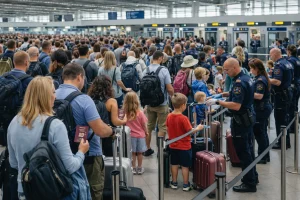
Since Brexit, UK passport holders are treated as non-EU nationals under Schengen border regulations. That places British travellers squarely within the full scope of EES requirements.
The first biometric registration naturally takes longer than subsequent entries. However, even repeat travellers are not guaranteed a faster experience. Inconsistent system compatibility between countries can mean biometric data must be verified again or manually reviewed.
Family travel further amplifies the issue. A family of four does not move through the system as one unit, it is four individual biometric transactions. If one person’s fingerprint scan fails or requires repetition, the entire group waits.
During school holidays from London Heathrow or Gatwick, this multiplies across hundreds of families arriving at once.
For UK holidaymakers heading to Spain, France, Italy or Greece, this creates cumulative pressure at already stretched border control points.
Is “Double Red Tape” Making EU Entry Exit System Problems Worse?
Yes, and this effect is temporary but significant.
Until April 2026, at least 35% of non-EU travellers must undergo biometric checks, increasing to full coverage upon complete rollout. During this phased period, manual passport stamping has not been entirely removed in many locations.
This effectively creates three separate processing stages:
- Biometric queue
- E-gate queue
- Manual stamping queue
Previously, travellers experienced only a single passport control line. Now, bottlenecks can form at any one of the three stages, particularly if staffing levels are insufficient.
Airports with compact arrivals areas, common in Spain, Portugal and smaller French regional airports popular with London traveller, struggle to physically accommodate these layered queues. When multiple UK flights land within a short time frame, congestion becomes unavoidable.
What Are the Main Operational Causes Behind EU Entry Exit System Problems?
Industry groups such as ACI Europe, Airlines for Europe (A4E), and IATA highlight three key factors behind current delays. First, many Schengen border agencies have not increased staffing despite added biometric checks, meaning longer processing times with the same number of officers, a gap that becomes obvious during peak travel when passenger numbers surge.
Second, technical disruptions continue to affect automated systems. Reports from countries like Spain and Portugal show e-gate failures, fingerprint misreads, and database slowdowns that force manual processing and lengthen queues.
Finally, limited adoption of pre-registration tools means most biometric data is still collected at airports, increasing congestion during busy travel periods.
Core Causes of EU Entry Exit System Problems:
Cause Impact on UK Travellers Resulting Delay Risk
Understaffing Fewer desks open during peak arrivals 1–2 hour queues
Technology failures Repeated biometric scans 20–60 minute add-ons
Manual stamping overlap Double processing Bottleneck congestion
Peak travel surges Arrival waves 2–4 hour extreme cases
What Is the EES Rollout Timeline and What Changes After Full Implementation?
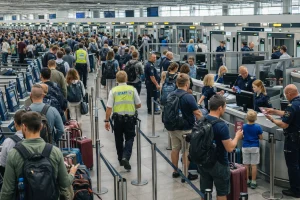
The phased introduction began on 12 October 2025. Full deployment remains scheduled for 9 April 2026.
From 10 April onward:
- All Schengen states must apply EES.
- Biometric registration becomes standard.
- Manual passport stamping should reduce significantly.
However, the European Commission has built in flexibility. Member states may temporarily suspend certain checks for up to 90 days after rollout, with a potential 60-day extension to manage summer congestion.
A Commission spokesperson stated:
“Rolling out such a large-scale system is complex. Built-in flexibility allows member states to manage potential problems.”
For UK travellers, this means implementation consistency may vary by airport and month.
EES Rollout Timeline
Phase Key Features Impact on UK Travellers
October 2025 Progressive rollout begins Partial biometric checks
Late 2025 35% minimum biometric screening target Mixed experiences
April 9, 2026 Full deployment required 100% application
Post-April Temporary flexibility window Possible summer suspensions
While the Commission maintains the system is functioning largely without issues, aviation leaders remain cautious about summer congestion.
The “Juxtaposed” Bottleneck: St Pancras, Dover, and Folkestone
Unlike flying to Spain or Italy, where you register upon arrival, travelers using the Eurostar, Eurotunnel, or Dover Ferries must complete EES registration on UK soil before they even leave. This is known as “juxtaposed” border control.
Because these sites handle massive volumes of vehicles and passengers in tight spaces, they are the primary focus of “EES Problems” in 2026.
The £10.5 Million Infrastructure “Safety Net”
To prepare for the April 10 deadline, the UK Government provided a £10.5 million grant specifically to these three ports to install hundreds of new biometric kiosks and expand passenger zones.
- Eurostar (St Pancras): Has installed 49 kiosks across three dedicated zones to handle up to 2,000 passengers per hour.
- Eurotunnel (Folkestone): Built a 7,000m² “Pre-Registration” hangar where up to 50 cars can register simultaneously.
- Port of Dover: Added dedicated “EES processing lanes” for coach passengers and car travelers.
LATEST REPRIEVE: April 10 Delay at Channel Crossings
Despite the heavy investment, there is a major update for travelers this week: French authorities have confirmed a temporary delay in biometric collection at Dover and Folkestone.
While the rest of Europe goes “full biometric” on April 10, the French border police (PAF) at the Channel crossings will initially create digital files based on passport data only, delaying the fingerprint/facial scan requirement by several weeks. This is a strategic move to prevent “gridlock” during the busy Easter travel period.
What this means for you: If you are taking the ferry or tunnel this weekend, you likely won’t be asked for fingerprints yet. However, if you are flying from Heathrow or Gatwick, you will.
Which Journeys Are Most at Risk?
For London and UK travellers, disruption linked to EU Entry Exit System problems depends largely on timing, destination, and airport infrastructure.
Not every journey will face delays, but certain travel patterns increase exposure to queues and processing bottlenecks.
Peak Summer Departures
Summer travel from major London airports often sees the highest disruption risk linked to EU Entry Exit System delays. Passenger volumes surge during July and August, and when several flights arrive close together, biometric processing times can quickly create queues.
Key risk factors:
- School holiday travel spikes
- Multiple simultaneous arrivals
- Full biometric checks for most travellers
- Limited border staff availability
Even small slowdowns per passenger can multiply into long waits, making peak-season journeys the most vulnerable to delays.
Ski Season Gateways
Geneva is a notable pressure point during half-term ski travel. Multiple London flights often land within short intervals, creating concentrated waves of UK passengers requiring biometric checks.
Minor technical slowdowns can trigger significant tailbacks, particularly for families managing equipment and tight transfers.
Short Layovers
Connections under four hours carry added risk if queues surge unexpectedly, especially during outbound passport checks when exiting Schengen.
Travel Type Risk Level Why
Summer leisure flight High Peak demand and full biometric processing
Half-term ski trip High Concentrated arrivals
Eurostar via St Pancras Moderate Pre-boarding registration
Off-peak weekday travel Lower Reduced passenger flow
Real-Time Example: A London Traveller at Alicante
A London family arriving in Alicante during Easter landed with three other UK flights and cleared biometric kiosks quickly, each taking under a minute. The delay came afterward: only one officer was stamping passports, creating a long queue worsened by fingerprint re-scan issues ahead.
Nearly 90 minutes passed before they exited control, delaying transfers and increasing stress. The problem wasn’t the technology itself but limited staffing and overlapping checks.
As they also stated:
“The tech is quick — everything around it slows you down.”
How Can You Reduce Your Risk of Getting Stuck in EES Queues?

Although EU Entry Exit System delays are largely outside travellers’ control, planning ahead can greatly reduce disruption. Choosing the right departure times, routes, and connection windows can make a noticeable difference, especially during peak travel seasons when queues are most unpredictable.
Smart Travel Planning Tips
- Avoid weekend morning departures from major London airports
- Choose midweek afternoon flights for lighter passenger flow
- Travel just outside school holiday peak dates
- Allow at least four hours for European connections
- Add extra time if exiting and re-entering Schengen
- Consider routes with pre-boarding biometric processing
Adopting a cautious approach during the rollout phase is practical. If your journey runs smoothly, treat it as a bonus rather than an expectation.
What Should You Do If You Miss a Flight Due to Border Delays?
If delays at passport control cause you to miss your flight, acting quickly can improve your chances of resolving the situation smoothly.
Start by contacting your airline immediately, explaining that border control queues prevented you from boarding, and request rebooking on the next available flight. If possible, ask for written confirmation that delays occurred, as documentation can be useful later.
Step What to Do Why It Matters
Contact airline Speak to staff or call support Faster rebooking options
Request proof Ask for delay confirmation Helps with claims
Gather evidence Take photos, save boarding pass Supports the insurance case
Keep receipts Save food, hotel, transport costs Needed for reimbursement
Check policy Review travel insurance terms Confirms eligibility
Staying organised and proactive is essential. Keep all travel documents, receipts, and records of communication, and review your insurance policy carefully, as coverage varies.
Some plans include missed-departure protection, while others exclude delays linked to border procedures, so understanding your policy can make the recovery process far easier.
How Is EES Different from ETIAS?
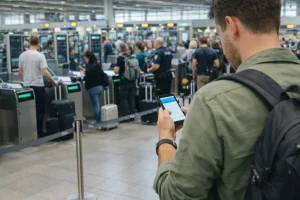
EES and ETIAS are often confused, but they serve different functions.
EES records your physical entry and exit from the Schengen Area using biometric data. It replaces manual passport stamping and tracks how long you stay.
ETIAS, expected later in 2026, is a pre-travel authorisation system. Before travelling, UK citizens will need to apply online and receive approval prior to departure.
In simple terms:
- EES operates at the border.
- ETIAS operates before you travel.
They are connected in purpose but function separately. Depending on timing, you may need to comply with both systems.
What Does “Travel Will Be Smoother” Actually Depend On?
The long-term promise of EES is efficiency. Whether that promise materialises depends on several practical factors.
Reliable biometric infrastructure must function consistently without repeated system crashes. Border authorities need sufficient staffing levels to manage peak arrival waves. E-gates must be fully compatible with UK passports and integrated smoothly into airport layouts.
Most importantly, reliance on manual passport stamping must reduce once rollout is complete.
If these elements align, queues should shorten and the process could become quicker than traditional stamping.
Until then, EU Entry Exit System problems remain part of a transitional phase affecting thousands of UK travellers, particularly those departing from London’s busiest airports. Careful planning and realistic expectations remain your strongest safeguards against disruption.
Conclusion
If you’re travelling from London or elsewhere in the UK to the Schengen Area in 2026, expect inconsistent experiences. Some trips may run smoothly, while others could involve noticeable delays depending on airport readiness, staffing levels, and system performance during the rollout phase.
The safest approach is practical planning. Build extra time into your journey, avoid tight layovers, travel during off-peak hours where possible, and check airport updates before departure.
These EU Entry Exit System problems are temporary, but until implementation stabilises, preparation remains your best protection against disruption.
FAQs About EU Entry Exit System Problems
Will you need to provide fingerprints every time you enter the EU?
After initial registration, subsequent entries generally require only one biometric verification. However, inconsistent system compatibility may lead to repeated checks in some locations.
Does EES apply to Eurostar and ferry passengers?
Yes. EES applies at all external Schengen borders, including rail and ferry terminals such as St Pancras and Dover.
How early should you arrive at Heathrow for a summer flight to Spain?
During peak summer, arriving at least three hours before departure is advisable, particularly if travelling during school holidays.
Can smaller airports reduce your risk of delays?
Not necessarily. Smaller airports may have limited biometric kiosks and staffing, which can increase congestion during arrival waves.
Is the April 9 deadline likely to move?
Officially, the deadline remains fixed. Flexibility applies only to temporary operational adjustments—not to the overall rollout schedule.
What happens if biometric kiosks crash?
Airports typically revert to manual passport checks, which significantly increases processing times.
Will ETIAS replace EES?
No. ETIAS is a pre-travel authorisation system, while EES records biometric entries and exits at the border.