Lloyds Bank Closures 2026–2027: Latest Timeline, Branches Closing and What Customers Need to Know
 • January 2, 2026
Last updated: 1 October 2026
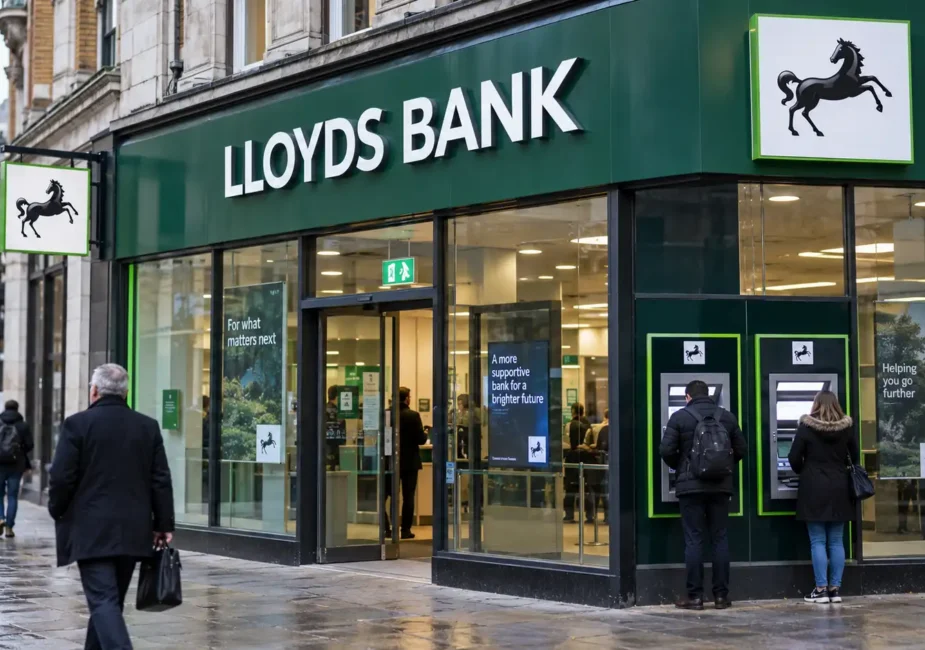
Lloyds Bank closures are continuing across the UK, with another significant group of branches scheduled to disappear from high streets during the final months of 2026 and further closures already confirmed for 2027.
The latest comprehensive schedules show 125 Lloyds Bank branches closed or due to close during 2026 and 2027. The wider Lloyds Banking Group programme also includes Halifax and Bank of Scotland locations, taking the number of affected group branches into the hundreds.
The closure programme has developed in several stages rather than through one single announcement. Many locations shut during the first half of 2026, another wave followed during the summer, and dozens of Lloyds branches remain on the timetable for October and November.
For customers, particularly those who still rely on face-to-face banking, the important questions are now whether their local branch is affected, when it will close and what banking facilities will remain nearby.
What Is the Latest Lloyds Bank Closures Update?
As of 1 October 2026, the Lloyds branch closure programme is still active.
Some of the largest closure waves have already taken place, but another concentrated run is scheduled during October and November.
The Rochdale branch has a closure date of 1 October 2026, while branches including Barnsley, Chatham, Camborne, Chepstow, Birmingham Harborne, Deal, Gorseinon, Blackpool and Rotherham are among those following during October.
Further closures continue into November.
A smaller number are already scheduled for 2027.
Lloyds Bank Closures at a Glance
| Detail | Current Position |
|---|---|
| Lloyds-branded branches closed or closing | 125 across 2026–27 |
| Main closure period | Throughout 2026 |
| Major remaining wave | October–November 2026 |
| Closures continue into | 2027 |
| Main reason given | Increasing use of mobile and online banking |
| Alternative physical services | Other group branches, Post Offices, Banking Hubs and Community Bankers |
| Halifax relationship | Halifax is being progressively rebranded as Lloyds |
The timetable can change as individual branch arrangements are finalised, so closure dates should be treated as branch-specific rather than assuming every location in an area will shut at the same time.
What Is the Recent Lloyds Bank Closure Timeline?
The scale of the changes becomes easier to understand when the announcements and closures are viewed chronologically.
January to March 2026
The year began with numerous previously announced closures.
Affected Lloyds branches included locations such as:
- Gillingham
- Mitcham
- Totnes
- Ammanford
- Fleet
- Chester-le-Street
- Ivybridge
- New Addington
- Havant
- Lewes
- Penzance
- Glossop
- Peterlee
- Manchester Moston
- Sleaford
- Okehampton
This early wave affected a mixture of suburban branches, regional towns and smaller communities.
May to August 2026
The pace increased again during the spring and summer.
A substantial number of branches closed in London and other major urban areas, including locations around Oxford Street, Tottenham Court Road, Victoria Street, Borough High Street, Camberwell Green and Golders Green.
Locations elsewhere in the UK were also affected, including Birmingham, Cardiff, Swansea, Bristol, Norwich, Sevenoaks, Newmarket and other towns.
The closure of physical banking locations is not unique to Lloyds. The wider pattern can also be seen in the current programme of Santander bank branch closures, where digital banking growth has similarly been accompanied by a smaller traditional branch network.
10 June 2026 – Another Major Closure Wave
A particularly important point in the timeline came in June, when another 79 Lloyds Banking Group branch closures were added to the programme.
That included:
- 31 additional Lloyds branches
- 48 additional Halifax branches
This announcement extended the closure timetable further into late 2026 and 2027.
It also made clear that branch consolidation was not simply an early-2026 programme but part of a longer restructuring of the group’s physical banking network.
September 2026
Another group of Lloyds locations disappeared during September.
Recent closures included branches in:
- Birmingham Soho Road – 23 September
- Harrow – 23 September
- Whitechapel – 23 September
- Chelmsford – 24 September
- Carlisle – 29 September
These closures brought the programme directly into autumn 2026.
October and November 2026
October is now one of the most important remaining months in the current timetable.
Dozens of locations are either closing during October or shortly afterwards.
Which Lloyds Bank Branches Are Closing Next?
The following are among the Lloyds locations scheduled to close during the remaining autumn 2026 programme.
| Branch | Closure Date |
|---|---|
| Rochdale | 1 October 2026 |
| Barnsley | 5 October 2026 |
| Chatham | 5 October 2026 |
| Camborne | 7 October 2026 |
| Chepstow | 7 October 2026 |
| Ryde | 7 October 2026 |
| Birmingham – Harborne | 8 October 2026 |
| Deal | 8 October 2026 |
| Gorseinon | 12 October 2026 |
| South Shields | 12 October 2026 |
| Southampton – Totton | 12 October 2026 |
| Blackpool | 13 October 2026 |
| Stamford | 13 October 2026 |
| Bristol – Knowle | 14 October 2026 |
| Rotherham | 15 October 2026 |
| St Helens | 15 October 2026 |
| Devizes | 21 October 2026 |
| Widnes | 21 October 2026 |
| Chesterfield | 22 October 2026 |
| Nottingham – Arnold | 27 October 2026 |
| Llandudno | 28 October 2026 |
| Braintree | 29 October 2026 |
| Accrington | 3 November 2026 |
| Wallsend | 3 November 2026 |
| Ilkeston | 5 November 2026 |
| Willenhall | 5 November 2026 |
| Leicester – Belgrave | 9 November 2026 |
| Liverpool – Huyton | 9 November 2026 |
| Wakefield | 10 November 2026 |
| Leicester – Wigston | 11 November 2026 |
| Worksop | 11 November 2026 |
| Harrogate | 19 November 2026 |
This means the Lloyds branch reduction programme will remain highly visible on UK high streets throughout the final quarter of 2026.
Which Lloyds Bank Branches Are Closing in 2027?
The programme does not finish at the end of this year.
Several Lloyds-branded locations already have closure dates extending into 2027.
Confirmed locations include:
| Branch | Scheduled Closure |
|---|---|
| Sheffield – High Street | 14 January 2027 |
| Clevedon | 15 March 2027 |
| Ebbw Vale | 15 March 2027 |
| Street | 15 March 2027 |
| Honiton | 16 March 2027 |
| Wednesbury | 16 March 2027 |
| Stoke-on-Trent – Longton | 17 March 2027 |
| Kirkby | 23 June 2027 |
Further changes to the wider group network are also possible as Lloyds completes the integration of its branch brands.
Why Is Lloyds Closing So Many Bank Branches?
The main explanation is the continuing change in how customers manage their money.
Mobile applications and online banking now handle many transactions that previously required a visit to the high street.
Customers can use digital banking for activities including:
- Checking balances
- Transferring money
- Paying bills
- Managing Direct Debits
- Freezing or replacing cards
- Applying for some financial products
- Viewing statements
- Contacting banking support
As more everyday transactions move online, fewer customers need to visit branches regularly.
That makes large traditional branch networks more expensive to maintain relative to the number of people using them.
However, the effect is not equal for every customer.
Some people continue to depend heavily on branches, particularly customers who are uncomfortable with digital banking, people who need help with complex transactions and businesses handling substantial amounts of cash.
What Is Happening to Lloyds Branches in London?
London has already experienced a significant concentration of closures during 2026.
Affected Lloyds locations have included branches around:
- Mitcham
- New Addington
- Croydon
- Oxford Street
- Tottenham Court Road
- Victoria Street
- Borough High Street
- Camberwell Green
- Golders Green
- Harrow
- Whitechapel
The pattern is particularly noticeable because London previously supported dense networks of branches where several banking locations could operate within a relatively short distance of one another.
That makes consolidation more practical from a banking perspective, because customers may still have another branch or alternative banking facility nearby.
However, distance alone does not explain the full impact.
Even in London, customers with mobility difficulties, small businesses handling cash and people who rely on face-to-face assistance can be affected substantially when a familiar local branch disappears.
A similar issue was visible when the Surrey Quays Halifax branch closed, demonstrating how individual closures can affect customers even when alternative banking services exist elsewhere in the capital.
Does the Halifax Rebrand Mean More Branches Are Closing?
Not necessarily.
This is an important distinction in the latest Lloyds Banking Group changes.
In July 2026, the group announced that Halifax will progressively change to the Lloyds brand.
Lloyds will become the main retail banking brand in England, Wales and Northern Ireland, while Bank of Scotland will continue as the group’s principal banking brand in Scotland.
That means customers may see Halifax branding disappear even where the physical branch itself remains open.
During 2027, Halifax locations will generally either:
- Become Lloyds-branded branches; or
- Be consolidated where another Lloyds branch already serves the same community.
Therefore, a Halifax sign being replaced should not automatically be interpreted as another branch closure.
For existing Halifax customers, the transition is primarily a branding and service integration process rather than an immediate requirement to change accounts.
Can Lloyds Customers Use Halifax Branches?
Lloyds Banking Group has increasingly integrated branch services across Lloyds, Halifax and Bank of Scotland.
Customers can already carry out many everyday banking activities through another branch within the group rather than being restricted entirely to the brand shown on their account.
This has become increasingly important as individual branches close.
The Halifax rebrand should eventually make the network appear more unified, particularly across England and Wales.
What Happens to Cash Access After a Lloyds Branch Closes?
One of the biggest concerns surrounding branch closures is maintaining access to physical cash.
When a branch is scheduled to close, local access to cash is assessed and alternative facilities may be considered.
Depending on the area, customers could have access to:
- Another Lloyds Banking Group branch
- A nearby Post Office
- A shared Banking Hub
- Community Banker services
- Cash deposit facilities
- ATMs
- Selected PayPoint banking services
A Banking Hub is particularly important in towns that have lost several traditional banks.
Rather than being operated by one bank, a hub can provide basic counter services to customers from several participating banks, while representatives from different banks may attend on specific days.
Will a Lloyds Branch Closure Affect Your Bank Account?
The closure of a physical branch does not normally mean the customer’s account is being closed.
Current accounts, savings accounts and other products remain active.
Customers can continue using:
- Debit cards
- Online banking
- Mobile banking
- Telephone banking
- Direct Debits
- Standing orders
- Bank transfers
The main change is where face-to-face banking can be carried out.
This distinction is important because a branch closure and a bank account closure are two completely different processes.
What Should Customers Do Before Their Lloyds Branch Closes?
Customers who regularly use an affected branch should make arrangements before its final trading day.
Useful steps include:
- Find the nearest alternative branch. Check whether another Lloyds or group location is convenient.
- Check Post Office facilities. Everyday services such as cash deposits and withdrawals may be available.
- Look for a Banking Hub. Some areas losing their final bank receive shared banking facilities.
- Set up mobile or online banking if suitable. Doing this while the existing branch is still open can make it easier to obtain assistance.
- Ask about cash-deposit arrangements. This is particularly important for business customers.
- Update regular banking routines. Customers who previously visited the same branch weekly may need to plan around another location.
- Check support for vulnerable customers. People who cannot comfortably use digital services should ask what assisted banking options are available locally.
How Could Lloyds Bank Closures Affect Small Businesses?
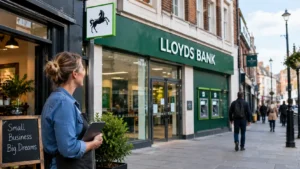
The impact can be greater for businesses than for many personal banking customers.
A retailer, restaurant or service business may regularly need to deposit notes and coins.
If the nearest branch moves several miles away, that can create additional:
- Travel costs
- Staff time
- Security risks when transporting cash
- Delays in depositing daily takings
- Difficulty obtaining change
- Administrative disruption
For businesses operating in cash-heavy sectors, a nearby Post Office or Banking Hub can therefore be more important than access to mobile banking.
The issue also extends beyond banking itself.
Traditional bank branches contribute to high-street footfall. Employees, customers and businesses visiting a bank may also visit nearby shops, cafés and other services.
Removing a major bank can consequently contribute to broader changes in town centres.
Are Lloyds Bank Closures Likely to Continue?
The direction of travel suggests that the UK banking network will continue becoming more concentrated.
Lloyds is not alone in reducing its estate. Other major banks have also been closing branches while investing more heavily in mobile banking, shared banking facilities and alternative cash-access arrangements.
However, traditional banking is unlikely to disappear completely in the near term.
Large numbers of customers continue to require:
- Cash services
- Complex account support
- Fraud assistance
- Identification checks
- Financial appointments
- Help with digital banking
- Face-to-face communication
The likely result is a smaller number of conventional branches combined with more Banking Hubs, digital services and alternative community banking arrangements.
What Does the Latest Lloyds Closure Programme Mean?
The Lloyds Bank closures of 2026 and 2027 represent more than a simple reduction in the number of branches.
They illustrate a fundamental change in the way high-street banking is organised.
Many of the earliest 2026 closures have already taken place, but the process is far from complete. A substantial autumn wave runs through October and November, while several Lloyds locations are already scheduled to shut during 2027.
Customers who rely heavily on their local branch should therefore check their arrangements early rather than waiting until the final trading day.
At the same time, the Halifax-to-Lloyds transition means customers should distinguish between a genuine physical closure and a branch that is simply being rebranded.
The Lloyds name may ultimately become more visible across the UK branch network, even while the total number of physical banking locations continues to decline.
Frequently Asked Questions
How many Lloyds Bank branches are closing?
Current comprehensive schedules list 125 Lloyds-branded branches as closed or due to close across 2026 and 2027.
Are Lloyds Bank branches still closing in October 2026?
Yes. Numerous Lloyds branches have closure dates during October 2026, followed by additional closures in November.
Are there Lloyds Bank closures planned for 2027?
Yes. Locations including Sheffield, Clevedon, Ebbw Vale, Street, Honiton, Wednesbury, Stoke-on-Trent and Kirkby have dates extending into 2027.
Why is Lloyds closing branches?
The main reason given is the continuing shift towards mobile and online banking, which has reduced the number of everyday transactions carried out in branches.
Does my account close when my Lloyds branch closes?
No. A branch closure normally affects the physical location only. Your bank account and regular payments continue operating.
Can Lloyds customers use Halifax branches?
Many everyday services can be accessed across Lloyds Banking Group’s branch network, and Halifax is progressively being brought under the Lloyds brand.
Is Halifax disappearing completely?
The Halifax retail brand is being transitioned to Lloyds, but many physical Halifax locations will become Lloyds branches rather than simply closing.
Can businesses still deposit cash after a branch closes?
Alternative arrangements can include other branches, Post Offices, Banking Hubs and eligible cash-deposit facilities, depending on the location.
Will every town losing Lloyds receive a Banking Hub?
No. Banking Hubs are introduced following local cash-access assessments, so their availability varies from one community to another.