Costa Coffee Losses Double to £13.5m: Why Is the UK Chain Struggling?
 • January 2, 2026
Last Updated On – 01-10-2026
Costa Coffee’s financial difficulties have intensified, with the UK coffee chain recording an operating loss of nearly £13.5 million in 2024, more than double the £5.8 million operating loss reported for 2023.
The deterioration came despite revenue continuing to move in the opposite direction. Costa generated approximately £1.23 billion of revenue during 2024, around 1% higher than the previous year.
That combination—slightly higher sales but substantially deeper operating losses—highlights the pressure on Costa’s margins rather than a simple collapse in customer spending.
The business is dealing with rising labour and commodity costs, softer high-street footfall and increasingly aggressive competition from both ends of the coffee market.
At the same time, parent company The Coca-Cola Company explored a sale of Costa before abandoning the process when prospective buyers failed to meet its valuation expectations.
Coca-Cola subsequently confirmed that it would retain full ownership and later brought restructuring specialists into the business to review Costa’s operations and finances.
How Much Money Did Costa Coffee Lose?
Costa Coffee’s operating loss increased from £5.8 million in 2023 to almost £13.5 million in 2024.
That represents an increase of approximately 132% in only one year.
The deterioration is particularly significant because revenue did not fall. Sales increased by approximately £9 million to £1.23 billion.
In other words, Costa continued generating substantial customer spending but found it increasingly expensive to turn that revenue into operating profit.
Before the pandemic, Costa had regularly generated much stronger profits, with annual profits in some periods reaching close to £100 million.
The latest accounts therefore show how dramatically the economics of operating a large coffee-shop estate have changed.
There is also an important accounting distinction.
Despite the £13.5 million operating loss, Costa reported a £67 million profit after tax, helped by an approximately £85 million dividend income receipt and a £2 million tax credit.
That does not erase the underlying operating problem. The operating result is more useful when examining how Costa’s day-to-day coffee business itself performed.
Why Did Costa Coffee’s Losses Increase Despite Higher Revenue?
Costa’s situation demonstrates that growing revenue does not automatically produce higher profits.
The chain has been dealing with several costs and competitive pressures simultaneously.
Softer High-Street Footfall
Costa itself identified softer footfall as one factor affecting performance.
Its large physical estate means the business is particularly exposed to changes in how frequently people visit traditional high streets, shopping centres and town centres.
Hybrid working, changing commuting patterns and pressure on household budgets have altered when and where consumers buy coffee.
A café can therefore continue generating significant sales while becoming less profitable if customer volumes do not increase quickly enough to absorb higher fixed costs.
Value-Led Competitors
Competition has become one of Costa’s most significant challenges.
Greggs and McDonald’s can sell coffee alongside relatively inexpensive food products, allowing them to compete aggressively for customers who prioritise value and convenience.
For a consumer purchasing breakfast or lunch, adding an inexpensive coffee to an existing food order can be more attractive than making a separate visit to a traditional coffee shop.
This puts particular pressure on Costa’s middle-market positioning.
Premium and Specialist Coffee Brands
Costa is simultaneously facing competition from businesses positioned around premium coffee, food quality, store design and brand experience.
Pret A Manger, Gail’s, Black Sheep Coffee, Blank Street and independent coffee shops all compete for different sections of the UK café market.
Some customers are therefore moving towards lower-priced convenience options, while others are willing to pay more for brands they see as offering a distinctive café experience.
Costa has to compete with both groups.
Has Greggs Overtaken Costa Coffee?
Competition from Greggs has become particularly noteworthy.
By September 2026, published industry figures indicated that Greggs had grown to 2,737 UK outlets, compared with around 2,707 Costa locations, putting Greggs ahead by physical outlet numbers.
Store counts can change as outlets open and close, but the comparison demonstrates how rapidly the competitive environment is evolving.
Greggs has been able to build its coffee business around an extensive food-to-go operation and a strong value proposition.
For Costa, this means competition is no longer limited to Starbucks, Caffè Nero or other traditional coffee-shop chains.
How Are Rising Costs Affecting Costa Coffee?
Costa is also facing many of the cost pressures affecting the wider hospitality industry.
These include:
- Higher coffee bean prices
- Increasing employee wages
- Employer National Insurance costs
- Energy and utility expenses
- Property rents and business costs
- Food and ingredient inflation
- Distribution and supply-chain expenses
- Refurbishment and maintenance costs
Arabica coffee prices rose sharply during the global commodity surge, at one stage moving above $4 per pound.
For a business operating thousands of outlets and selling millions of drinks, relatively small increases in ingredient costs can become substantial when multiplied across the entire network.
Labour is another major expense.
From April 2026, Costa increased its standard starting rate for baristas at company-owned UK stores to £13.12 per hour, while qualifying central London baristas receive £14.12.
The pay increase formed part of a £7 million investment affecting more than 16,000 employees.
More information about current wage levels is available in London Business Insider’s guide to Costa Coffee’s £13.12 barista pay rates.
Pay increases can help Costa recruit and retain staff in a competitive hospitality labour market, but they also illustrate the scale of the cost increases the business has to absorb.
Why Did Coca-Cola Try to Sell Costa Coffee?
Coca-Cola agreed to acquire Costa from Whitbread in 2018 in a transaction worth £3.9 billion, with the acquisition subsequently completed in 2019.
The deal was intended to give Coca-Cola a major global presence in the coffee market.
Several years later, however, Costa had not delivered the financial performance Coca-Cola originally expected.
Coca-Cola chief executive James Quincey acknowledged in 2025 that Costa had not performed as originally anticipated from an investment perspective.
Against that background, Coca-Cola began examining strategic options for the business during 2025, including a possible sale.
Reports suggested a valuation of approximately £2 billion was being sought.
That would already have represented a substantial reduction compared with the £3.9 billion acquisition price.
Why Was the Costa Coffee Sale Abandoned?
The sale process ultimately failed because prospective buyers were reportedly unwilling to meet Coca-Cola’s valuation expectations.
Private equity groups connected with the process included TDR Capital and Bain Capital, while other investment firms had reportedly examined Costa during earlier stages.
The timeline is important because reports about Costa being “for sale” are now outdated.
| Period | Development |
| 2018 | Coca-Cola agrees £3.9bn Costa acquisition |
| 2019 | Acquisition completed |
| August 2025 | Coca-Cola begins exploring a possible sale |
| Late 2025 | Private equity bidding process continues |
| December 2025 | Sale discussions reportedly brought to an end |
| January 2026 | Abandoned sale becomes publicly reported |
| February 2026 | Coca-Cola confirms it will retain Costa |
| June 2026 | Restructuring advisers reported to be reviewing Costa |
Therefore, it is no longer accurate to say that Coca-Cola is currently trying to sell Costa for £2 billion.
The attempted sale did not proceed.
Does Coca-Cola Still Own Costa Coffee?
Yes.
Coca-Cola confirmed in February 2026 that Costa Coffee would remain 100% owned by the company.
Its position following the abandoned sale was that there were no immediate plans for another transaction and that attention would instead turn towards improving Costa’s performance.
That significantly changes Costa’s strategic outlook.
Rather than preparing the chain for an immediate new owner, Coca-Cola now has to determine how it can improve profitability while retaining the business within its portfolio.
Why Has Coca-Cola Brought in Restructuring Advisers?
The failed auction did not bring Costa’s strategic review to an end.
In June 2026, reports emerged that Coca-Cola had brought restructuring specialists into the business.
AlixPartners was reported to be carrying out an operational review, while Alvarez & Marsal was associated with a review of Costa’s finances.
Bringing advisers into a business does not automatically mean that administration, insolvency or large-scale closures are planned.
Restructuring specialists can examine areas such as:
- Store profitability
- Property costs
- Staffing structures
- Supply-chain expenditure
- Procurement
- Pricing
- Capital investment
- Underperforming locations
- Operational efficiency
- Debt and financial structure
For Costa, the objective is likely to centre on improving the economics of a very large store network while protecting sales.
Is Costa Coffee Closing Down?
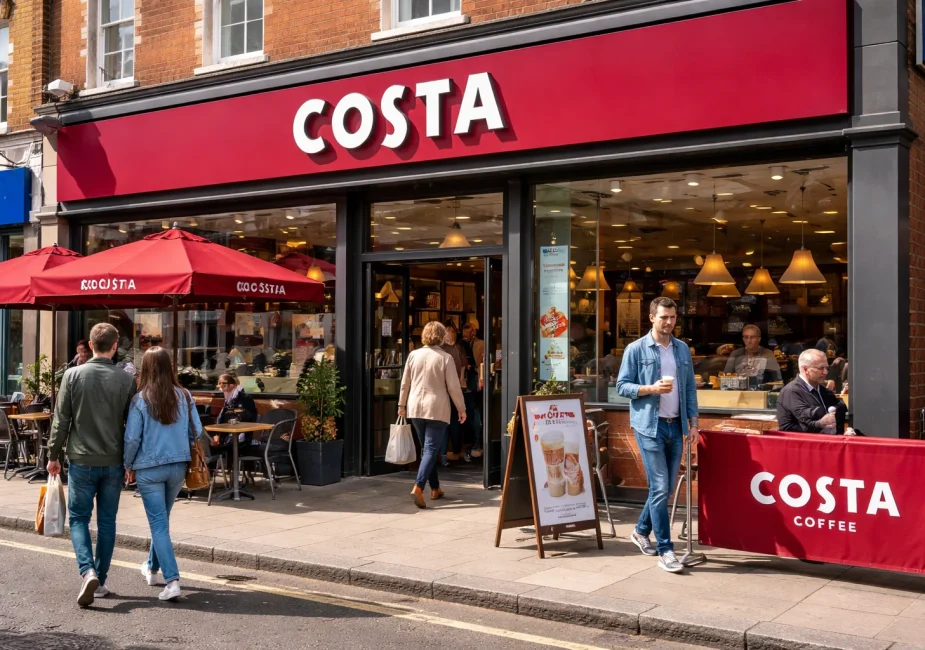
There is no indication that Costa Coffee is closing down as a company.
Individual Costa locations have closed, and the profitability of the store estate is clearly an important issue, but isolated closures should not be interpreted as evidence that the entire UK chain is disappearing.
London Business Insider has separately tracked reported Costa Coffee closures across the UK, including branches that have shut in different high-street, retail and service-station locations.
At the same time, Costa has continued investing in parts of its estate.
The company reached approximately 400 UK drive-thru locations during 2026 and announced plans for further drive-thru openings.
Its strategy therefore appears more nuanced than simply reducing the number of stores.
Costa can close weaker sites while simultaneously investing in formats and locations where customer demand remains stronger.
Why Are Drive-Thru Stores Important to Costa’s Recovery?
Drive-thru locations reduce some of Costa’s dependence on traditional town-centre footfall.
They can capture motorists, commuters and customers seeking convenience without requiring a lengthy café visit.
That matters because one of the problems identified in Costa’s results was softer footfall.
A greater mix of drive-thrus, transport locations and strategically placed convenience sites could therefore reduce exposure to underperforming traditional high streets.
However, expansion alone will not fix the underlying problem if the economics of individual stores remain weak.
New locations still have staffing, property, utility and supply-chain costs.
Costa’s challenge is consequently to improve profit per location, not simply increase the number of branded outlets.
What Does Costa Coffee’s £13.5 Million Loss Really Show?
The most revealing part of Costa’s financial performance is not simply that the business lost £13.5 million at operating level.
It is that the operating loss more than doubled while revenue increased.
That points towards a margin problem.
Costa still has customers. It still generates more than £1 billion in annual revenue. It remains one of Britain’s most recognisable coffee brands.
The difficulty is converting that scale into sufficient operating profit.
A business can grow sales but become less profitable where:
- Wage costs increase faster than menu prices.
- Ingredient costs rise.
- Customers trade down to cheaper products.
- Promotions reduce margins.
- Underperforming stores remain expensive to operate.
- Footfall does not increase sufficiently.
- Competitors capture higher-growth customer segments.
Costa is currently facing several of these pressures at the same time.
Can Costa Coffee Return to Profit?
Costa retains significant advantages.
It has one of the UK’s best-known coffee brands, a nationwide estate, significant customer awareness, drive-thru infrastructure and Coca-Cola’s financial resources behind it.
Its problems are therefore different from those of a small hospitality company struggling to access funding.
The central question is whether Costa can make its existing scale more profitable.
Areas likely to remain important include:
- Improving underperforming stores
- Reviewing the size and location of its estate
- Expanding stronger drive-thru formats
- Controlling staffing and procurement costs
- Refreshing stores
- Developing new drinks and food ranges
- Strengthening value perception
- Improving loyalty and visit frequency
- Differentiating Costa from both budget and specialist rivals
Closing weaker stores may form part of that process, but wholesale retrenchment is not the only option.
Costa also continues investing in employees, selected locations and alternative store formats.
Frequently Asked Questions
How much did Costa Coffee lose in 2024?
Costa Coffee recorded an operating loss of approximately £13.5 million in 2024, compared with £5.8 million in 2023.
Why did Costa Coffee’s losses double?
Costa cited softer footfall and increasing competition from value-led rivals, while higher wages, coffee prices and wider operating costs have also put pressure on margins.
Did Costa Coffee’s revenue fall?
No. Revenue increased by approximately 1% to around £1.23 billion during 2024 despite the larger operating loss.
Is Coca-Cola still trying to sell Costa Coffee?
No immediate sale is currently planned. Coca-Cola abandoned the sale process and confirmed in February 2026 that it would retain full ownership of Costa.
How much did Coca-Cola pay for Costa?
Coca-Cola agreed to acquire Costa Coffee from Whitbread for £3.9 billion in 2018, with the transaction completed in 2019.
Was Costa going to be sold for £2 billion?
Around £2 billion was widely reported as the level Coca-Cola wanted during the attempted sale. Bids did not meet expectations and the process was abandoned.
Is Costa Coffee going out of business?
There is no evidence that Costa Coffee is going out of business. Individual stores have closed, but the company continues operating a large UK network and investing in selected locations and formats.
Who are Costa Coffee’s main competitors?
Costa faces value-led competition from businesses such as Greggs and McDonald’s and competition from established and specialist café brands including Starbucks, Caffè Nero, Pret A Manger, Gail’s, Black Sheep Coffee and Blank Street.