Pavers Confirms Store Closures – Which Branches Are Shutting and Why?
 • February 10, 2026
🛍️ PAVERS STORE CLOSURE – 2026 LOCAL UPDATE
📍 What’s Still Open: Pavers Barbican store continues to operate normally with full in-store services available.
⚠️ Notice: The closure is localised. There is no indication of wider nationwide shutdowns across Pavers’ 160+ UK and Ireland locations.
This update reflects the latest developments in Pavers’ store network as part of its operational adjustments in 2026. Customers are encouraged to check the store locator for updated hours and locations.
Why Is Pavers Closing Its Plymouth City Centre Store?
The closure of Pavers’ Plymouth city centre store on New George Street has caught the attention of many local shoppers. Given its central location and previously steady footfall, the decision has come as a surprise.
Pavers has not given a detailed explanation for why this branch was chosen. This is fairly typical, as retailers rarely comment on individual store closures when they are part of wider reviews.
A spokesperson for the company confirmed the closure but stressed continuity elsewhere, stating:
“We don’t give formal comments on store closures, however I can confirm that the Plymouth Barbican store is remaining open.”
While no official reason has been shared, several wider factors likely played a role:
- Rising operating and energy costs
- Business rates and rent pressures
- Shifts in footfall away from some city centres
For Pavers, which still operates more than 160 stores across the UK and Ireland, this closure appears to be a targeted decision rather than a sign of widespread retrenchment.
When Is the Pavers Store in Plymouth Shutting Its Doors?
The Plymouth city centre Pavers store officially closed on Sunday, 8 February. In the days leading up to the closure, the retailer launched a prominent closing‑down sale, drawing customers eager to take advantage of significant discounts.
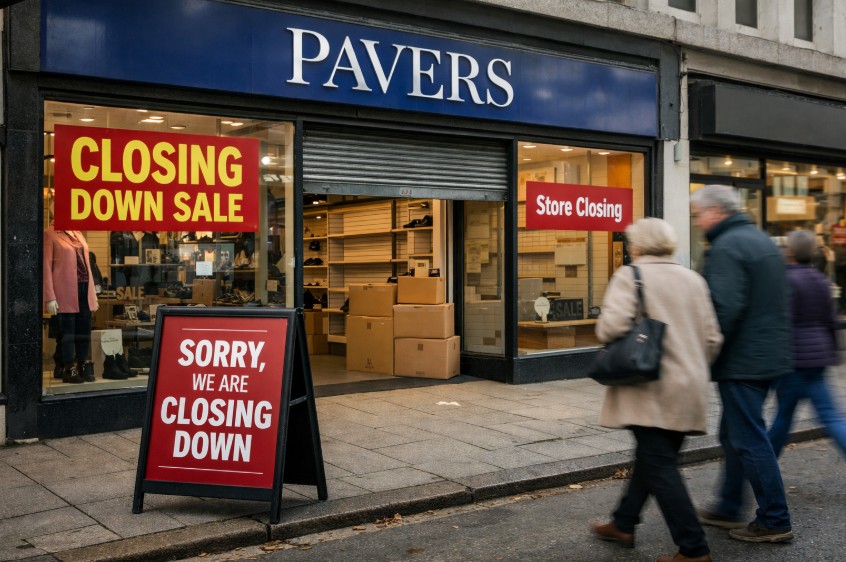
Shoppers reported signage in the store windows reading:
“Sorry, this store is closing down. But don’t worry, this isn’t a goodbye.”
This messaging was clearly intended to reassure customers that Pavers was not abandoning Plymouth entirely. The timing of the closure, at the end of a trading week, aligns with common retail practice and allows for stock clearance, staffing transitions, and lease handover.
The short notice nature of the shutdown, however, left some customers feeling caught off guard. For many, the store was a regular destination, particularly valued for its reputation for comfort‑focused footwear and knowledgeable staff.
Which Other Pavers Locations Are Still Open Nearby?
While the closure of Pavers’ New George Street branch in Plymouth has understandably concerned loyal customers, it’s important to clarify that this decision is not part of a wider wave of shutdowns.
In fact, the brand maintains a strong retail footprint, both locally and nationally. The closure is specific and strategic, with other branches in the area still operating as normal.
Nearest Alternative: The Barbican Store
The most immediate reassurance for Plymouth shoppers is the confirmation that the Pavers store at the Barbican remains open.
Located just a short distance from the now-closed New George Street location, the Barbican outlet offers a convenient alternative with the same footwear collections and customer service that Pavers is known for.
This store provides:
- In-store fitting and personalised service
- Access to seasonal collections
- Support for returns, exchanges, and loyalty offers
From a business standpoint, this consolidation makes strategic sense. Rather than overextending resources across two city-centre sites, Pavers is focusing on its higher-performing store while continuing to serve the local community effectively.
Other Operating Branches in the South West
Outside of Plymouth, Pavers continues to maintain a stable presence across the South West, including retail parks, shopping centres, and outlet villages. These stores remain unaffected by the recent announcement and continue to operate normally.
The table below provides a snapshot of current store status:
| Location Area | Store Status | Notes |
|---|---|---|
| Plymouth – New George Street | Closed | Closed on 8 February |
| Plymouth – Barbican | Open | Confirmed to remain trading |
| South West (various towns) | Open | No closures announced |
| UK & Ireland (160+ stores) | Open | Trading as normal |
This table highlights an important point: the current focus of pavers store closures is limited and localised, not nationwide.
Customers across the South West can continue to visit their nearest Pavers store, while those in Plymouth have the option to shop at the Barbican or online through the brand’s website.
The consistency in store operations across the UK also suggests the company remains financially sound and operationally stable.
“We’re continuing to invest in areas where we see growth and customer demand,” one Pavers regional representative reportedly said. “Optimising our store network ensures we deliver the best service possible.”
Is This Closure a Sign of Bigger Trouble for Pavers?
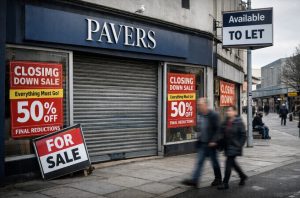
It is understandable that shoppers may worry that one closure could lead to more. However, the available evidence suggests caution rather than crisis.
Pavers remains a financially active retailer with a strong brand identity and a loyal customer base. Founded in 1971 by Catherine Paver, the company has navigated multiple economic downturns over its 50‑year history. Single‑store closures, particularly where nearby alternatives exist, are often part of routine retail optimisation rather than a sign of financial distress.
The timing of this closure, shortly after other high‑profile retail struggles such as Quiz entering administration, has inevitably drawn comparisons. Yet there is a crucial difference. Quiz’s difficulties stemmed from broader structural issues, while Pavers continues to trade normally across the vast majority of its estate.
How Are Customers Reacting to the Pavers Closure?
Public reaction has been emotional, particularly among long‑standing customers who relied on the New George Street store. Many expressed disappointment not just at losing Pavers, but at what the closure represents for Plymouth city centre more broadly.
One shopper commented:
“Another casualty of online shopping. I buy all my boots from Pavers – they’re the best.”
Others voiced concern about the cumulative impact of closures on the local economy, with comments suggesting fears that the city centre could become increasingly hollowed out.
At the same time, some customers have welcomed the reassurance that the Barbican store remains open. For them, the closure is inconvenient rather than catastrophic, especially if service quality remains consistent at the remaining branch.
This mix of frustration, sadness, and cautious acceptance mirrors public sentiment seen across many UK towns experiencing similar retail changes.
What Discounts Are Available in the Pavers Closing Down Sale?
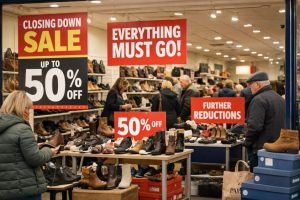
As news of the Plymouth store closure broke, many customers were drawn in not just by concern, but by the promise of significant savings.
In a bid to clear remaining stock ahead of the shutdown, Pavers launched a major closing down sale, offering compelling discounts that quickly grabbed attention both on the high street and online.
Sale Messaging and In‑Store Offers
In the lead-up to the final day of trading, bold signage appeared across the New George Street branch, signalling reductions of up to 50% off across a wide range of footwear and accessories.
Messages such as “everything must go” and “take a further 50% off stock” appeared in the shop windows, sparking a surge of last-minute shoppers hoping to grab a bargain.
The sale spanned some of Pavers’ most popular product lines, including:
- Men’s and women’s leather boots
- Comfort-fit trainers and walking shoes
- Slippers, sandals, and smart casual shoes
- Accessories such as bags, scarves, and socks
Notably, many of the sale items reflected the brand’s core strength, supportive, comfort-driven footwear, making this a rare opportunity for value-conscious customers.
These sales served several purposes:
- Clearing remaining stock efficiently to avoid costly storage or redistribution
- Rewarding loyal customers who regularly shop in-store
- Creating urgency to drive footfall in the final trading days
The timing was particularly strategic, coinciding with the early February retail lull and giving customers a reason to re-engage with the store.
Why Closing Down Sales Are Common?
It’s worth clarifying that closing down sales are not a signal of company-wide distress. Rather, they are a standard and strategic part of the retail playbook during planned store exits.
By heavily discounting remaining stock:
- Inventory is sold through quickly without requiring transport to other branches
- Lease obligations can be fulfilled with a clean unit handover
- Labour costs and logistics are minimised during the store’s wind-down
In this instance, the sale was clearly limited to the Plymouth New George Street location and did not extend to other Pavers outlets or the online store. This supports the narrative that the closure was isolated and local, rather than indicative of a brand-wide financial issue.
Furthermore, a Pavers spokesperson reiterated:
“This isn’t a goodbye. Your nearest store is: Plymouth, The Barbican.”
This continued presence reinforces the idea that the sale was a practical exit strategy, not a distressed move.
Will There Be Job Losses After the Store Closure?
One of the most sensitive aspects of any retail closure is its impact on staff. At present, Pavers has not confirmed whether jobs were lost as a result of the Plymouth city centre closure.
Retailers sometimes seek to redeploy staff to nearby stores, particularly when another branch remains open in the same city. However, without official confirmation, it is impossible to state definitively whether all employees were offered alternative roles.
A company spokesperson reiterated the limited scope of the announcement, saying:
“We don’t give formal comments on store closures.”
This lack of detail has understandably left some uncertainty, but it is worth noting that Pavers’ continued presence in Plymouth may have softened the impact compared with a full city exit.
Is Pavers Moving Toward Online‑Only Shopping?
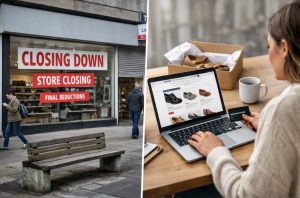
The discussion around Pavers store closures has naturally raised questions about whether the retailer is shifting to an online-only model. Across the UK, shopping habits continue to evolve, with many customers now blending digital and in-store experiences, researching online before buying in person, or vice versa.
Footwear remains a more complex category. While online sales have grown, many shoppers still prefer to try shoes in person, particularly when comfort, fit, or specialist support matters. Pavers has traditionally performed strongly here, with in-store advice playing a key role in customer loyalty.
Rather than moving fully online, Pavers appears to be refining its approach by:
- Reducing underperforming locations
- Strengthening remaining stores alongside online services
This strategy points to adaptation rather than withdrawal, with physical stores still central to the brand as retail habits continue to change.
What Does This Say About the Future of UK High Streets?
The closure of a well‑known retailer inevitably feeds into broader concerns about the future of UK high streets. Rising rents, business rates, and uneven footfall have placed significant strain on town and city centres, particularly outside prime retail zones.
However, closures are not uniform. Some locations continue to thrive, benefiting from mixed‑use development, residential growth, and experience‑led retail. Others struggle, highlighting the uneven nature of recovery.
| Factor Affecting High Streets | Impact on Retailers |
|---|---|
| Business rates & rent | Increased operating costs |
| Online competition | Reduced footfall |
| Local economic health | Spending power varies |
| Store clustering | Drives consolidation decisions |
In this context, pavers store closures reflect broader structural pressures rather than isolated missteps. The challenge ahead lies in adapting high streets to new consumer realities rather than attempting to restore old models unchanged.
Final Thoughts on Pavers Store Closures
The closure of Pavers’ Plymouth city centre store is significant, but it should be viewed in proportion. This is a single, targeted closure, not a mass withdrawal from the high street.
With more than 160 stores still trading and a continued presence in Plymouth via the Barbican branch, Pavers remains very much part of the UK retail landscape.
For customers, the key takeaway is reassurance rather than alarm. For observers of UK retail, the episode serves as another example of how even established brands must continually adapt to shifting economic and consumer realities.
FAQs About Pavers Store Closures
Are any other Pavers stores closing soon?
At present, Pavers has not announced any additional closures beyond the Plymouth city centre branch.
Is Pavers leaving Plymouth altogether?
No. The Barbican store remains open and continues to serve customers in the area.
Does a closing‑down sale mean Pavers is struggling financially?
Not necessarily. Closing‑down sales are common when individual stores shut and do not automatically indicate wider financial trouble.
How many stores does Pavers currently operate?
Pavers operates more than 160 stores across the UK and Ireland.
Can customers still shop online with Pavers?
Yes. Pavers continues to offer online shopping alongside its physical stores.
Why are so many UK retailers closing stores?
Rising costs, changing shopping habits, and uneven footfall are placing pressure on many high street retailers.
Will Pavers open new stores in the future?
There has been no announcement regarding new openings, but the brand continues to invest selectively in its store network.