
HMRC Tax Investigation Time Limits: How Far Back Can HMRC Go?
 • August 28, 2026

There is no single HMRC tax investigation time limit for every case.
HMRC normally has 12 months after a Self Assessment return is delivered to open a formal enquiry. Different rules can apply when a return is filed late or later amended.
Separate assessment rules determine how far back HMRC can recover tax. Depending on the circumstances, the main periods are 4 years, 6 years, 12 years or 20 years.
These limits answer different questions. The 12-month period concerns opening an enquiry. The 4, 6, 12 and 20-year periods generally concern assessments. An enquiry that has already been validly opened does not automatically expire after one of these periods.
HMRC Investigation Time Limits at a Glance
| Circumstance | Typical Time Limit | What It Means |
|---|---|---|
| Normal Assessment | 4 Years | Standard assessment period |
| Careless Behaviour | 6 Years | Longer period where relevant tax was lost through carelessness |
| Certain Offshore Matters | 12 Years | Can apply to qualifying offshore Income Tax, CGT and IHT matters |
| Deliberate Behaviour | 20 Years | Extended period where relevant tax loss was deliberate |
| Certain Failures to Notify | Up to 20 Years | Longer assessment period can apply |
| Self Assessment Enquiry | Normally 12 Months | Normal period for HMRC to open a formal enquiry |
| Existing Enquiry | No Universal Fixed Maximum | Separate closure procedures apply |
HMRC’s Compliance Handbook was updated on 13 August 2026 and continues to identify the principal assessment periods as 4, 6, 12 and 20 years.
What Does an HMRC Tax Investigation Mean?
“Tax investigation” is commonly used to describe several types of HMRC compliance activity.
You might receive a formal Self Assessment enquiry, a compliance check focused on a particular issue, or an assessment relating to an earlier tax year.
The statutory framework includes the Taxes Management Act 1970, although the precise rules depend on the tax and procedure involved.
What Is a Self Assessment Enquiry?
A Self Assessment enquiry allows HMRC to examine information contained in your tax return.
The enquiry could focus on one figure or cover several areas, such as business income, expenses, property income or Capital Gains Tax.
A formal enquiry must be opened within the relevant statutory period.
What Is a Discovery Assessment?
A discovery assessment can become important after the ordinary enquiry window has closed.
It gives HMRC a route to assess additional tax where the statutory discovery conditions are satisfied and the relevant assessment deadline has not expired.
This is why the end of the normal enquiry window does not necessarily mean an older tax year can never be examined again.
How Long Does HMRC Have to Open an Investigation?
For a Self Assessment return delivered on time, HMRC normally has 12 months from the date the return was delivered to open a formal enquiry.

The deadline changes in some situations.
What If You Filed Your Tax Return Late?
A late return can extend HMRC’s enquiry window.
You should therefore calculate the deadline using the actual filing circumstances rather than assuming the ordinary filing deadline determines when HMRC’s powers end.
What If You Amend Your Tax Return?
An amendment can create a new period in which HMRC may enquire into the amended information.
HMRC guidance says an enquiry following an amendment may generally be opened up to the relevant quarter day following the first anniversary of the amendment.
How Far Back Can HMRC Investigate Your Tax Affairs?
The answer depends on why tax has been lost.
HMRC’s current guidance identifies four main assessment periods. The normal period is four years, with longer periods applying in specified circumstances.
What Is the HMRC 4-Year Rule?
The standard HMRC assessment period is generally four years from the end of the relevant tax period.
This is the normal starting point where a longer statutory period does not apply.
When Can HMRC Go Back 6 Years?
A six-year time limit can apply where relevant tax has been lost because of careless behaviour.
Carelessness is different from deliberate conduct. HMRC must consider the circumstances and whether reasonable care was taken.
The existence of an error does not automatically establish deliberate behaviour.
When Can HMRC Go Back 12 Years?
A 12-year assessment period can apply to certain Income Tax, Capital Gains Tax and Inheritance Tax cases involving qualifying offshore matters or offshore transfers.
It is not a general rule applying whenever someone owns overseas property, receives foreign income or holds assets abroad.
The detailed offshore conditions still need to be met.
When Can HMRC Go Back 20 Years?
HMRC can have 20 years to assess in specified circumstances, including cases where relevant tax was lost through deliberate behaviour.
A 20-year period can also apply to certain failures to notify HMRC of a tax liability. HMRC’s current guidance confirms that the failure-to-notify time limit can extend to 20 years.
This does not mean HMRC automatically receives 20 years in every investigation.
How Long Can an HMRC Investigation Stay Open?
There is no single maximum duration that automatically ends every HMRC enquiry.
The 4, 6, 12 and 20-year periods are principally assessment time limits. They should not be treated as automatic deadlines for completing an enquiry that was validly opened.
Some enquiries finish relatively quickly. Others can take longer where HMRC is reviewing several tax years, disputed transactions, incomplete records, offshore issues or complicated company arrangements.
You are not necessarily required to accept an open-ended enquiry indefinitely.
HMRC’s Enquiry Manual confirms that a taxpayer can apply to the tribunal for a direction requiring HMRC to issue a partial or final closure notice. HMRC must show reasonable grounds for continuing if it wants the tribunal not to direct closure.
Practical information about applications and tax disputes is from the First-tier Tribunal Tax Chamber.
Can HMRC Investigate After the 12-Month Enquiry Window?
Yes, in some circumstances.
The end of the ordinary 12-month enquiry period does not automatically prevent HMRC from assessing additional tax.
For example, discovery assessment powers may remain available where their statutory conditions are met. HMRC must still act within the assessment period that applies to the particular case.
This distinction is central to understanding the HMRC tax investigation time limit. The enquiry deadline and the assessment deadline are not the same thing.
Change The Question And The Deadline Changes
HMRC’s 12-month enquiry window and its longer assessment periods do different jobs. Switch between them to see the distinction.
Opening A Formal Enquiry
For an on-time Self Assessment return, HMRC normally has 12 months after the return is delivered to open a formal enquiry.
An enquiry that has already been validly opened does not automatically expire simply because an assessment period later reaches its end.
Different Circumstances Open Different Years
The normal assessment period is four years, but longer periods can apply where the relevant statutory conditions are met.
Change The Circumstances
Select the basis of the case and the relevant archive drawer will move forward.
Four years is the normal assessment period where a longer statutory period does not apply.
Latest HMRC Investigation Changes for 2026/27
HMRC's compliance operation is expanding during 2026/27, but that should not be confused with a replacement of the existing 4, 6, 12 and 20-year assessment framework.
The changes mainly concern staffing, data, digital systems and how HMRC identifies potential non-compliance.
HMRC Is Recruiting More Compliance Officers
HMRC says it has recruited more than 2,100 additional compliance officers so far and plans to recruit another 1,100 during 2026/27. Its longer-term target is 5,500 additional compliance officers by 2029/30.
That does not mean every taxpayer faces a greater likelihood of investigation. It does mean HMRC is increasing its capacity to carry out compliance work.
HMRC Is Making Greater Use of Data and AI
HMRC is continuing to develop data-led compliance systems and AI-supported tools.
Its 2026 Transformation Roadmap says the department is improving how third-party information is used for risk assessment and compliance work.
It is also developing AI tools to support administrative and casework functions while keeping skilled caseworkers responsible for final decisions.
These developments may help HMRC identify inconsistencies more efficiently, particularly where information reported by taxpayers differs from data available elsewhere.
Making Tax Digital Is Expanding
Making Tax Digital for Income Tax became mandatory from April 2026 for qualifying sole traders and landlords with gross income above £50,000.
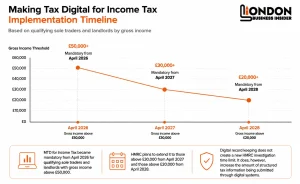
HMRC plans to extend it to those above £30,000 from April 2027 and those above £20,000 from April 2028.
Digital record keeping does not create a new HMRC investigation time limit. It does, however, increase the amount of structured tax information being submitted through digital systems.
What Records Matter During an HMRC Investigation?
Good records can make it easier to establish what happened and why figures were reported in a particular way.
Depending on your circumstances, relevant documents may include:
- Tax Returns. Keep copies of returns and amendments.
- Bank Statements. Retain records supporting business and personal transactions under review.
- Invoices And Receipts. Keep evidence for income, costs and claimed expenses.
- Company Records. Preserve accounts, payroll records and supporting documents.
- Property Records. Keep evidence of purchase prices, improvements, income and disposals.
- HMRC Correspondence. Keep letters, notices and copies of information supplied.
For company directors, transactions between you and your business may also attract scrutiny. An overdrawn director loan account can create separate reporting and tax issues depending on the balance and what happens to it.
Evidence can become particularly important when HMRC and a taxpayer disagree about what a transaction represents.
The recent HMRC director's loan tax tribunal case shows how the treatment of a director's loan can depend on the practical facts and documentation surrounding the balance.
Record-retention requirements should not be confused with HMRC assessment periods. They are related practical issues, but they answer different legal questions.
What Should You Do If HMRC Opens a Tax Investigation?
If HMRC contacts you:
- Check The Notice. Confirm the tax and years being examined.
- Keep Your Records. Preserve documents relevant to HMRC's questions.
- Respond Accurately. Do not guess when information is missing.
- Watch Deadlines. Reply within the stated period or request more time where necessary.
- Get Advice If Needed. Consider specialist help for complex or disputed cases.
Conclusion: Understanding the HMRC Tax Investigation Time Limit
The HMRC tax investigation time limit depends on which deadline you are dealing with.
HMRC normally has a 12-month window to open an enquiry into an on-time Self Assessment return. Its assessment powers can extend to 4, 6, 12 or 20 years depending on factors such as carelessness, offshore matters, deliberate behaviour or certain failures to notify.
An enquiry already in progress is different again. It does not automatically end when one of those assessment periods expires, although taxpayers can use formal closure procedures where appropriate.
If HMRC contacts you about an older tax year, the important questions are what power it is using, which statutory time limit applies and why HMRC believes any extended period is available.
This article provides general information and is not personal tax or legal advice.
Frequently Asked Questions About HMRC Investigation Time Limits
What Is the HMRC Tax Investigation Time Limit?
There is no single limit. Depending on the issue, HMRC may be working within a 12-month enquiry window or a 4, 6, 12 or 20-year assessment period.
Does HMRC Only Have 12 Months to Investigate You?
No. Twelve months normally relates to opening a Self Assessment enquiry, not every HMRC assessment or investigation.
Can HMRC Go Back More Than 4 Years?
Yes. Six, 12 or 20-year assessment periods can apply where the relevant statutory conditions are satisfied.
When Can HMRC Go Back 6 Years?
The six-year period can apply where relevant tax was lost because of careless behaviour.
Can HMRC Go Back 12 Years?
Yes, for certain qualifying offshore Income Tax, Capital Gains Tax and Inheritance Tax matters.
When Can HMRC Go Back 20 Years?
A 20-year period can apply in specified cases involving deliberate behaviour or certain failures to notify HMRC.
Can You Ask HMRC to Close an Investigation?
Yes. During a formal enquiry, you may apply to the tribunal for a direction requiring a partial or final closure notice where appropriate.