

PIP Assessment Trick Questions And Answers: What To Expect And How To Answer In 2026?
 • August 14, 2026
•
1 Comment
• August 14, 2026
•
1 Comment

There is no official DWP list called “PIP assessment trick questions and answers”. However, assessors can ask about everyday activities, routines, work, driving, shopping, hobbies, pets and how someone spends a typical day.
These questions can feel like tricks because the answer may provide information about several areas of functional ability.
The safest approach is not to memorise supposedly perfect PIP answers. A claimant should answer truthfully and give enough context to show what an activity actually involves, including any help, pain, fatigue, prompting, aids, distress, extra time or recovery afterwards.
PIP is concerned with how a long-term condition or disability affects daily living and mobility.
For relevant activities, the assessment considers whether they can be completed safely, to an acceptable standard, repeatedly and within a reasonable time.
A person should also avoid describing only an unusually good day or only an exceptionally bad day.
Where a condition fluctuates, the pattern across time matters. GOV.UK states that difficulty generally needs to affect the relevant task on more than half of the days over the applicable period.
What Does A PIP Assessor Actually Assess?
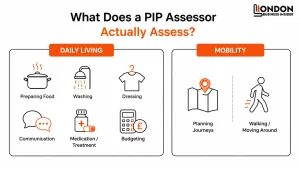
A PIP assessment looks at functional difficulties rather than simply asking whether a person has a particular diagnosis.
The daily living activities include areas such as preparing food, washing, dressing, communicating, managing treatment, social interaction and budgeting. Mobility considers planning and following journeys and physically moving around.
An assessor may consider:
- What the Claimant Can And Cannot Do?
- Whether Another Person Provides Help?
- Whether Prompting Or Supervision Is Needed?
- Whether An Aid Or Appliance Is Used?
- How Long An Activity Take?
- Whether Pain, Fatigue Or Distress Occurs?
- Whether The Activity Can Be Repeated?
- Whether The Claimant Can Do It Safely?
The health professional produces an assessment report and recommendation. The DWP then makes the benefit decision.
Why Can Ordinary Questions Feel Like Trick Questions?

Questions about ordinary life may appear unrelated to PIP descriptors.
For example, asking whether someone shops does not merely establish whether they enter a supermarket.
The fuller picture could include how they travel there, how far they walk, whether they use a trolley for support, whether someone accompanies them and how they feel afterwards.
A claimant discussion supplied as a reference illustrates this distinction. One person described relying on a supermarket trolley for support, stopping because of pain and increasingly using home delivery.
That demonstrates why a simple answer such as “yes, I shop” may leave out important functional information.
The same principle applies to driving, smartphone use, hobbies and pet care. None should automatically prove that somebody can perform a particular PIP activity reliably.
The Four PIP Reliability Rules Every Answer Should Explain
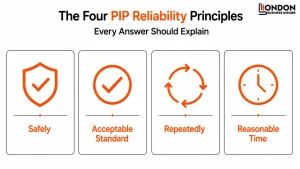
One of the most important parts of understanding how to answer PIP assessment questions is knowing what “reliably” means.
The DWP assessment criteria require consideration of whether an activity can be completed safely, to an acceptable standard, repeatedly and within a reasonable time.
Can The Activity Be Done Safely?
A claimant should explain any genuine risk that arises when completing an activity.
This could include:
- Falls While Walking Or Washing
- Burns Or Cuts While Preparing Food
- Medication Mistakes
- Severe Psychological Distress
- Dizziness Or Fainting
- Risk To Another Person
A person who can technically cook a meal but regularly risks dropping hot pans may have a different level of functional ability from somebody who can prepare the same meal safely.
Can It Be Done To An Acceptable Standard?
- Completing an activity does not necessarily mean it has been completed adequately.
- For example, someone may technically be able to dress but be unable to fasten clothing correctly, or they may wash without being able to clean themselves sufficiently.
- The answer should describe the outcome rather than simply stating that the activity was attempted.
Can It Be Done Repeatedly?
- Being able to perform an activity once does not always establish that it can be repeated whenever reasonably required.
- A claimant might walk a particular distance once but experience enough pain or fatigue afterwards that the same journey cannot reasonably be repeated later.
- Recovery time is therefore relevant.
Can It Be Done Within A Reasonable Time?
- DWP guidance treats reasonable time as no more than twice the time a person without the relevant limitation would normally need to complete the activity.
- Someone who takes considerably longer to wash, dress or prepare food should explain why.
The “Yes, But…” Principle
“Yes, but” can be useful as a way of remembering to provide context, although it should never be used to manufacture difficulties.
For example:
“Yes, the claimant can prepare food, but only while sitting on a perching stool. Chopping is difficult, another person handles heavy pans, and the claimant normally needs to rest afterwards.”
The important part is the explanation after the initial answer.
20 Common PIP Assessment Trick Questions And Answers

The following are examples of questions reported in claimant experiences and PIP advice material. They are not an official list of DWP trick questions, and individual assessments differ.
Claimant accounts supplied for this article report questions covering smartphones, pets, work, hobbies, shopping, walking and day-to-day routines.
1. “How Did You Get Here Today?”
The claimant should explain the whole journey rather than simply saying “by car” or “by bus”.
Relevant details could include walking distance, whether another person drove, difficulty using public transport, anxiety, stops, mobility aids and recovery afterwards.
If someone was given a lift because travelling alone is difficult, that context matters.
2. “Do You Drive?”
Driving is not an automatic bar to PIP.
A claimant should answer honestly and explain how often they drive, the length of journeys, any vehicle adaptations, pain while driving, help getting in or out and whether driving causes fatigue or other symptoms afterwards.
Employment and driving can coexist with disability-related needs. PIP itself is not an unemployment benefit, and someone can be working while claiming PIP if the relevant daily living or mobility criteria continue to be met.
3. “Do You Use A Smartphone?”
Using a smartphone may provide some information about communication, concentration or hand function, but it does not automatically establish that another PIP activity can be completed reliably.
A complete answer could explain:
- How Long The Phone Can Be Used
- Whether Voice Controls Are Needed
- Whether Hand Pain Limits Use
- Whether Someone Helps With Apps Or Messages
- Whether Calls Cause Anxiety
- Whether Concentration Is Limited
Claimant reports frequently identify smartphone questions as ones that feel indirect or unexpected.
4. “Do You Have Any Pets?”
Owning a pet does not show who actually looks after it.
The claimant should explain whether another household member feeds, walks, cleans up after or takes the animal to appointments.
If the claimant performs some tasks, the answer should describe how they are managed and whether assistance, rest or adaptations are required.
5. “What Hobbies Do You Have?”
The word “have” can hide an important distinction between something a person currently does regularly and something they used to enjoy.
A claimant could explain:
- How Often The Activity Is Actually Done
- Whether It Has Been Reduced Or Stopped
- Whether Equipment Has Been Adapted
- Whether Another Person Helps
- How Long The Activity Can Be Continued
- What Happens Afterwards
A person who says “gardening” may mean spending five minutes sitting outside while somebody else performs most physical gardening tasks.
6. “Do You Go Shopping?”
“Yes” does not explain what the shopping trip involves.
The claimant may need to describe whether shopping is mainly online, whether another person accompanies them, how far they walk, whether a trolley is used for support and whether they can carry purchases.
The Benefits and Work discussion supplied as a reference shows how a supermarket trip may involve frequent stops, pain and use of a trolley as physical support.
7. “How Far Can You Walk?”
The answer should be based on a realistic distance the claimant can manage reliably.
Relevant information includes:
- Distance Before Stopping
- Walking Speed
- Pain Or Breathlessness
- Use Of A Stick Or Other Aid
- Physical Assistance
- Number Of Stops
- Recovery Time
- Whether The Distance Can Be Repeated
The claimant should avoid choosing a longer distance simply because it was achieved once under unusual circumstances.
8. “How Long Can You Walk Before Stopping?”
Some claimants find time-based walking questions difficult because PIP mobility descriptors are closely concerned with distance.
One supplied forum example describes being asked how long the person could walk on a smooth, flat surface and finding it difficult to translate time into functional distance while also accounting for support and stopping.
If the claimant does not know an exact distance, they can give a familiar example and explain the limitations around it rather than inventing a precise number.
9. “Can You Cook For Yourself?”
Preparing food involves more than whether somebody occasionally produces a meal.
The claimant may need to describe difficulties with:
- Chopping And Peeling
- Standing At A Worktop
- Handling Hot Pans
- Using A Hob
- Remembering Cooking Times
- Needing Prompting
- Using A Microwave Instead
- Needing Supervision
Someone who uses a microwave because using a hob is unsafe should explain that distinction.
10. “What Did You Have For Breakfast?”
This may sound like small talk, but the answer can provide information about preparing food, eating, routine and whether another person helps.
There is no need to search for a clever answer.
If breakfast was prepared by somebody else, that can simply be stated. If the claimant skipped breakfast because preparing food was too difficult, that context may also be relevant.
11. “Can You Wash And Dress Yourself?”
A yes-or-no answer may hide significant difficulty.
The claimant should consider whether they need:
- A Shower Seat
- Grab Rails
- Help Getting In Or Out
- Help Washing Certain Areas
- Help With Fastenings
- Prompting
- Extra Time
- Rest Afterwards
The fact that somebody eventually gets dressed does not necessarily mean they can do so reliably without assistance.
12. “Who Does The Housework?”
Housework itself is not one of the PIP daily living activities, so conclusions should not be drawn from it too simplistically.
However, the answer may provide general context about functional ability.
If family members clean because the claimant cannot stand for long, lift items or manage fatigue, that can be explained.
13. “Who Lives With You?”
The assessor may need to understand what support is available in the household.
A claimant should distinguish between someone being present and someone actually providing assistance.
Living with a partner does not automatically mean the partner helps with every activity. Equally, if the partner provides prompting, supervision or physical assistance every day, that information should not be omitted.
14. “What Is A Typical Day Like?”
This is one of the broadest common PIP assessment questions.
The claimant can describe a normal day in chronological order:
- Getting Out Of Bed
- Medication
- Washing And Dressing
- Preparing Food
- Leaving The House
- Rest Periods
- Help From Other People
- Evening Activities
- Night-Time Difficulties
Specific information is more useful than phrases such as “everything is difficult”.
15. “What Is A Bad Day Like?”
A bad day can be explained, but a PIP assessment should not be answered as though every day is the claimant’s absolute worst day.
The better approach is to describe how often bad days occur, what happens on them and how they differ from better days.
This is especially important for fluctuating conditions.
The ongoing Timms Review has also highlighted concerns about whether the present system adequately captures fluctuating, complex and less visible conditions. Its interim findings were published in July 2026.
16. “Do You Work?”
Working does not automatically prevent someone from receiving PIP.
A claimant should describe the real working arrangement, including home working, specialist equipment, reduced duties, flexible hours, support from colleagues, additional breaks or recovery after work.
Someone wondering how many hours can be worked while receiving PIP should also distinguish the absence of a fixed PIP working-hours limit from the separate question of whether their work activities are consistent with the functional difficulties being described.
17. “How Do You Manage Your Medication?”
The claimant should explain whether medication is managed independently or with:
- Reminders
- A Dosette Box
- Someone Organising Tablets
- Supervision
- Help Reading Instructions
- Assistance With Treatment
Forgotten doses, confusion or difficulty managing treatment can be relevant where they reflect the applicable activity.
18. “How Do You Manage Money And Pay Bills?”
Using direct debits does not necessarily prove that someone independently understands and manages complex budgeting decisions.
The claimant should explain if another person manages finances, checks payments, provides prompting or helps them understand bills.
The focus should remain on what support is genuinely required.
19. “Can You Answer The Door?”
This question may reveal contextual information about mobility, communication, anxiety or interaction with unfamiliar people.
Someone might physically reach the door but only very slowly. Another person may be physically mobile but experience overwhelming psychological distress when dealing with unexpected visitors.
The claimant should explain whichever difficulty is actually present.
20. “Is There Anything Else You Want To Tell Me?”
This should not be treated as an unimportant closing question.
It can be used to clarify:
- An Earlier Answer That May Have Been Misunderstood
- A Relevant Activity That Was Not Fully Discussed
- How Often Symptoms Fluctuate
- Why Help Is Needed
- What Happens After An Activity
- Important Evidence Not Yet Mentioned
The claimant should stay factual rather than trying to add new difficulties simply because the assessment is ending.
PIP Phone Assessment Trick Questions: Are They Different?

Telephone assessments can involve many of the same functional questions as face-to-face consultations.
DWP guidance allows assessments to take place by telephone, video, face to face and, in some circumstances, at home or another appropriate location.
The supplied claimant material also shows that telephone assessments commonly include questions about home life, food preparation, medication, shopping, work, hobbies, smartphones, social interaction and mobility.
What Happens During A Telephone Assessment?
The assessor normally works through relevant aspects of the claimant’s health conditions and functional difficulties.
A claimant can have their paperwork nearby and should ask for a question to be repeated if it is unclear.
From 29 June 2026, an important rule changed. Telephone and face-to-face health assessments for PIP are now audio recorded by default. A claimant can ask for the assessment not to be recorded and should not be disadvantaged for opting out. The current GOV.UK health assessment recording rules confirm the change.
This is a significant 2026 development because older PIP advice may still describe recording as something claimants must specifically request.
What Can An Assessor Consider During A Phone Assessment?
A telephone assessor cannot physically observe walking, posture or movement in the way a face-to-face assessor can.
However, the consultation can still provide information through the claimant’s answers, any support or prompting during the call, requests for breaks and the consistency of the information given.
The claimant should not deliberately perform symptoms or attempt to sound more or less impaired. Difficulties should simply be described as they occur.
Can Someone Be Present During A PIP Phone Assessment?
A claimant can usually have another person present for support.
The person may help with note-taking, prompting or providing relevant information when appropriate, although the assessment should still focus on the claimant.
Citizens Advice advises people to prepare for questions about day-to-day difficulties and notes that support can be available during an assessment.
What Should Someone Not Say At A PIP Assessment?
There is no banned-word list that automatically decides a PIP claim.
The main risk is giving an incomplete, inaccurate or exaggerated picture.
Avoid Giving Only A Yes Or No When More Explanation Is Needed
- Questions such as “Do you cook?”, “Do you shop?” and “Can you wash yourself?” often require context.
- “Yes” might technically be true while leaving out the fact that the activity requires substantial assistance.
- Citizens Advice recommends explaining how a condition affects day-to-day activities rather than limiting the discussion to simple answers. Its PIP assessment preparation advice also encourages claimants to explain difficulties even where they were already included on the claim form.
Avoid Describing An Unusually Good Day As Normal
- Someone who occasionally completes an activity should not automatically describe that as their normal ability.
- The frequency and reliability of the activity matter.
Do Not Exaggerate Or Invent Limitations
- Claimants should not follow online advice that encourages them to pretend they cannot perform an activity they actually manage without difficulty.
- Inconsistencies can undermine the reliability of the evidence.
- The aim is accurate description, not finding a supposedly winning answer.
Do Not Hide Activities Such As Driving, Shopping Or Hobbies
- Trying to conceal an activity can create unnecessary inconsistencies.
- The stronger approach is to explain what the activity actually involves.
- A claimant may drive only short distances, shop mainly online, garden while seated or have given up a hobby because of worsening symptoms.
Do Not Guess Walking Distances Without Context
- An exact number should not be invented simply because the assessor asks for one.
- The claimant can use known distances where possible, such as the distance from the front door to a nearby landmark, while explaining stops, aids, pace and recovery.
Look beyond the simple answer.
Questions about driving, shopping, smartphones, hobbies and everyday routines can sound ordinary. Explore what useful context may sit behind the answer.
Explore the question behind the question
Choose an example from the article. Each one reveals different details that may help explain how an activity is actually managed.
Do you drive?
Driving does not automatically prevent someone from receiving PIP. The useful context is how often the person drives, what the journey involves and whether genuine difficulties occur.
Run the activity through four reliability gates
The article explains that relevant activities are considered in terms of whether they can be completed safely, to an acceptable standard, repeatedly and within a reasonable time.
Build the context behind “yes”
Select only details that genuinely apply. The interaction demonstrates the article’s “Yes, but…” principle rather than creating a score.
Select genuine details
Start with what is true.
“Yes” may be accurate, but it may not explain how the activity is actually managed. Add only genuine context that changes the picture.
What A PIP Assessment Question May Be Exploring?
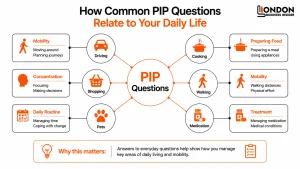
Different questions can provide context across several functional areas. They should not be treated as automatic shortcuts to a particular descriptor.
Example Question Possible Relevant Context Details Worth Explaining
Do You Drive? Mobility, concentration, physical function Frequency, adaptations, pain, assistance
Do You Shop? Mobility and daily routine Distance, support, online shopping, recovery
Do You Have Pets? General functional context Who feeds, walks and cares for them
Can You Cook? Preparing food Safety, aids, prompting, supervision
How Far Can You Walk? Moving around Distance, speed, stopping, aids, repetition
How Do You Manage Medication? Managing treatment Reminders, supervision, organisation
How Do You Pay Bills? Budgeting Understanding, prompting, assistance
The Disability Rights UK PIP guidance was revised in April 2026 and covers the scoring system, descriptors, claim form, healthcare assessment and challenging decisions.
How To Prepare For Common PIP Assessment Questions?

Preparation should help the claimant remember accurate information, not teach rehearsed answers.
Re-Read The PIP2 Form
- The claimant should review the information originally provided about how their disability affects them.
- This helps identify relevant changes and reduces the risk of accidentally giving an incomplete answer because the original form was completed months earlier.
Make Notes About Each Relevant PIP Activity
Short notes can include:
- Help Needed
- Aids Used
- How Long The Activity Takes
- Pain Or Fatigue
- Safety Problems
- How Often The Difficulty Occurs
- Recovery Time
These notes can be particularly useful during a telephone assessment.
Prepare Specific Examples Of Difficulties
- Specific examples can make the functional impact easier to understand.
- Instead of saying “walking is difficult”, the claimant could describe a recent journey, the approximate distance, where they stopped, what assistance they used and what happened afterwards.
Consider Better Days, Worse Days And Fluctuating Symptoms
The claimant should think about the overall pattern rather than only one type of day.
Useful details include:
- How Many Days Are Typically Worse?
- Which Activities Change?
- How Much Ability Changes?
- Whether Symptoms Are Predictable?
- How Long A Flare-Up Lasts?
Note Any Aids, Appliances, Prompting Or Assistance
- People often become accustomed to adaptations and stop thinking of them as help.
- A shower seat, walking stick, perching stool, dosette box, grab rail or prompting from another person may be relevant and should not be forgotten simply because it has become part of everyday life.
Have Relevant Evidence Available
Useful evidence depends on the individual claim and might include medical correspondence, treatment information, prescription details and documents showing how the condition affects daily activities.
The evidence should support functional difficulties rather than simply repeating a diagnosis.
What PIP Assessors Look For In Answers?
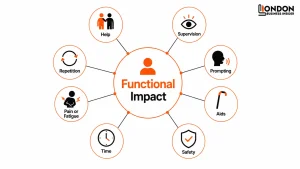
Assessors are expected to consider the available evidence and determine which descriptors best reflect the claimant's functional ability.
Functional Impact Rather Than Diagnosis Alone
- Two people with the same diagnosis can have very different support needs.
- PIP therefore focuses on how the condition affects relevant daily living and mobility activities.
Consistency Across The Available Evidence
- An assessor may compare information from the claim form, supporting evidence and consultation.
- This does not mean every difference is proof of dishonesty. Conditions fluctuate, circumstances change and earlier forms may have been completed months before the assessment.
- Where an apparent inconsistency has a genuine explanation, the claimant should explain it clearly.
Help, Supervision And Prompting
- The assessment should distinguish between different forms of support.
- Someone who can physically complete an activity may still require another person to prompt them to begin it, supervise them for safety or physically assist them.
Aids And Appliances
- Equipment that helps someone complete an activity may affect which descriptor applies.
- Claimants should describe the equipment they actually use and why it is needed.
Pain, Fatigue, Breathlessness And Anxiety
- Symptoms can affect whether an activity is completed safely, repeatedly and within a reasonable time.
- Their impact should be explained rather than merely naming the symptom.
Whether Activities Can Be Repeated Reliably?
- The fact that a claimant completed something before or during an assessment does not end the reliability analysis.
- If doing it once means they cannot repeat it when reasonably required, that consequence may be relevant.
PIP Assessment Rules And Changes In 2026
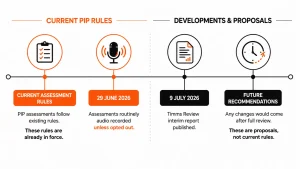
PIP has been the subject of substantial reform debate, but proposed changes and current rules must be kept separate.
What Rules Apply To PIP Assessments Now?
As of 14 August 2026, the current PIP assessment still uses the existing activities, descriptors and reliability principles.
The proposal to require at least four points from a single daily living activity was removed from the Universal Credit legislation in 2025. Official advisory material recorded that the relevant clause would be removed and that changes to PIP eligibility, activities and descriptors would not be made before completion of the review.
This distinction matters because some older coverage of DWP PIP reform proposals for 2026 reflects plans discussed before the legislative position changed.
Claimants preparing for an assessment now should follow the rules currently in force, not assume an earlier proposal has already become law.
What Is The Timms Review?
The Timms Review is a comprehensive review of Personal Independence Payment.
Its interim report was published on 9 July 2026, with the review examining the purpose, assessment criteria, activities, descriptors and wider experience of PIP. The Government's Timms Review collection was updated again on 12 August 2026 as the review moved into workshops intended to help shape recommendations.
The interim review concluded that PIP is widely valued but that the current system is no longer fit for purpose.
That conclusion does not itself replace the present assessment rules.
What Has Not Yet Changed?
Claimants should distinguish between:
- Current Assessment Rules
- Recommendations Under Review
- Earlier Political Proposals
- Future Changes That Would Require Implementation
Until a change is formally introduced, an assessor should continue applying the current rules.
What Happens After The PIP Assessment?
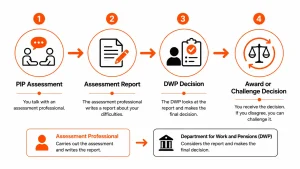
Once the consultation is complete, the health professional prepares an assessment report and sends it into the decision-making process.
The DWP makes the final decision rather than the assessment professional making the benefit award themselves.
The Health Professional Sends A Report To DWP
- The report records the assessor's findings and recommendations.
- The claimant should then wait for the formal DWP decision rather than treating comments made during the assessment as confirmation of an award.
When The PIP Decision Arrives?
- The decision should explain whether PIP has been awarded and, if so, which component and rate applies.
- Where someone needs to contact the department about an existing claim, the relevant DWP contact numbers and opening times include a separate line for existing PIP claims and assessments.
- If an award results in arrears, the rules around start dates and back payments can vary with the circumstances. Older claimants in particular may want to understand how PIP backdated payments can arise following delayed or revised decisions.
- Once regular payments are established, calendar dates can also affect when money reaches an account. For example, August Bank Holiday DWP payment dates may move a scheduled PIP payment to the preceding working day when it falls on the bank holiday.
What To Do If The Decision Appears To Be Wrong?
- A claimant who disagrees with a PIP decision can normally ask the DWP to reconsider it through Mandatory Reconsideration before progressing to an appeal.
- The disagreement should focus on the relevant activities, descriptors and supporting evidence rather than simply saying the decision is unfair.
- Any deadline on the decision letter should be checked promptly.
Conclusion: How To Approach PIP Assessment Trick Questions And Answers
The most important point about PIP assessment trick questions and answers is that there is no secret script that guarantees an award.
Questions about driving, smartphones, pets, shopping, work or hobbies can feel indirect because they may help build a broader picture of everyday functional ability. However, none should automatically determine entitlement without proper context.
A claimant should answer honestly, avoid unnecessary one-word answers and explain what completing an activity actually involves. Help from another person, aids, pain, fatigue, psychological distress, time taken, safety and recovery can all matter where they relate to the relevant PIP activity.
The four reliability principles provide a useful framework throughout: can the activity be completed safely, to an acceptable standard, repeatedly and within a reasonable time?
Current 2026 developments also make source checking particularly important.
The previously proposed four-point rule is not currently in force, the Timms Review is still developing recommendations, and telephone and face-to-face health assessments have been routinely audio recorded since 29 June 2026 unless the claimant opts out.
Frequently Asked Questions
Are There Really Trick Questions In A PIP Assessment?
There is no official DWP list called “trick questions”. Some questions may feel indirect because assessors can ask about everyday routines and activities to understand functional ability. The claimant should answer truthfully and explain the full context rather than trying to guess a hidden “correct” response.
Why Does A PIP Assessor Ask Whether Someone Drives?
Driving may provide contextual information about physical movement, concentration, journeys and everyday activities. However, being able to drive does not automatically mean someone is ineligible for PIP. The frequency of driving, adaptations, pain, assistance and after-effects may all provide important context.
Why Might A PIP Assessor Ask About Pets Or Hobbies?
Questions about pets and hobbies may help establish what activities a claimant actually performs. Someone may own a dog without walking it, or identify with a hobby they can now do only rarely. The claimant should explain who performs the task, how often it occurs and what assistance or adaptations are needed.
Does Using A Smartphone Affect A PIP Assessment?
Smartphone use may provide some contextual information about communication, concentration or manual dexterity, but it should not automatically establish that someone can complete a separate PIP activity reliably. A claimant can explain any limits on how the device is used.
What Is The Best Way To Answer PIP Assessment Questions?
The best approach is to answer honestly and specifically. Where relevant, the claimant should describe assistance, prompting, supervision, aids, pain, fatigue, safety, time taken and recovery afterwards. The answer should reflect the actual pattern of the condition rather than only an unusually good or exceptionally bad day.
Can Another Person Join A PIP Telephone Assessment?
A claimant can generally have another person available for support during an assessment. That person may help with notes, prompting and relevant information, although the assessment remains focused on the claimant's own functional difficulties.
What Should Someone Say If Their Condition Changes From Day To Day?
The claimant should explain how the condition fluctuates, how many days are typically affected and how functional ability changes. They should not describe every day as the worst day if that is inaccurate. PIP rules consider how difficulties affect activities over time, including whether limitations occur on more than half of the relevant days.






[…] benefits are not replaced by Universal Credit. For example, Personal Independence Payment can continue separately where the person remains […]